
India’s Next 20-Year Cycle: Designing Intelligence, Not Just Adopting It
India’s next transformation will not be defined by how widely it adopts artificial intelligence, but by whether it builds and owns the systems in which it operates. The real opportunity lies in embedding AI into infrastructure that shapes decisions at scale.
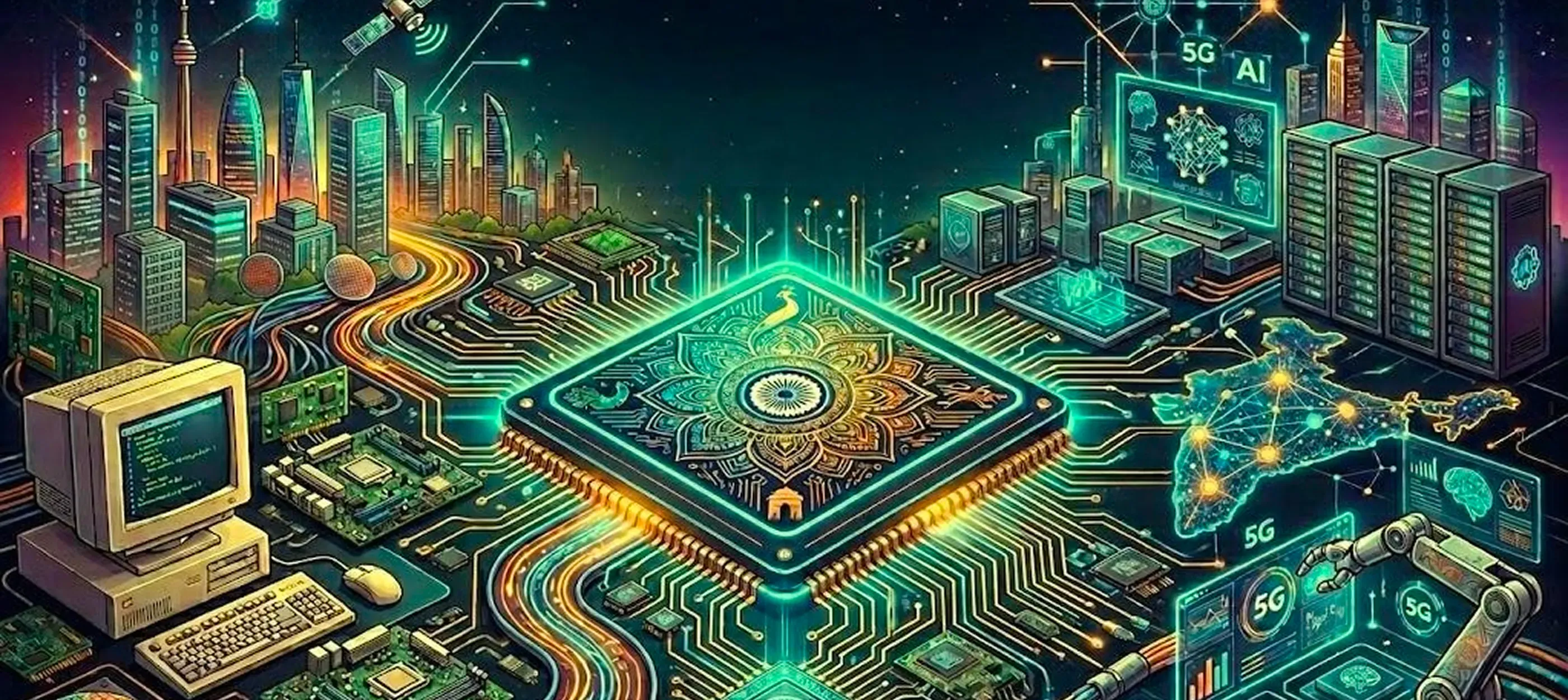
India does not transform by accident. It does so in long, deliberate cycles, each spanning roughly two decades, where technology, policy and behaviour align to solve a national problem at scale. The Green Revolution, led by scientists such as M. S. Swaminathan in the 1960s and 1970s, redefined food security. The eradication of polio, when India was declared polio-free in 2014, demonstrated institutional coordination at scale. The IT services wave of the 1990s and 2000s positioned India globally as a knowledge economy.
We are now at the beginning of the next such cycle.
“Artificial intelligence is not simply another technology wave; it is the design layer for the India of 2045 and beyond.”
And like every cycle before it, the outcome will depend less on how quickly we adopt AI, and more on what we choose to build deliberately with it.
Building AI as National Infrastructure
The central tension is this: India knows how to build transformative infrastructure. It does not yet know how to claim AI as one. Instead of asking whether India will use AI, we should ask whether by 2045 it will own the systems that shape everyday economic and civic life, or depend on those built elsewhere.
Today, much of India’s AI effort is disproportionately concentrated on inputs such as compute access, model integration, and application-layer use cases, while the harder question of system design remains under-addressed. There is a tendency to treat AI as an entirely new frontier that is complex, uncertain, and externally defined. That framing is misleading. India has already demonstrated the ability to design and deploy infrastructure-grade technology that reshapes behaviour at a national level.
UPI is the clearest example. Launched in 2016, it now processes over 10 billion transactions a month, making it one of the most widely used real-time payment systems in the world. This was not a product discovered by market demand. It was a system designed ahead of visible use cases, as a set of public rails upon which private innovation could flourish. It shifted complexity away from the citizen and into the infrastructure itself. Payments became instantaneous and interoperable not because consumers demanded it first, but because the system made it inevitable.
AI will follow a similar trajectory, but only if it is approached as infrastructure, not as a layer of tools. Most AI deployments in India remain confined to the productivity layer: chat interfaces, automation tools, marginal efficiency gains. In practice, these layers tend to plateau quickly. They improve outputs, but they rarely change outcomes.
“The shift that matters is when intelligence is embedded into the system itself and decisions are automated.”
That is the transition India has not yet made.
This shift is already visible in early deployments. AI is beginning to move from a visible tool to an embedded layer, governing how credit is assessed, how benefits are delivered, and how risk is evaluated. Over time, the citizen will not “use AI”; they will experience systems where AI is embedded at the core of decision-making, systems that are largely invisible but critical to outcomes.
UPI was not inevitable. It was designed. AI infrastructure will require the same intentionality before the use cases are fully visible.
Where Value Will Actually Accrue
India is at risk of repeating a familiar pattern: participating heavily in the early layers of a technology wave, while ceding control of the layers where long-term value accumulates.
India contributes significantly to data generation, model training pipelines, and AI-enabled services. Yet ownership of core systems, where pricing power, standards, and long-term control reside, remains concentrated elsewhere.
“The real opportunity lies in embedding AI into physical, information-dense systems where India’s complexity becomes an advantage rather than a constraint.”
Energy, healthcare, agriculture: these are not just sectors; they are systems defined by fragmented data, unpredictable variables, and deeply localised conditions. This is where AI can create moats: not in models, but in systems that become indispensable.
Consider India’s informal economy, which employs nearly 85–90% of the workforce. For decades, its constraints have been informational: lack of credit visibility, fragmented demand signals, and absence of reliable quality verification. In practice, these gaps make scaling far harder than building the product itself.
AI does not remove these constraints, but it allows systems to work despite them.
India’s informal sector is often framed as a drag on efficiency. It should instead be seen as one of the most demanding environments in which to build intelligent systems. If AI can work here, across languages, trust deficits, and fragmented supply chains, it can work anywhere.
The Bottleneck Is Institutional, Not Individual
India has already demonstrated its ability to design digital public infrastructure - from Aadhaar to UPI and now ONDC. But AI requires extending this approach into decision systems, not just transaction rails.
AI infrastructure, particularly in sectors such as energy, healthcare, and governance, does not align with the timelines of traditional venture capital. These are not products that can be iterated into viable businesses within a few quarters. They require sustained integration with real-world systems, regulatory alignment, and the ability to operate over longer time horizons.
In practice, this creates a predictable outcome: founders gravitate towards what can be funded, not what needs to be built. The result is an ecosystem optimised for speed, with activity concentrated at the application layer, while the foundational layers remain underdeveloped.
India does not need to replicate global models. It does, however, need an equivalent: an institutional mechanism that allows a small number of teams to work on system-level AI problems across sectors like energy, agriculture, and public services over a 7–10 year horizon, without immediate commercial pressure. Until that changes, we will continue to produce impressive companies, but not necessarily enduring systems.
Designing the India of 2045
Every transformational cycle in India’s history has solved a national problem through deliberate design. The Green Revolution ensured that India could feed itself. The polio campaign ensured that scale did not come at the cost of public health. The IT wave ensured that India could participate in a global economy.
AI must now solve a different class of problems: those created by India’s own scale and complexity.
“If we get this right, the India of 2045 will not be defined by AI adoption, but by structurally different outcomes.”
Urban systems - energy, mobility, logistics - will not react to demand; they will predict and optimise for it in real time. Farmers will not rely on static advisories, but on continuously learning systems that predict yield, price, and climate risk at a hyperlocal level. Credit will not be denied due to lack of formal history, but dynamically assessed through behavioural and transaction signals. Public services will not require navigation; they will anticipate eligibility and deliver themselves.
In such a system, intelligence will not be an interface. It will be embedded into the fabric of how decisions are made. This is what it means to move from a service economy to one that builds infrastructure-grade intelligence: not exporting talent into global systems, but owning the systems themselves.
The alternative is equally clear. If India becomes a large-scale user of intelligence designed elsewhere, it will be efficient and integrated, but ultimately dependent. Its complexity will continue to train global systems without translating into domestic advantage.
There will not be a second cycle to correct this. The India of 2045 is already being designed. The only question is whether we choose to design it ourselves.

Nitin Raj
Co-founder & CVO, T9L Venture Studio
0 Comments
- No comments yet. Be the first to comment.



You Might Like
Stories and perspectives from leaders shaping India’s long-term future.

Chapter 1: The History of Scarcity
Nitin Raj
India@2047: What Must Change Now?
Gurcharan Das
India at the Strategic Crossroads: AI, Talent, and the Long Game
Viney Sawhney
India's Climate Tech Moment Has Arrived. Here Is What Will Unlock It
Dr Somnath Baidya Roy-1.webp&w=3840&q=75)
India Is Not Waiting Anymore. The Question Is Who’s Steering
Sakshi Anand.webp&w=3840&q=75)
A Billion Minds, One Unasked Question: What Are We Actually Building?
Gaurav Gaggar
One Big Future: A Collective Vision for Viksit Bharat
Dr Subho Ray