
India's Climate Tech Moment Has Arrived. Here Is What Will Unlock It
The science exists. The startups are emerging. What's missing is the ecosystem to scale them.
Dr Somnath Baidya Roy
Dean (Planning), IIT Delhi & Professor, Centre for Atmospheric Sciences Rockefeller Foundation Climate Science and Technology Chair
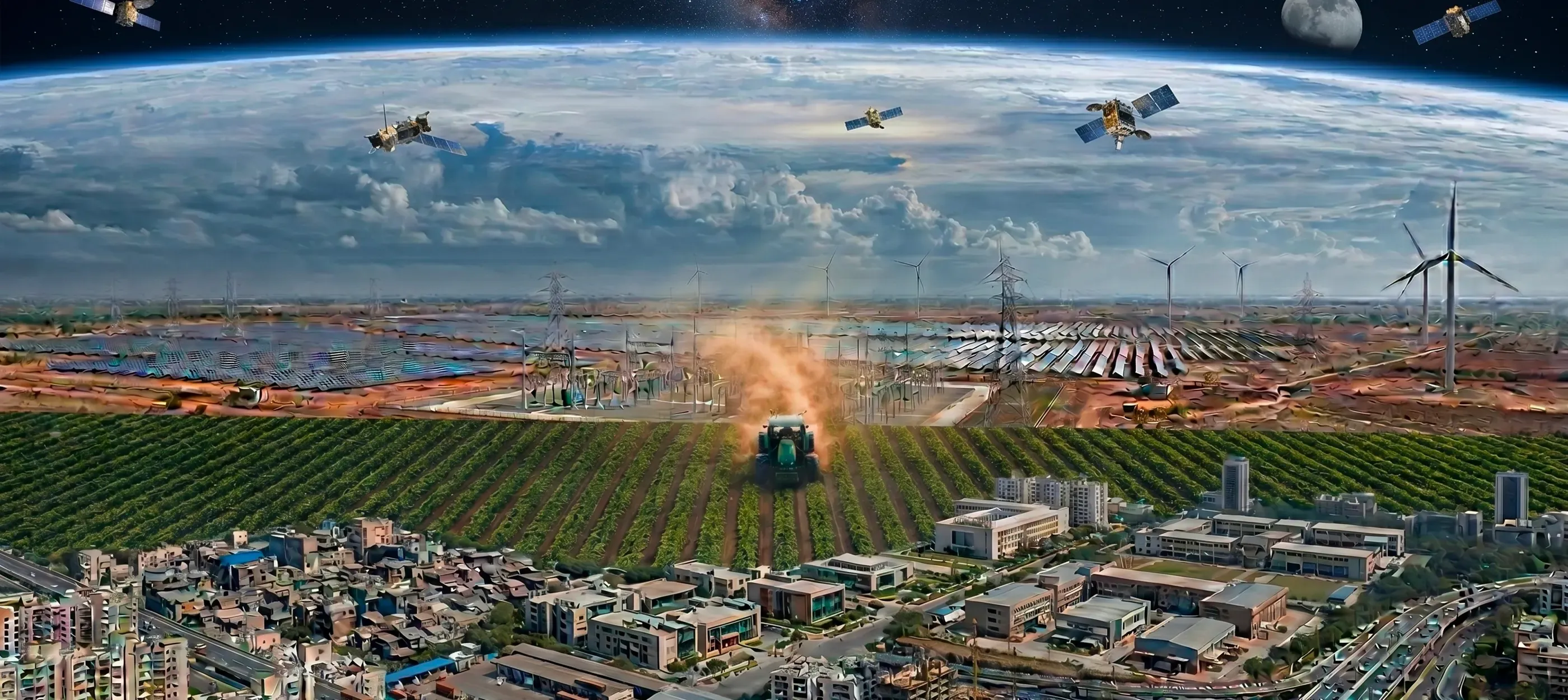
Climate change has arrived. It is visible in compressed monsoons that overwhelm drainage without recharging groundwater, in extreme weather events that erase an entire agricultural season, in the mass movement of people away from coastlines and flood plains that are becoming difficult to inhabit. The scientific community has understood this trajectory for decades. What India now needs is the capacity to respond at scale and in time.
That capacity lives at the intersection of academia, capital, and technology. And it is precisely at that intersection that India's climate ecosystem remains underdeveloped. We have scientific institutions of genuine quality. We have entrepreneurial depth. We are beginning to see a climate startup community with ambition and ideas.
“What we lack is the connective tissue — the trained people, the aligned incentives, and the patient capital — that turns knowledge into enterprise, and enterprise into resilience.”
The Talent Pipeline India Needs
Every breakthrough in science and technology stands on an accumulated body of knowledge built by generations of researchers, most of whom never saw a commercial outcome from their work. Climate tech is no different.
“The startups that will define India's climate resilience over the next two decades are building on science being done today.”
And yet the people needed to do this work are not being trained at anywhere near the scale India requires.
Here the gap is stark. The United States has over a hundred undergraduate programs in atmospheric sciences, meteorology, and oceanography. Europe, Japan, China, and Australia are comparably served. India has a handful. This is not an academic footnote. Climate challenges now cut across agriculture, logistics, energy, infrastructure, and finance. Every sector that will feel climate change needs people who understand it. At present, this pipeline is thin.
IIT Delhi is in the process of establishing what will be among the first undergraduate programs in atmospheric, weather, and climate sciences in the country. It will take time to show results. But the jobs are already there. Across energy, transport, and operations, demand for climate-trained professionals is consistent and growing. In the United States, meteorology has ranked among the most professionally meaningful degrees: graduates stay in the field and build careers from it. There is no reason India cannot build the same, and with climate change accelerating, considerably more urgency to do so.
Training more people, however, is only part of the answer. The academic reward system, which is built around publications, citations, and disciplinary depth, does not naturally incentivise the work of translation: turning scientific knowledge into tools and products that industry can use. Researchers who work at that boundary are doing something genuinely difficult and genuinely necessary. The ecosystem around them needs to support them.
This is compounded by the tendency of academic disciplines to work in isolation.
“Climate does not organise itself around departments. Addressing India's energy transition alone requires atmospheric science, electrical engineering, economics, and policy to function as an integrated system.”
We have known that sustainability challenges are systemic. We need to build our institutions to match that understanding.
The Case for Patient Capital
Private sector R&D in India, outside pharmaceuticals, is negligible. This is a structural problem with deep consequences for climate tech. In the United States, the private sector has historically done fundamental research alongside government and academia. Bell Labs, an industrial research operation, produced some of the most consequential scientific work of the twentieth century. Their technologies underpin everything from the device in our pockets to the renewable energy systems India is building at scale. That investment in knowledge-building was patient, long-horizon and indifferent to quarterly returns. It created a culture of innovation that extended far beyond any single company or product. India has no equivalent. The wall between what academia knows and what industry builds has to come down seamlessly connecting the two worlds that shape our future.
The IP question calls for a straightforward answer. Investors routinely ask software-based climate startups for patent portfolios as proof of defensibility. It is the wrong test. Software patents in India are restricted to narrowly defined cases. In pure tech involving algorithms, data products, and decision tools, the protection a patent offers is largely illusory. A competitor adds a conditional statement, files anew, and three years of development time have been spent on a moat that does not hold. India's largest unicorns carry few or zero patents. Their value came from solving real problems faster than anyone else.
Consider what Flipkart understood that Amazon did not: that the specific friction blocking e-commerce adoption in India was not technology but trust and access. It solved this elegantly by offering cash on delivery. Its success was based on a clear-eyed reading of the market and the will to act on it. Capital for climate tech needs precisely this quality of thinking: not focusing on what innovations can be protected, but on what friction can be removed, and how scientific knowledge can be made accessible enough to reach the people who need it.
“Open source tools, common-sense product design, and deep domain knowledge are more likely to build India's climate tech sector than any IP portfolio.”
The capital problem extends further. Recently, we organized KlimaNexis, supported by The Rockefeller Foundation, in partnership with Indian Venture Capital Association and Carbon Removal India Alliance, that brought together more than a hundred startups in the weather, climate, and sustainability sectors. During that event, a dialogue between climate founders and investors revealed a clear fault line: investors focused on ROI within three years, while founders knew that the nature of climate tech demands considerably longer to move from research to product to market. In the 1990s, venture capital backed e-commerce platforms that bled money for a decade before transforming entire economies. The bet was not on current returns; it was on the size and inevitability of the market being created. Climate tech asks for the same quality of thinking, for problems that are more consequential and markets that are more certain. That faith built the digital economy. Climate tech deserves the same conviction.
When Academia, Capital, and Industry Move Together
India has the scientific depth, the entrepreneurial instinct, and in nascent form, the institutional infrastructure to build a climate tech sector of genuine consequence. What it lacks is alignment between the timelines on which knowledge is built and the timelines on which capital expects returns; between what academic institutions produce and what the market needs.
Alignment problems, unlike capability problems, are solvable.
“The evidence that things are moving is already visible in the startups sequestering carbon while improving farm yields, in the weather intelligence products being built for farmers and logistics operators, in the founders showing up to difficult conversations with investors.”
What is harder to build, and more important, is systems-level thinking: the willingness of academia, capital, and industry to stop working in parallel and start working together.
The rest follows from that. Train the right people, give them the room to work across boundaries, and they will find answers we have not yet thought to ask for. That has always been how hard problems get solved.
Written in collaboration with Tanvi Khemani, COO, One Big Future.
Dr Somnath Baidya Roy
Dean (Planning), IIT Delhi & Professor, Centre for Atmospheric Sciences Rockefeller Foundation Climate Science and Technology Chair

0 Comments
- No comments yet. Be the first to comment.



You Might Like
Stories and perspectives from leaders shaping India’s long-term future.

Chapter 1: The History of Scarcity
Nitin Raj
India@2047: What Must Change Now?
Gurcharan Das
India at the Strategic Crossroads: AI, Talent, and the Long Game
Viney Sawhney-1.webp&w=3840&q=75)
India Is Not Waiting Anymore. The Question Is Who’s Steering
Sakshi Anand.webp&w=3840&q=75)
A Billion Minds, One Unasked Question: What Are We Actually Building?
Gaurav Gaggar
India’s Next 20-Year Cycle: Designing Intelligence, Not Just Adopting It
Nitin Raj
One Big Future: A Collective Vision for Viksit Bharat
Dr Subho Ray