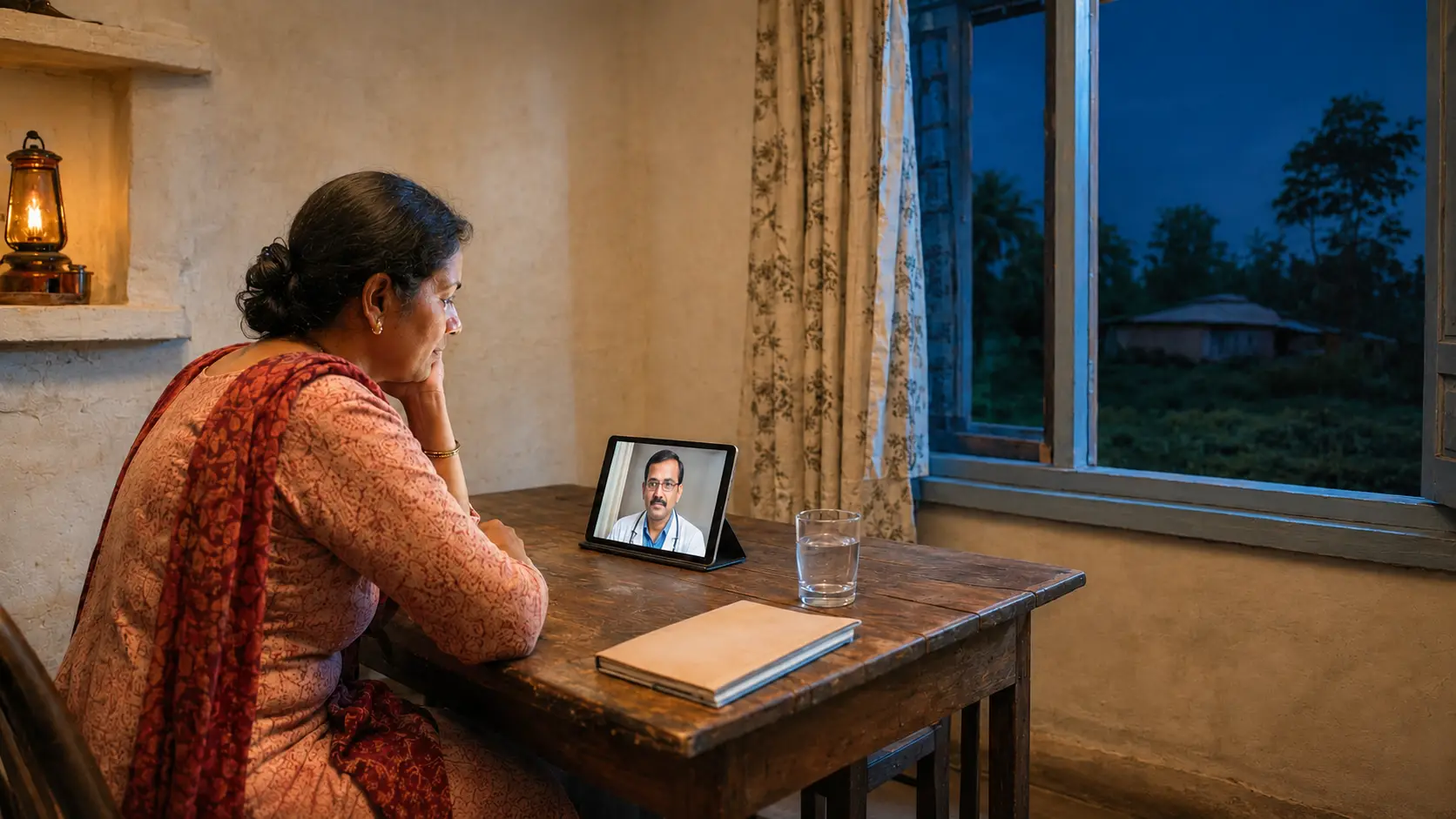

In 1974, if your child spiked a fever in the middle of the night and you lived more than an hour from a city, you did the only thing you could.
You waited for morning.
Then you drove to the one doctor in the district and waited your turn behind everyone else who had had the same kind of night. If that doctor wasn’t sure, you waited weeks for a specialist in a bigger town, and you paid for the privilege of being seen.
Expertise, back then, was a place you travelled to.
Today that same parent unlocks their phone at 2 a.m., describes the symptoms, gets a credible read on whether this is “watch and wait” or “go now,” and books an appointment with a specialist accordingly. The fever is the same. The fear is the same. What’s changed is that competent judgment has stopped being scarce.
Hold that word. Scarce.
Because once you see it, you cannot stop seeing it.
The Thing You Keep Mistaking For Convenience
We tell ourselves the last fifty years were about devices getting better. They were not.
Every convenience you now take for granted is the same event wearing different clothes: a scarcity quietly ending.”
Music was once something you owned, one album at a time. Now every song ever recorded fits in your pocket for less than the price of a single record.
Photographs came twenty-four to a roll, and you waited a week to learn whether any of them were good. Now you take forty before breakfast and delete thirty-nine.
Maps lived in glove compartments, and getting lost was a normal part of going somewhere new. A taxi was something you hoped for as you stood in the rain. A long-distance call was rationed by the minute and watched by the clock — and now it is free, and shows the other person’s face.
None of these were really about apps. Each was a scarcity dissolving. And that gives us the first law of how the future actually works: Every technological revolution removes a scarcity.
Once you recognise the pattern, you can do something most commentary about technology cannot. You can look back and understand it. And you can look forward, and anticipate it.
Fifty Years Ago
For almost the entire history of our species, the binding scarcity was food.
Thomas Malthus made the arithmetic famous in 1798: population grows faster than the harvest, so hunger is not a problem to be solved but a ceiling to be lived under. In 1968, the biologist Paul Ehrlich restated the fear for the modern age, predicting that hundreds of millions would starve and that countries like India could not feed themselves. It was not a fringe view. It was the consensus of serious people.
They were wrong because of a revolution happening in wheat fields rather than headlines. An agronomist named Norman Borlaug had bred hardier, higher-yield wheat, and within roughly a decade India moved from the edge of famine to feeding itself, and later to exporting the very grain it had been expected to beg for. The oldest scarcity humanity had ever known stopped being a deciding factor in its future.
Step back one more revolution and the pattern deepens. Before food, the scarcity was power. For thousands of years, the only energy available to do work was muscle, wind, and water. The Industrial Revolution did not invent ambition; it made power cheap, so that one person could suddenly command the strength of hundreds. Every city, every factory, every commodity today is the outcome of that single shift.
Each revolution turned an ancient scarcity into something ordinary within a lifetime.
Today
The two revolutions reshaping our own moment follow the same pattern, with newer scarcities.
The internet ended the scarcity of information. From a time when you could only access knowledge through proximity and access, we now live in a world where the sum of recorded human knowledge sits one search away.
The cloud ended the scarcity of computing power and the capital it demanded. You no longer need to own a server room to build something serious; you rent computing the way you rent electricity, by the second. A teenager today can summon the kind of computing power once guarded by government laboratories.
But here something important comes into view — something the breathless version of this story always skips.
Look at the order. Power. Food. Information. Compute. The scarcities are not random. They are moving inward — from the physical world around us toward the world inside our heads.
First we conquered the scarcity of muscle, then of calories, then of facts. Each revolution reached a little further in, from matter, toward mind.”
And as each revolution ended a scarcity, it quietly created a new one.
When information became infinite, attention became scarce. The economist Herbert Simon saw it as early as 1971: a wealth of information creates a poverty of attention. We did not end the struggle of knowing things; we traded it for the struggle of choosing what is worth knowing, and most of us are losing that one. This is the second law, and it is the one almost everyone forgets: Every abundance creates a new scarcity.
There is a harder truth beneath it. Abundance is not the same as access. The Green Revolution grew enough grain to feed billions, yet hunger never disappeared — because, as the economist Amartya Sen showed, famines often strike with no real shortage of food at all. They are failures of access: of poverty, of broken systems, of who can command what exists. The food was there. The reach was not. A revolution can end scarcity without answering the human question of who actually gets to benefit from it.
The question everyone is asking about AI is the wrong one.
Now let’s look at AI through this lens rather than the usual one.
Everyone is asking whether it is intelligent. That is the engineer’s question, and it leads nowhere useful. The historian’s question is the only one that has ever predicted anything: which scarcity is it ending now?
And the answer continues the migration inward. Not muscle, not calories, not facts — but expertise. Applied judgment. For all of history the doctor, the lawyer, the teacher, the engineer have been expensive, slow to train, and unevenly spread across the earth. Most people were never truly short of information. They were short of someone who could competently interpret it for their particular situation. That is the scarcity now beginning to end.
Which brings us to the idea this whole series is built on: Technology never ends scarcity; it only moves it inward from the world around us to the trust between us.
Scarcity is not destroyed by revolutions. It migrates. From matter, to information, to judgment, with each layer more interior than the last. So where does that line take us, decades into the future? The answer is not an easy one.
Fifty Years From Now
If the pattern holds, expert judgment will become ordinary the way calories and information did before it. Competent medical guidance, legal reasoning, and patient tutoring become nearly free at the edges for the parent at 2 a.m. and the farmer in a remote district alike.
That is the optimistic reading, and history supports it. But the same history demands caution.
The transformation will take far longer than the enthusiasts promise. Factories did not become more productive the moment electricity arrived; the gains took decades, because the work had to be rebuilt around the new power, not merely plugged into the old machines. As one economist quipped in 1987, you could see the computer age everywhere except in the productivity statistics. New capability arrives at the speed of institutions, not the speed of software.
And expertise is an innate quality people possess. AI may scale the explainable portion of expertise, but it will stall precisely where the real risk lives. A great clinician carries judgment she cannot fully explain even to herself. She possesses tacit knowledge that no manual can replace.
Then there is access, again. Abundant expertise will not reach the people who need it most on its own. Whether it does will be decided by institutions, regulation, and incentives. We have made expertise cheap before we have made it fair.
And there is one more catch. While scarcity moves inward, it does not always stay there. Look beneath the abundance of machine expertise and you find the oldest scarcity returning in a new costume: all of this runs on staggering quantities of energy, on advanced chips that only a few places on earth can make, on data centres that strain power grids built for a smaller age.
The Industrial Revolution made power abundant. The AI revolution is quietly making it scarce again. The first scarcity we ever conquered is now standing between us and the future we are being promised.”
The Vanished Scarcity
This decade will be defined by the machine the way other decades came to be defined by the steam engine and the internet. But this is the wrong perspective.
Remember, the steam engine mattered because cheap power did. The internet mattered because cheap knowledge did. And if AI matters in the time to come, it will be because it makes ordinary something rationed in every society that has ever existed: the ability to know what to do.
Think back to that parent in 1974, driving through the dark toward the one doctor in the district. They were not short of love, or effort, or will. They were short of judgment they could reach in time.
Every revolution is really the story of a scarcity like that one ending.
Every civilisation solves one scarcity only to discover another.
We solved the scarcity of food. We solved the scarcity of power. We solved the scarcity of information. We may soon solve the scarcity of expertise.
And if that happens, the next great scarcity may not be intelligence at all.
It may be trust.
An abundance of expertise will make us question who we can really believe. This is tricky because it requires anticipating what is coming clearly. And that’s something societies have very rarely managed to do. The shift from reacting to anticipating is where this series goes next.
***
This essay is part of a longer series tracing a single argument across history, economics, governance and human behaviour: that every technological revolution solves a scarcity and every new abundance creates a new scarcity. Following this pattern into the AI era, the series argues that trust is the defining scarcity of our time. Read them here:
Chapter 1: The History Of Scarcity
Chapter 2: The Personalisation Revolution
Chapter 3: The Age Of Anticipation
Chapter 4: The Digital Workforce