

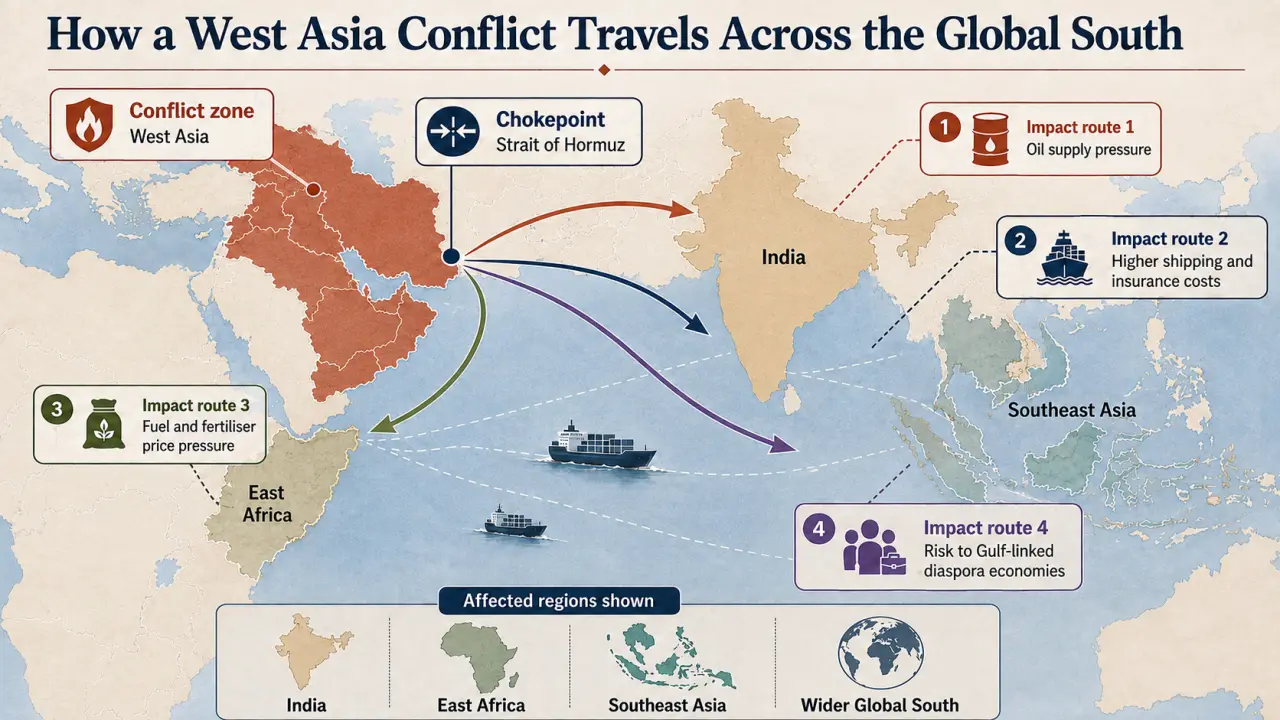
The 2026 West Asia war began on February 28, when Israel and the United States launched a campaign of strikes against Iran aimed at its nuclear and ballistic missile programmes, triggering Iranian counter-strikes and the closure of the Strait of Hormuz.¹ A first ceasefire was reached on April 7–8, though hostilities flared intermittently through the following months, with a memorandum of understanding to formally end the conflict announced for signature in mid-June.² The crisis did more than rattle oil markets for a few months. It exposed, in stark relief, how exposed the Global South remains to conflicts it has no part in starting. Energy bills spiked, shipping insurance costs soared, and countries from East Africa to Southeast Asia watched fuel and fertiliser prices climb on the back of a war fought thousands of kilometres away.
For New Delhi, which imports the overwhelming majority of its crude oil and depends on the Gulf for both energy and a vast diaspora workforce, the crisis was a live stress test of its strategic autonomy doctrine.”
What emerged from that test is the foundation of the argument now being made, with increasing confidence, in Delhi, in African capitals, and across the non-aligned middle powers of Asia and Latin America: that India is no longer simply a large developing country seeking a seat at the table, but a credible anchor for a multipolar order — one that offers the Global South a development pathway distinct from both the post-war Western model and the debt-heavy infrastructure diplomacy associated with China.
Energy Security As The First Test
India’s response to the Hormuz shock drew on groundwork laid over the previous decade. Strategic petroleum reserves, diversified crude sourcing from Russia, the Americas, and West Africa, and long-term contracts negotiated well before the crisis cushioned the immediate shock to domestic fuel prices. But the more consequential shift was structural: the crisis accelerated a transition that was already under way, pushing India to treat energy security not as a question of which countries to buy oil from, but as a question of how quickly it could reduce its exposure to imported fossil fuels altogether.
Renewable capacity additions, which had already made India one of the fastest-growing major markets for solar and wind, picked up pace through 2025 and 2026. Rooftop solar schemes for households, utility-scale solar parks in Rajasthan and Gujarat, and a rapidly expanding green hydrogen mission gave India a domestic energy buffer that had simply not existed during earlier Gulf-linked oil shocks.
The lesson India is now exporting to the rest of the Global South is straightforward: energy security in the twenty-first century is, increasingly, energy sovereignty through renewables, not diversified dependence on fossil fuel suppliers.”

The Solar Alliance And The Wind Opportunity
The International Solar Alliance, headquartered at the National Institute of Solar Energy in Gurugram and co-founded by India and France in 2015, has quietly become one of the more substantive instruments of South-South cooperation to emerge from the past decade. As of 2026 it counts roughly 125 member and signatory countries,³ the majority of them in the sun-rich but capital-poor regions of Africa, the Pacific, and South Asia. The pitch is simple: India combines among the lowest solar manufacturing and deployment costs in the world with financing windows, technical training, and standards support that smaller economies cannot assemble on their own.
For African nations in particular, this matters because the alternative has often been a binary choice between expensive Western-financed projects with long approval timelines and Chinese-financed infrastructure that comes bundled with debt obligations. India’s solar diplomacy positions itself as a third option, lower-cost technology transfer paired with capacity building, so that countries are not just buyers of panels but eventually producers of them.

Wind technology tells a similar story, though it is earlier in its development. Indian wind turbine manufacturers have scaled up domestic production substantially, and offshore wind potential along India’s southern coastline is now drawing serious investment. As costs fall further, the same playbook used for solar — manufacturing scale at home, then technology partnerships abroad — is being applied to wind, particularly for coastal nations in Africa and Southeast Asia facing similar geography and energy access gaps.
Climate Resilience And Agriculture
Climate resilience is where India’s domestic necessity and its Global South diplomacy converge most naturally.
A country with hundreds of millions of smallholder farmers, increasingly erratic monsoons, and frequent extreme weather events has had little choice but to invest heavily in climate-resilient agriculture — drought-tolerant and flood-tolerant crop varieties, digital advisory services that reach farmers via mobile phones, and weather-indexed crop insurance schemes.”
These are not abstract pilot projects. India’s network of agricultural research institutes has developed and released climate-adapted seed varieties at a scale few developing countries can match, and digital agriculture platforms now reach tens of millions of farmers with localised advisories on planting, irrigation, and pest management. For African nations facing similar climate stress on smallholder agriculture, this body of practical experience — developed under real fiscal constraints rather than in donor-funded pilot programmes — is arguably more transferable than agricultural models built around large-scale mechanised farming in temperate climates.
India has begun formalising this through agricultural cooperation agreements across Africa and parts of Asia, offering not just seed varieties but the institutional architecture around them: extension services, weather data systems, and farmer producer organisations that aggregate smallholders into something resembling collective bargaining power.
Digital Infrastructure As A Governance Export
If there is one area where India’s claim to offering an “alternative model” is most concrete, it is digital public infrastructure. The combination of a biometric identity system, an interoperable real-time payments network, and open digital platforms for health records, education credentials, and welfare delivery — collectively referred to as the India Stack — has been built at a scale and cost that Western digital identity and payments systems have never approached.
The pitch to other developing countries is again about sovereignty: rather than adopting proprietary platforms controlled by a handful of large foreign technology firms, or building expensive bespoke systems from Digital Infrastructure as a Governance Export
If there is one area where India’s claim to offering an “alternative model” is most concrete, it is digital public infrastructure. The combination of a biometric identity system, an interoperable real-time payments network, and open digital platforms for health records, education credentials, and welfare delivery — collectively referred to as the India Stack — has been built at a scale and cost that Western digital identity and payments systems have never approached.
The pitch to other developing countries is again about sovereignty: rather than adopting proprietary platforms controlled by a handful of large foreign technology firms, or building expensive bespoke systems from scratch, countries can adapt open-source digital public infrastructure designed explicitly for low-bandwidth, low-cost, high-volume environments. Several African and Southeast Asian governments have already begun pilots based on India’s digital payments and identity architecture, often with Indian technical teams providing implementation support through bilateral development partnerships rather than commercial licensing arrangements.
This digital layer also underpins India’s domestic economic story — financial inclusion, direct benefit transfers that reduce leakage in welfare spending, and a formalising economy — which gives the export pitch credibility that a purely theoretical framework would lack.

Democracy At Scale
India’s other claim to global relevance is less technical and more political: it remains, by a wide margin, the largest democracy to conduct national elections, and it does so across a population more linguistically, religiously, and economically diverse than almost anywhere else on earth. The Election Commission of India has, over the years, provided technical assistance and observation support to election bodies across Africa, Asia, and the Pacific, sharing experience on everything from electronic voting machines to managing logistics across difficult terrain.
The narrative India increasingly projects — sometimes summarised as the “mother of democracy” framing — is that democratic governance is not a Western export that developing nations must awkwardly retrofit onto their own societies, but something with deep indigenous roots that can be organised at a scale and cost appropriate to developing-country budgets. Whether or not other nations frame their own democratic institutions through this particular lens, the practical offer — low-cost election technology and administrative know-how, without the conditionalities that often accompany Western election-assistance programmes — has obvious appeal to governments wary of being lectured about governance standards by their former colonial powers.
Building The Skills Pipeline: From IITs To A National Skilling Ecosystem
India’s higher education story is often told through its most famous institutions — the Indian Institutes of Technology and the Indian Institutes of Management — whose graduates populate technology leadership across Silicon Valley and increasingly across India’s own booming start-up ecosystem. But the more relevant story for the Global South is what sits below that elite tier: a national skilling ecosystem built to take a population where a majority is under thirty and give it employable skills at a pace and cost that traditional university systems cannot match.
Vocational training centres, short-cycle technical certifications, and apprenticeship programmes linked directly to manufacturing and services employers have been scaled nationally, with the explicit goal of converting India’s demographic profile from a potential liability into what is now routinely described as a “demographic dividend.”
For countries across Africa with similar young populations and limited fiscal space for expanding university systems, the IIT/IIM model is aspirational but the mass-skilling model is replicable — and India has begun offering training partnerships and curriculum-sharing arrangements through its development cooperation programmes, particularly in digital skills, healthcare support roles, and manufacturing trades.
Traditional Knowledge Meets Modern Science: AYUSH, Yoga, And Integrative Medicine
Perhaps the most distinctive plank of India’s soft power is the formal integration of traditional medicine systems — Ayurveda, Yoga, Unani, Siddha, and Homeopathy, collectively governed under the AYUSH framework — into a modern regulatory and research apparatus. The establishment of a WHO Global Centre for Traditional Medicine on Indian soil reflects an explicit bet that traditional knowledge systems, when subjected to modern clinical research standards, can complement rather than compete with conventional medicine.
International Yoga Day, now marked across the United Nations system, is the most visible expression of this, but the underlying strategy runs deeper: positioning India as a hub where traditional wellness practices are documented, standardised, and in some cases clinically validated, then packaged for export both as wellness tourism and as complementary care models for health systems in countries where access to expensive pharmaceutical-driven healthcare remains limited. For Global South countries with their own rich traditional medicine practices — across Africa, Latin America, and Southeast Asia — India’s regulatory and research framework offers a template for formalising indigenous medical knowledge without simply discarding it in favour of imported clinical models.
Pharmacy Of the World, Now Backed By Manufacturing Scale
India’s role as the world’s largest supplier of generic medicines by volume took on new significance during the pandemic years, when vaccine production capacity became a matter of geopolitical leverage. That role has only deepened since: India is the third-largest pharmaceutical producer globally by volume, supplying around one-fifth of the world’s generic medicines and more than half of global vaccine demand.⁴ Pharmaceutical exports reached roughly $30.5 billion in FY2024–25, reaching over 200 countries.⁵ Indian generic drug manufacturers supply a large share of essential medicines used across Africa, and vaccine manufacturing capacity built up domestically has been positioned explicitly as a Global South resource — both for India’s own population and for export to countries that cannot sustain domestic pharmaceutical manufacturing at scale.
This pharmaceutical capacity is increasingly bundled with India’s traditional medicine diplomacy: generic pharmaceuticals for acute care, AYUSH-based products for chronic and wellness-oriented care, marketed and distributed together as a more affordable, less foreign-dependent healthcare basket than the alternatives available to many developing-country health ministries.
The Automobile And Manufacturing Hub
India’s automobile sector has been transformed by production-linked incentive schemes that have drawn global manufacturers to expand Indian plants for both domestic sale and export. As of 2025, India’s automotive industry is the world’s third-largest by annual production value, at roughly $250 billion, behind the United States and China,⁶ with a growing share of output — particularly two-wheelers, small commercial vehicles, and increasingly electric vehicles — destined for markets across Africa, the Middle East, and Southeast Asia where Indian-made vehicles compete on price and after-sales serviceability with both Western and Chinese alternatives.
The electric vehicle transition adds a further dimension: as battery costs fall and India builds out domestic cell manufacturing, the same low-cost manufacturing playbook that made India a major exporter of internal combustion vehicles to the Global South is being extended to electric two- and three-wheelers, which are particularly well suited to the short-distance, high-density urban transport needs of cities across Africa and South Asia.
The Africa, Asia, And “China Plus One” Opportunity
The “China plus one” trend — global manufacturers diversifying supply chains away from sole dependence on China — has been one of the more consequential shifts in global trade over the past several years, and India has positioned itself as a primary beneficiary.
Electronics assembly, pharmaceutical intermediates, and textile manufacturing have all seen meaningful relocation of capacity to India, supported by the production-linked incentive framework and a large, increasingly skilled labour force.”
For Africa and the rest of Asia, India’s pitch is twofold. First, as a manufacturing and export partner that offers an alternative sourcing option to China without the geopolitical baggage that increasingly attaches to China-dependent supply chains in Western markets. Second, and more ambitiously, as a partner for countries themselves seeking to attract “China plus one” investment — sharing policy lessons on special economic zones, labour reforms, and infrastructure sequencing that India has learned, often the hard way, over the past two decades.
India’s diplomatic outreach to Africa has accelerated accordingly, with summit-level engagement, lines of credit for infrastructure projects, and an expanding network of skill-development and digital-infrastructure partnerships that explicitly position India as a development partner rather than a donor — language chosen deliberately to distinguish the relationship from both Western aid conditionality and Chinese debt-financed infrastructure.
The Demographic Dividend, And Its Double Edge
Underlying all of this is India’s population profile: the largest pool of working-age and young people of any country in the world. This is presented, accurately, as an enormous economic asset — a domestic consumer market, a labour force for India’s own manufacturing expansion, and a source of skilled and semi-skilled migrant labour for ageing. Underlying all of this is India’s population profile: the largest pool of working-age and young people of any country in the world. This is presented, accurately, as an enormous economic asset — a domestic consumer market, a labour force for India’s own manufacturing expansion, and a source of skilled and semi-skilled migrant labour for ageing economies in the Gulf, Europe, and East Asia.
But the dividend is conditional, not automatic. It depends on whether the skilling ecosystem described earlier can actually absorb the numbers entering the workforce each year, whether manufacturing growth translates into formal-sector jobs rather than informal underemployment, and whether migration corridors remain open and well-governed.

India’s policy establishment is well aware that the same demographic profile that is an asset in a growth scenario becomes a serious social and political liability in a stagnation scenario — which is part of why skilling, manufacturing incentives, and migration agreements have all received sustained policy attention rather than being treated as background conditions that will sort themselves out.”
An Alternative Model — On India’s Own Terms
Taken together, these threads — energy transition leadership through the Solar Alliance, digital public infrastructure as an open alternative to proprietary platforms, election administration at scale without conditionality, traditional medicine formalised alongside modern pharmaceutical manufacturing, and a manufacturing base increasingly woven into “China plus one” supply chains — form the basis of the argument India makes about itself: that it offers the Global South a development pathway that draws on indigenous knowledge and institutions, scales technology for low-cost deployment, and engages on a partnership basis rather than through the conditionality structures associated with Western development assistance or the debt structures associated with Chinese infrastructure financing.
It is worth being clear-eyed about the limits of this framing. India’s own development indicators — on poverty, health outcomes, and inequality — remain a work in progress, and its domestic political debates over the health of its democratic institutions are contested rather than settled.”
Other Global South nations will reasonably weigh India’s offer against alternatives on its merits rather than on the strength of the narrative alone, and India’s relationships with China, Pakistan, and within South Asia more broadly continue to complicate its claim to speak for the Global South as a whole. The argument for India as an alternative model is best understood as a position India is actively building and advocating for, rather than a status that has been universally conferred.

Policy Imperatives Going Forward
For India to convert this moment into durable global influence, several policy priorities stand out:
• Deepen energy sovereignty: accelerate domestic renewable manufacturing — solar cells, wind components, battery storage — so that the technology India exports through the Solar Alliance is increasingly Indian-made, not merely Indian-assembled from imported components.
• Scale digital public infrastructure exports as public goods: continue offering India Stack-derived systems through development partnerships rather than commercial licensing, to preserve the “alternative to proprietary platforms” positioning that g… rts as public goods: continue offering India Stack-derived systems through development partnerships rather than commercial licensing, to preserve the “alternative to proprietary platforms” positioning that gives the offer its distinct appeal.
• Invest in agricultural research for export-ready climate resilience: expand formal cooperation agreements that pair seed technology with the institutional architecture — extension services, farmer organisations, weather data — that makes the technology usable.
• Expand skilling capacity faster than labour force growth: the demographic dividend narrative depends on absorption capacity; underinvestment here converts an asset into a liability within a single political cycle.
• Formalise traditional medicine within global regulatory frameworks: continued investment in clinical research standards for AYUSH systems is necessary for the “integrative medicine” pitch to be credible to health ministries making procurement decisions, not just to wellness tourists.
• Sustain manufacturing competitiveness beyond incentive schemes: production-linked incentives have driven the initial “China plus one” gains, but logistics infrastructure, power reliability, and land and labour reforms will determine whether those gains are sustained once incentive budgets are exhausted.
• Manage the Global South leadership claim carefully: continued investment in summit diplomacy, development financing, and technical cooperation with Africa and Southeast Asia is necessary to substantiate the “voice of the Global South” framing with concrete delivery, not rhetoric alone.

The 2026 West Asia crisis was, in the end, a reminder of how interconnected and fragile global energy and trade systems remain. What India does with the credibility it has built in the aftermath — whether the offer to the Global South translates into delivered partnerships or remains primarily a diplomatic narrative — will likely shape how durable its claim to a leadership role in the emerging multipolar order actually proves to be.
***
Disclaimer:
This article is published as a guest contribution in the interest of encouraging informed public debate. The author is responsible for the accuracy of all facts, claims, data, citations, references and representations made in the article. One Big Future does not independently verify every statement, claim or source contained in guest submissions and shall not be held liable for any errors, omissions, inaccuracies, copyright issues, defamation claims or other consequences arising from the author’s contribution.: