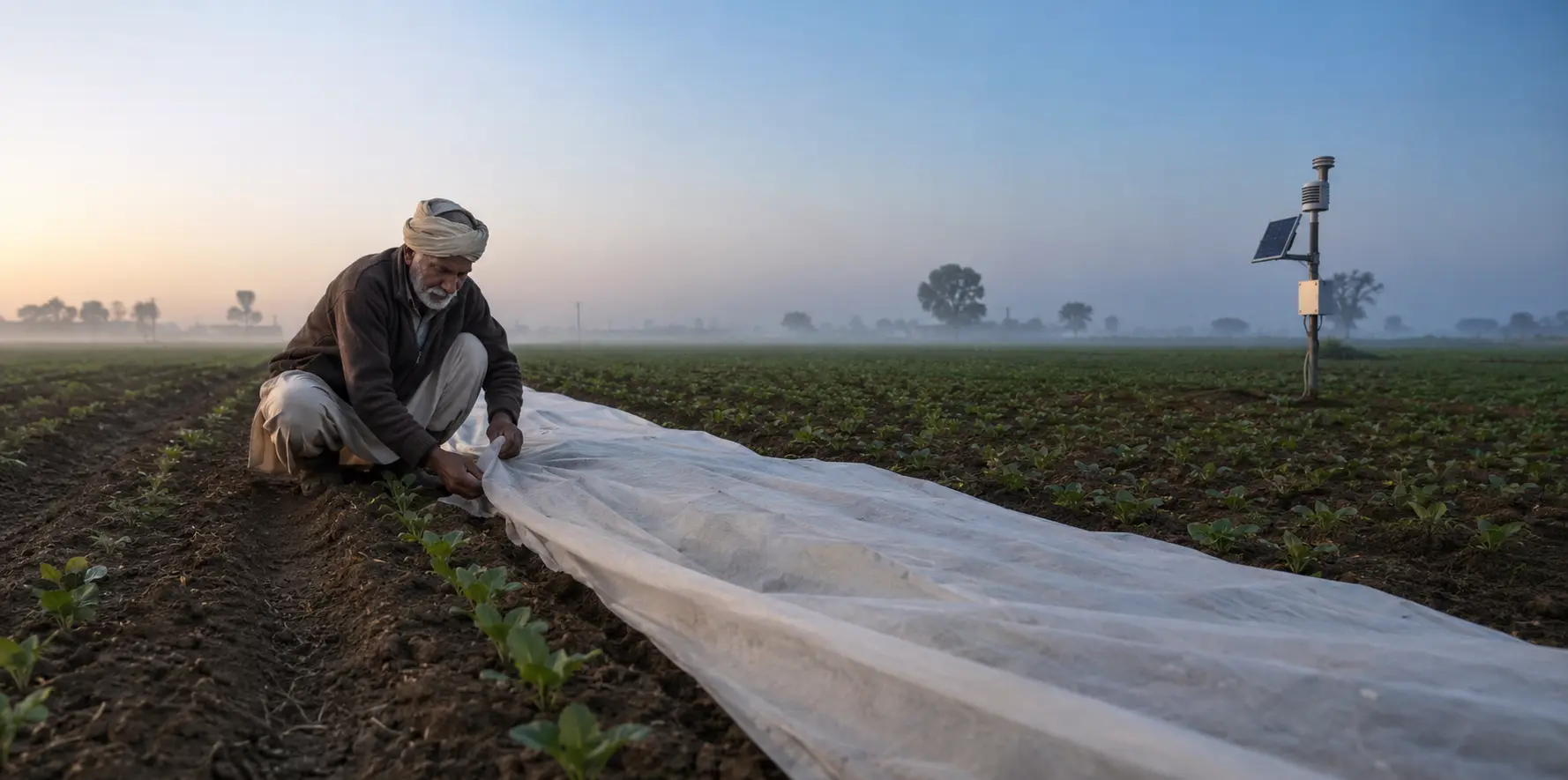

In 1971, a farmer who had spent forty years in the same fields could read the sky better than any instrument. He watched the colour of the morning and the behaviour of the birds. He noticed the ache that settled into his knee before rain. He read the almanac. And he planted by it.
But one day, the future simply arrived without warning, the way it always does.
One clear night in spring, the temperature fell further than any sign had promised, and by morning, frost had taken the season.
Nothing in the farmer’s reading had been wrong, exactly. He could not see what was coming, so he built his life around surviving it after it came. This has been the human condition for nearly all of history.
The Day You Already Live Ahead Of
Now consider how differently you move through a single ordinary day.
Your phone tells you to grab an umbrella before you have even looked outside. Your maps app reroutes you around a traffic jam you cannot yet see. Your calendar says leave now or you’ll be late. Your smart watch flags a heartbeat that feels normal to you but isn’t. Your phone warns you it will die by noon. Your keyboard finishes your sentence before you do.
We live, now, inside a quiet hum of small predictions. We have stopped merely reacting to the present; in a thousand tiny ways, we have started living slightly ahead of it.
This is not a gadget story. It is the beginning of the next major shift in how societies operate. In the first essay in this series, we saw how the last revolution made expertise abundant. This brings us to the question of what happens next.
The first thing that abundance buys us is foresight, which means the future belongs to societies that anticipate rather than react.”
Fifty Years Ago
Humans have always tried to see ahead with stars, oracles, and almanacs. And yet, the first time we did it well, we did it through institutions and processes, not instruments. In the late seventeenth century, merchants gathering at Lloyd’s coffee house in London began pooling the risk of ships that might not return. The first real machinery of anticipation was born when actuaries priced those bets with mortality tables, probability, and insurance. That was the first time a society looked at an uncertain future, put a number on it, and acted in the present.
Weather forecasting traced the same slow arc: useless, then crude, then eventually good enough to empty a coastline before a hurricane made landfall and save thousands who a generation earlier would simply have drowned. Radar let us see the attack before it arrived. Public health let us see the outbreak in the pattern of the dead before we understood the disease — when John Snow mapped London’s cholera cases to a single water pump in 1854, the map was the prediction, and removing the pump handle was the act.
In every one of these instances, making the prediction was only ever half of it. The harder part was acting on what one saw.
Today
Prediction is now becoming abundant the way information and computing became abundant before it. Cheap sensors, vast data, and machine learning are turning forecasting into a utility you summon rather than something you commission. We can increasingly see the storm, the shortage, the equipment failure, the disease, months before they arrive.
And here is the uncomfortable discovery waiting at the end of that abundance. With prediction becoming cheap, the bottleneck is action.
The clearest proof is the one we live with every day.
We have seen the climate crisis coming for half a century, with steadily sharpening clarity, and the seeing has never been what failed us. The acting has.”
We have had pandemic early-warning signals and ignored them; flood maps for towns that flooded anyway; risk models for crises that arrived on schedule and found us unprepared. Knowing, it turns out, is not doing.
So the scarce resource of the next fifty years will not be foresight.
We are about to have more foresight than we know what to do with.”
The scarce resource will be the will, and the institutions, to act on it before the damage is done.
The Humility This Demands
There are good reasons to be careful when estimating our ability to predict the future.
Prediction is extremely difficult, and confident prediction is often worse than none. The psychologist Philip Tetlock spent decades scoring expert predictions. He found that the most famous and confident experts often relied on a single grand theory. And they were frequently the least accurate. A model that explains the past perfectly can fail the future completely; before 2008, many financial models signalled stability just before a historic collapse.
There is also a subtler trap. The more we trust forecasts, the greater the risk that we stop preparing for the unexpected. Prediction can reduce resilience.
Yet prediction has another vulnerability. A warning system is only as strong as the trust it earns. Cry wolf too often and people stop covering the seedlings.
A false alarm wastes effort, but more critically, it erodes the credibility that makes the next warning effective.”
In the end, anticipation runs on trust. That is a quiet hint about where this larger story is heading.
Fifty Years From Now
So what does solving this mean? It means going beyond making the most accurate six-month forecast and turning that warning into a six-month head start. Without the institutions to move on them, predictions remain footnotes. That brings us to the law running underneath this whole series: Technology changes quickly, while institutions change slowly.
A forecast updates in seconds. On the other hand, a health ministry, a building code, a supply chain, or a parliament changes over years.
The widening gap between how fast we can now see and how slowly we still act is the defining governance problem of the coming era.”
A few societies are tackling this particular problem. The UAE has built anticipation into the machinery of the state, with mandates and institutions pointed deliberately at the long horizon. Singapore has planned its water, its land, and its economy in decades rather than election cycles. These examples show that anticipation is a capacity societies can deliberately build, rather than a temperament they are simply born with. That does not make them models to copy wholesale, but it does make them worth studying.
The same shift is beginning to surface in the systems being built around us, and the revealing part is that it is appearing everywhere at once. Across the ventures we build and observe at T9L, the same move keeps recurring in unrelated domains — early efforts to make climate risk legible months in advance, such as Pinpoin, and others attempting to turn governance from a periodic report into a continuous signal, such as Augur.bot. These are best read as hypotheses, not conclusions; they are early, and each runs straight into the wall this essay is about: the distance between seeing and doing. But it’s worth noticing that the same instinct is emerging in climate and in governance at the same moment.
The Age We Are Leaving
For almost all of history, the future arrived without warning, and the best a person or a society could do was endure it and rebuild. That farmer in 1971 was not foolish. He was living in the only age humans had ever known, which is the age of reaction.
We are leaving it. Not because we have finally learned to predict, but because prediction is becoming ordinary, and in becoming ordinary it has exposed the real work: closing the gap between knowing what’s coming and doing something about it.
The future will not belong to those who see it most clearly. It will belong to those who act on what they see while there is still time for it to matter.”
And there is one more thing this new sight gives us. The same intelligence that can forecast a storm across a whole region can forecast a single person — your risk, your need, your next move. Anticipation, turned upon the individual, becomes something else entirely. It becomes personalisation. That is where we turn next.
***
This essay is part of a longer series tracing a single argument across history, economics, governance, and human behaviour: that every technological revolution solves a scarcity, and every new abundance creates a new scarcity. Following this pattern into the AI era, the series argues that trust is the defining scarcity of our time.
You can read the first essay here.