
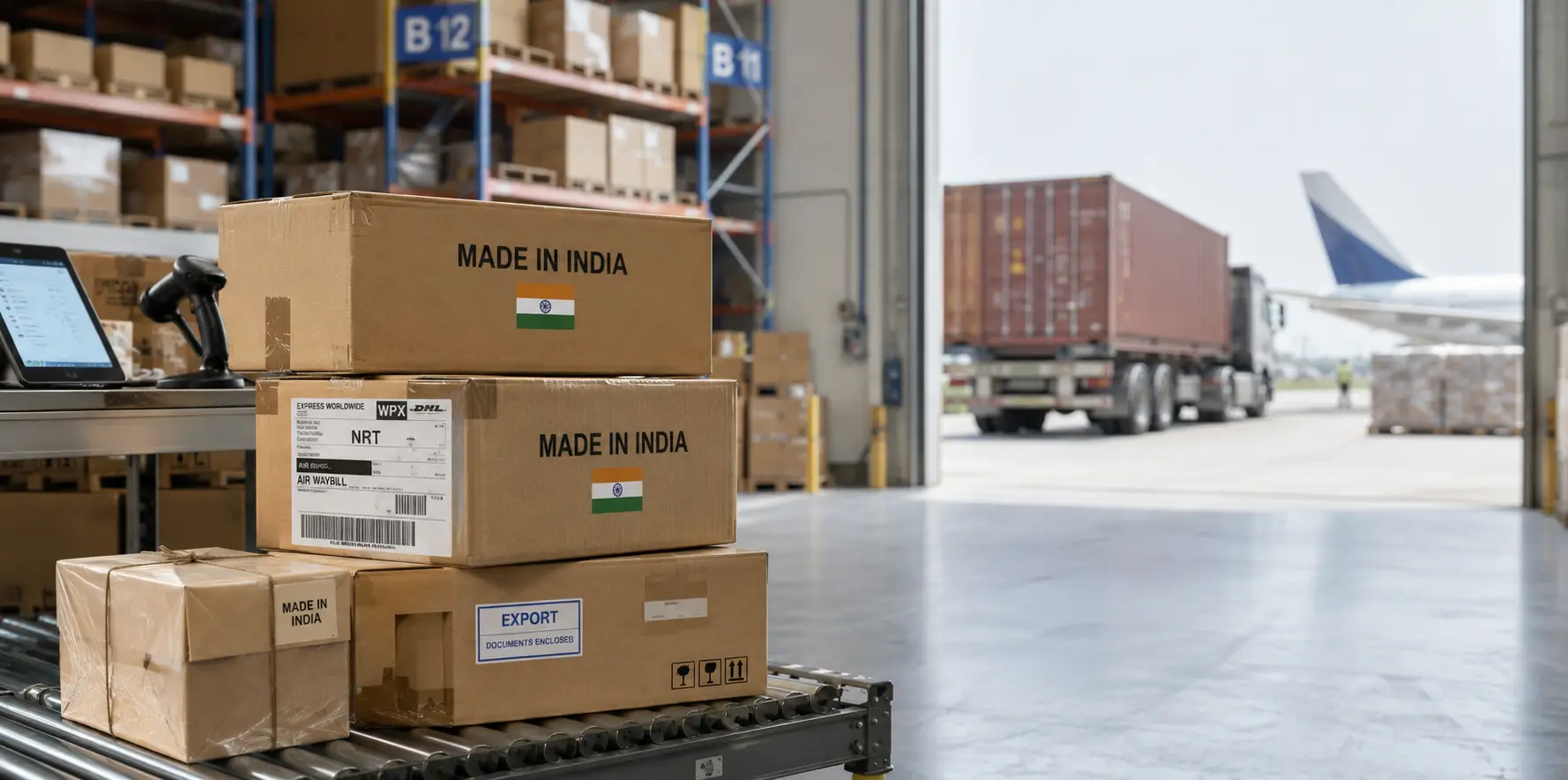

India has approved foreign direct investment in inventory-based e-commerce for companies exporting goods manufactured in India. This will allow foreign-owned platforms like Amazon and Flipkart to buy from Indian sellers and hold their own stock in India for the first time, a facility that was until now reserved for domestic Indian sellers. The move comes as the government works to raise manufacturing’s share of GDP to 25 per cent by 2035, and lift merchandise exports to $1 trillion (INR 95.6 lakh crores) by 2030, up from $442 billion (INR 42.3 trillion) last year. The extent of its impact on India’s smaller manufacturers will depend on how the policy is implemented.
What Is Changing?
The policy is based on DPIIT’s Press Note No. 3 of 2026. It provides an exemption from India’s ban on foreign direct investment in inventory-based e-commerce, but only for goods manufactured or produced in India and sold abroad. The Directorate General of Foreign Trade then issued an implementation framework on 5 August in accordance with the Foreign Trade Policy 2023.
Foreign platforms in India have so far only been allowed to run as marketplaces, connecting independent sellers to buyers without owning the goods themselves. This model already permits 100% FDI, as does business-to-business e-commerce, which has allowed foreign investment since 2000. The inventory-based model, where the platform owns the goods and sells them directly to consumers, has remained off-limits to foreign platforms, to protect small retailers from the market dominance of large global companies.
DPIIT stated the change is intended to facilitate greater exports through easier access to global markets for Indian sellers.
Why Does It Matter?
India has roughly over 63 million MSMEs (micro, small and medium enterprises), spanning textiles, handicrafts, food processing, leather and light engineering, many of them based outside major metros. Yet only about 12,000 of these currently manage to export through e-commerce on their own, according to estimates from the India SME Forum. The gap is not a lack of demand for their goods abroad, but the practical burden of exporting: arranging international shipping, clearing customs in another country, holding stock overseas, and managing a foreign currency, all without the scale or expertise that larger exporters have.
By allowing platforms to own inventory and manage the export process directly, the policy is intended to reduce the operational burden on smaller manufacturers, enabling them to access overseas markets without having to build their own logistics, warehousing and export infrastructure.
Amazon’s Global Selling programme offers some indication of what this model could enable, although its figures need to be read carefully. The company says the programme facilitated more than $20 billion in cumulative e-commerce exports from India between 2015 and 2025, involving exporters from over 200 cities. It is now targeting $80 billion in cumulative exports by 2030—not $80 billion in exports each year.
The opportunity for India as a whole could be much larger. The Global Trade Research Initiative estimates that India’s e-commerce exports could reach $350 billion (₹33.48 lakh crore) by 2030, compared with roughly $5 billion today. The new policy is intended to help narrow that gap by making it easier for smaller Indian manufacturers to reach global buyers.
What Happens Next?
The Ministry of Finance’s FEMA notification is the next step, and the policy becomes operative only once it is issued. Operational guidelines for manufacturers, expected from the DGFT, would follow that notification. The domestic ban on foreign-owned inventory-based e-commerce continues to apply, as the new change opens the model up only for exports.
The policy is expected to face a practical test in how strictly export inventory can be kept separate from domestic inventory, since enforcing this distinction is likely to be difficult. The outcome of this policy remains to be seen: it could be a routine technical clarification with limited impact, an opening that mostly benefits large e-commerce players, or a genuine boost for Indian manufacturers looking to export.
What Should India Do?
India should treat this as an early, contained step rather than a finished policy. The priority now should be ensuring that exports and domestic sales stay genuinely separate as this rolls out, so the exception serves the manufacturers it was designed for. India should also use this phase to strengthen the support smaller manufacturers need to actually make use of this opening, from export documentation to quality certification, so the benefit is not limited to those who already have scale. Handled well, this could become one working model for how India opens up further access without compromising its domestic retail protections.
***
Source note:
This article is based on DPIIT Press Note No. 3 of 2026; DGFT Notification No. 27/2026-27 and Public Notice No. 25/2026-27, both dated 5 August 2026; the PIB operational announcement; Amazon Global Selling data; and concerns raised by CAIT and GTRI, as reported by Moneycontrol. The corresponding FEMA notification referred to in the DPIIT Press Note could not be located in the official public record as of 7 August 2026.
Editorial Disclosure:
AI-assisted tools were used to help summarise and organise information from the source reports and to support language and copy-editing.