
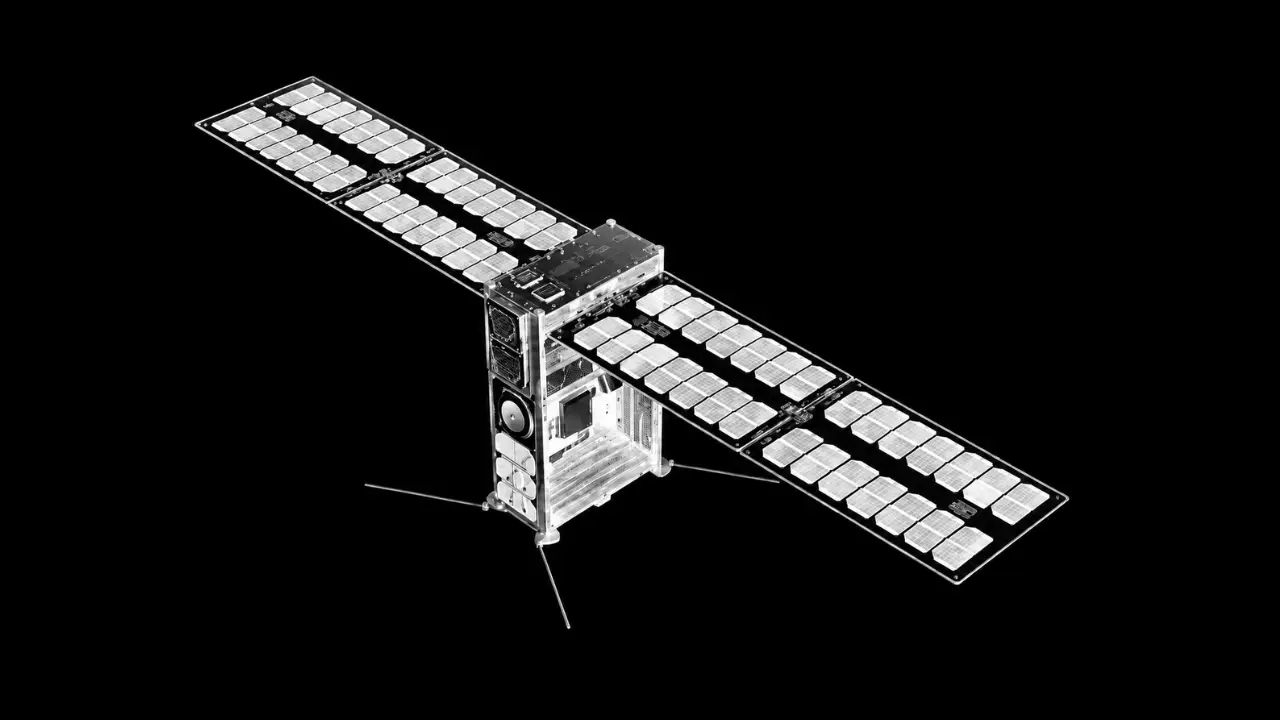

Hyderabad-based TakeMe2Space plans to launch its MOI-1A satellite on 1 October aboard SpaceX’s Transporter-18 rideshare mission, which carries satellites for multiple customers. MOI-1A combines an imaging instrument with Nvidia Orin NX processors to capture and analyse images of Earth in orbit, then transmit the results to the ground. The company describes it as India’s first orbital-computing satellite. It says it has signed 23 customers for the mission, including mapping companies, educational institutions and businesses in agriculture, mining, supply-chain management and insurance. If successful, the mission could strengthen India’s position at a new space frontier: commercial computing in orbit.
From Experiments To A Commercial Mission
Founded by software engineer and entrepreneur Ronak Kumar Samantray, TakeMe2Space has developed its technology through successive experiments in space. In January 2024, it flew an experiment to test a coating designed to protect satellite electronics from radiation. That December, its MOI-TD demonstrator launched on ISRO’s POEM platform, which uses a rocket’s spent upper stage to host experiments in orbit. The mission tested uploading AI applications from Earth, running them in space and returning the results. Its next satellite, MOI-1, was lost in the PSLV-C62 launch failure in January 2026. MOI-1A is its next attempt to put the service into commercial operation.
TakeMe2Space is part of India’s growing space startup sector, where companies are developing launch vehicles, satellite imaging, propulsion systems and data services. Its work extends that activity into computing in orbit.
Where Indian Space Engineering Meets AI
computing. TakeMe2Space says most of its satellite subsystems are designed and manufactured in India, while chips, solar cells and propulsion systems are sourced from abroad. The mission therefore reflects both the domestic capability being built around satellite design and integration, and the components for which India still depends on overseas suppliers.
The company is building that capability with a mix of private capital and public support. TakeMe2Space raised $5 million in January 2026 in a round led by Chiratae Ventures, with participation from Unicorn India Ventures, Artha Venture Fund and SeaFund. The company said the funding would support a six-satellite constellation and further development of in-orbit AI computing. IN-SPACe is also supporting TakeMe2Space’s StarSense programme through its Technology Adoption Fund, as part of the company’s wider effort to develop more satellite technology within India.
From One Satellite To A Network
MOI-1A will test whether processing imagery in orbit can reduce the amount of data that needs to be transmitted to Earth. A customer monitoring flooding, for example, could receive a map of the affected area rather than the full set of images used to produce it. The commercial question is whether lower data-transmission costs can justify the cost of computing in orbit.
TakeMe2Space is already planning beyond that first test. It has signed a launch agreement for two larger satellites targeted for 2028, which are intended to exchange data and computing workloads through optical links between spacecraft. That would move the model from computing on individual satellites towards distributing work across a network in orbit.
***
Source note:
This article is based primarily on Reuters’ 28 September 2026 report on MOI-1A’s launch, onboard computing capability, customers, manufacturing and sourcing. Details of TakeMe2Space’s earlier radiation-shielding experiment come from the company’s March 2024 RSEM note, while its MOI-TD demonstration is supported by ISRO’s POEM-4 mission information. Funding details come from The Economic Times’ January 2026 report on TakeMe2Space’s $5 million raise, and information on its StarSense programme comes from TakeMe2Space and IN-SPACe. Plans for two larger satellites in 2028 and a networked orbital-computing model come from Business Standard.