
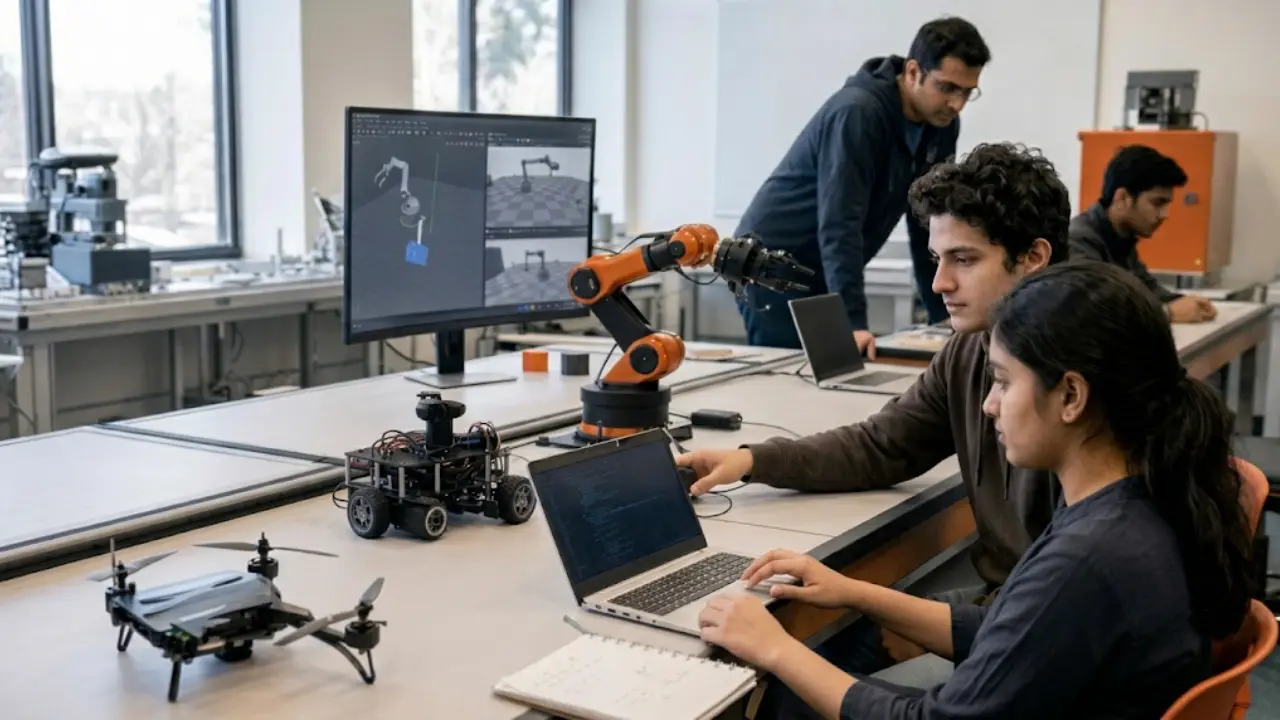

On 26 October 2026, IIT Kharagpur announced a ₹35-crore initiative to establish the Benjamin Gupta School of Physical AI, which it described as India’s first dedicated academic school in the field.
The school plans to offer specialised Master’s programmes, professional certifications, executive education and interdisciplinary training, with academic programmes expected to begin in the upcoming academic session. Its proposed research includes intelligent robotics, autonomous systems, physics-informed machine learning, digital twins and AI-assisted scientific experimentation, with potential applications across manufacturing, energy, agriculture, healthcare and infrastructure.
The initiative is part of a wider effort in India to build research infrastructure and specialised expertise for technologies combining AI with physical systems. The government-funded National Mission on Interdisciplinary Cyber-Physical Systems is supporting research, skill development and technology commercialisation, while IIT (BHU) Varanasi has also established a dedicated Physical AI school.
What Is Changing
According to a January 2026 explainer by IBM, Physical AI refers to AI systems capable of operating and interacting with their physical surroundings. These systems combine AI models with sensors, mechanical components and control technologies to interpret conditions and perform actions.
IIT Kharagpur’s approach also extends to scientific AI, which applies machine learning to scientific and engineering problems. The institute envisages interdisciplinary projects, laboratory exposure and industry-linked learning.
Explaining the vision behind the school, IIT Kharagpur Director Prof. Suman Chakraborty said: “Our vision is to move beyond treating AI as a black-box solution. An engineer must understand the physics behind an intelligent machine; a scientist must connect AI predictions with fundamental scientific principles; and a medical professional must combine algorithmic intelligence with biological and clinical understanding.” Chakraborty added that future advances would depend not simply on using AI but on integrating it with deep domain knowledge to create reliable, explainable and impactful technologies.
Why It Matters For India
Since 2018, the Department of Science and Technology has been developing an institutional network for cyber-physical systems, which integrate computation, sensing and control with physical processes. Although broader than Physical AI, this research encompasses many of the engineering capabilities needed to develop intelligent machines and autonomous technologies.
The National Mission on Interdisciplinary Cyber-Physical Systems, approved with a ₹3,660-crore outlay and extended to 2027, has established 25 Technology Innovation Hubs at academic institutions. These support technology development, specialised training, startups and industry partnerships across robotics, AI, autonomous systems and other fields. In 2025, four hubs were supported as Technology Translation Research Parks, including one at IISc Bengaluru specialising in robotics and AI systems. The parks are intended to help researchers work with industry, develop usable products and commercialise technologies. IIT Hyderabad’s TiHAN provides test tracks, simulation systems and facilities for assessing autonomous vehicles under different environmental conditions, including rain and fog.
Alongside these research investments, institutions are expanding specialised education. IIT (BHU) Varanasi established its School of Physical AI and Autonomous Systems in July 2026, with plans reported for an undergraduate programme. IIT Kharagpur already hosts AI4ICPS, a hub working on AI and machine-learning applications in cyber-physical systems, providing an existing research base relevant to the proposed school.
What India Needs Next
Students and researchers will need access to hardware, sensors, simulation systems and experimental facilities, while industry partnerships can provide practical problems and opportunities to test technologies under operating conditions.
At a scientific conclave on 29 October, NITI Aayog Member Abhay Karandikar described Physical AI as an interdisciplinary systems-engineering problem involving sensors, actuators, computing, control and AI algorithms. He also referred to consultations on a possible national Physical AI Mission that could build on the existing cyber-physical systems programme. Such a mission remains a proposal rather than an approved initiative.
For IIT Kharagpur, the next step is to translate its academic plans into specialised training, research facilities and industry partnerships that can support the development of Physical AI technologies in India.