
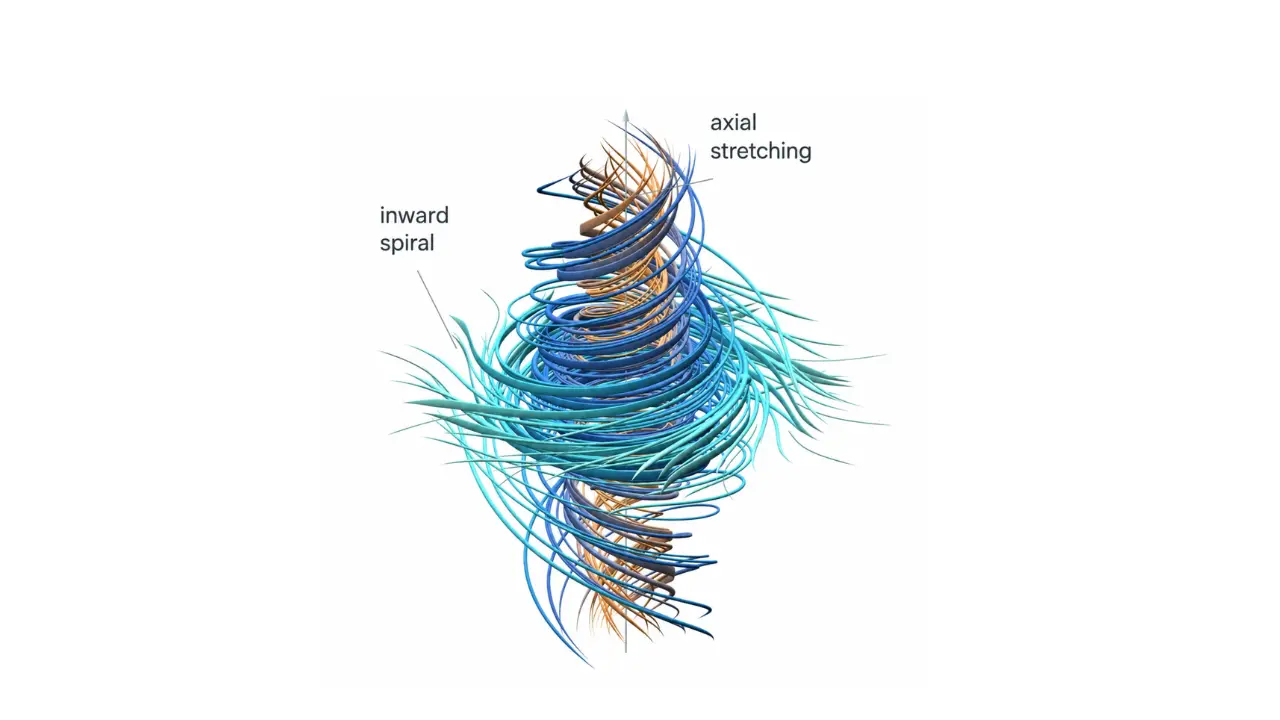

An AI system claims to have cracked a 90-year-old mathematical question about how fluids move. The claim is contested, the credit is disputed and the consequences reach beyond mathematics, including to India.
The Equation That Describes Almost Everything That Flows
Pour milk into coffee and watch the swirls. Sit in a plane as it lifts off. Feel your pulse. In each case, something flows and the mathematics describing it is essentially the same set of formulas, written in the 19th Century by the French engineer Claude-Louis Navier and refined by the Irish physicist George Gabriel Stokes.
Why Solving This Problem Is Essential
In 2000, the Clay Mathematics Institute identified seven of the hardest unsolved problems in mathematics and offered a $1 million prize for solving each one. They became known as the Millennium Prize Problems. More than 25 years later, only one has been solved. One of the six that remain is the Navier–Stokes problem.
The Navier–Stokes equations describe how fluids move. Engineers and scientists already use these equations every day. The problem is that mathematicians still do not know whether the equations always behave properly.
Why does this matter if we already use the equations successfully? Because they sit underneath many important computer models. Weather forecasting, aircraft and rocket design, blood-flow simulations, flood modelling and industrial systems all rely on versions of them.
A significant amount of global supercomputing time goes to fluid simulation. Math matters because we have built critical infrastructure on equations we haven’t fully deciphered. Understanding that limit could improve our knowledge of where computational models may break down.
Here Comes OpenAI
On 8 September 2026, OpenAI claimed that an internal AI system had produced a proof that the three-dimensional Navier–Stokes equation “blows up” at a certain point, with a written proof.
The numbers OpenAI gave are extraordinary. Around 10,000 AI agents worked in parallel, messaging one another for about 88 hours. Quanta reported the agents exchanged close to five million messages, costing several million dollars. This is the first time an LLM has claimed to solve one of the toughest mathematical equations. However, OpenAI’s claim requires formal Lean verification, meeting conditions set by the Clay Institute and acceptance by the mathematical community before a Millennium Prize Problem is considered solved.
Man Vs Machine?
Twelve hours earlier, Tristan Buckmaster of NYU’s Courant Institute and Levent Alpöge, a mathematician at Anthropic, published three verified results showing the Navier–Stokes equations can develop singularities in certain settings. Their results showed finite-time blowup under smooth forcing in three systems: incompressible porous media, the Boussinesq system, and the three-dimensional incompressible Euler equations. While their work is a major step toward solving the Navier–Stokes problem, it is not a solution itself. Terence Tao, the field’s most prominent living figure, called the work a remarkable achievement. Then came Buckmaster’s question.
Alongside his research papers, Buckmaster published a four-page statement describing two phone calls he had on 6 September with Sébastien Bubeck, who leads OpenAI’s mathematics team.
According to Buckmaster, Sébastien Bubeck told him that an internal OpenAI model had produced a roughly 100-page proof showing a finite-time blow-up for a version of the Navier–Stokes equations. What made this striking was that the AI apparently followed the same broad approach Buckmaster and Alpöge had been developing privately. Buckmaster also says OpenAI only began prompting its model on this approach after learning of their unpublished work.
That raised another concern. Throughout the project, Buckmaster and Alpöge uploaded and worked on their drafts using Codex, OpenAI’s coding tool. Buckmaster therefore asked whether OpenAI’s mathematics model could have been trained on or had access to those private Codex sessions.
He says he was told the model did not retrieve user data. But when he asked if those sessions could have been used for training, he did not receive a clear answer.
Buckmaster himself stopped short of making an accusation. He stressed that he did not have OpenAI’s proof, did not know how the model arrived at it and wrote: “I am not accusing anyone of anything.”
OpenAI later denied the allegation, saying its investigation established that Buckmaster’s Codex prompts during the two months preceding publication could not have influenced the system, including through training. However, the claim has not been independently established.
The controversy follows earlier complaints. In August, Scientific American reported that mathematicians criticised how OpenAI presented results from its Astra model, arguing it did not properly recognise earlier mathematical work.
The Actual Million Dollar Question
The episode raises concerns beyond one mathematical proof. If researchers cannot be sure work uploaded to AI platforms remains private and excluded from model training, the boundary between assistance and appropriation becomes hard to ascertain.
That creates risks around confidentiality, intellectual ownership, and whether original researchers receive proper credit. The concern grows because a few companies control capable frontier AI models.
Researchers, companies, and individuals increasingly upload valuable unpublished work to these systems, raising a broader question: how securely is that work protected and who ultimately controls what can be learned from it?
The larger lesson from the Navier–Stokes episode is not just whether AI can solve a difficult mathematical problem. Valuable human work is increasingly created alongside systems controlled by a few companies outside India. India must learn to benefit from those systems without surrendering control over its research, ideas and intellectual capital while continuing to invest in its own.