
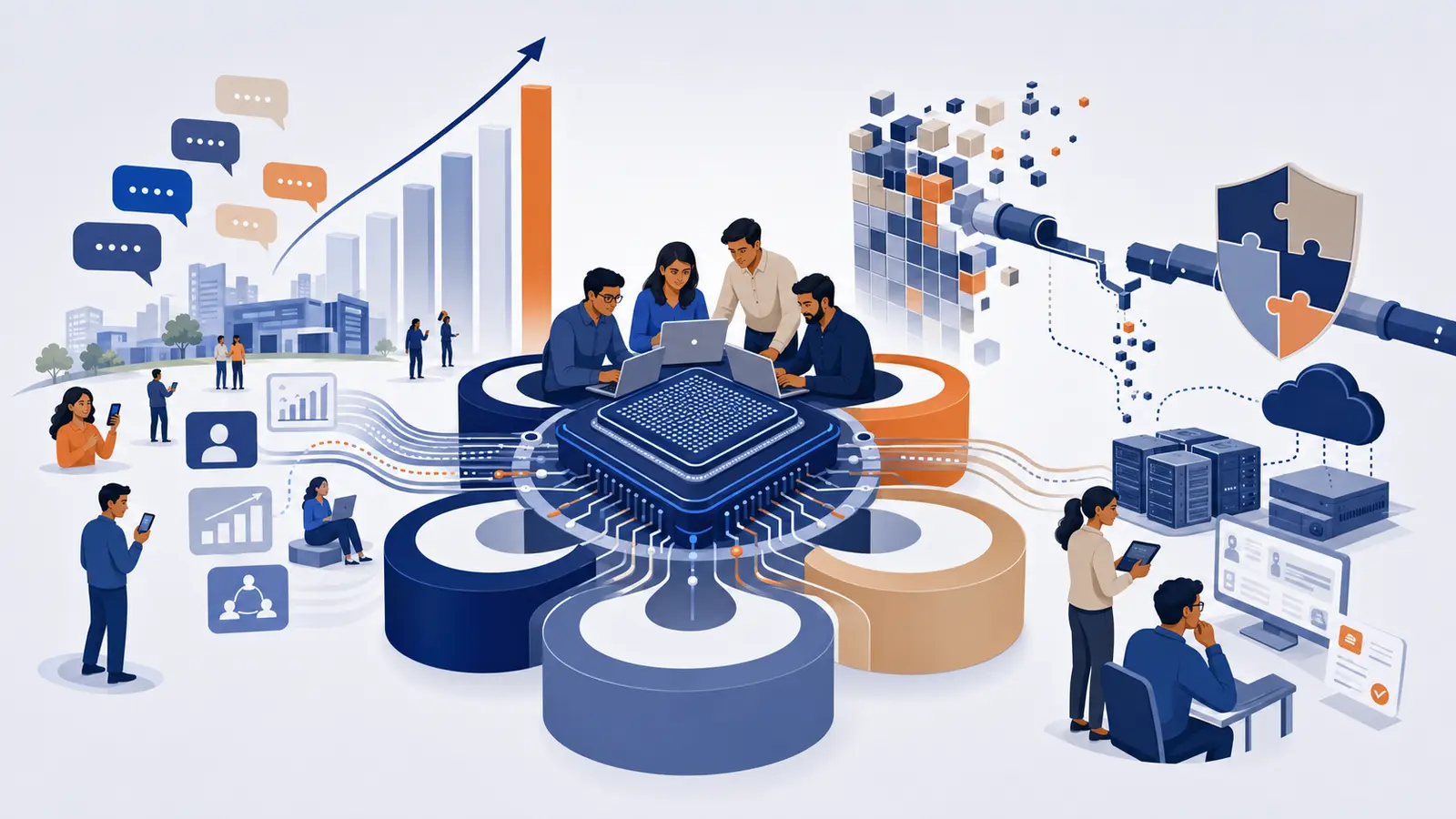

Artificial intelligence is no longer a distant idea for India. It is not something being discussed only in technology conferences, startup panels or boardrooms. AI is already entering the way Indian companies work, sell, serve customers, manage operations and make decisions.
A new EY-CII report, Is India Ready for Agentic AI? The AIdea of India: Outlook 2026, asks a timely question. Is India ready for the next wave of AI, where systems do not just answer questions, but can also take goals, plan steps and act with limited human supervision?
This is what Agentic AI means in simple terms. It is AI that can do more than generate text or summarise information. It can complete tasks, use tools, follow workflows and assist teams like a digital co-worker. For businesses, the promise is enormous: faster work, lower costs, better customer service and round-the-clock productivity.
But the real question is not only whether Indian companies are using AI. They clearly are. The bigger question is whether India is ready to absorb AI safely and meaningfully into its economy, workforce, institutions and digital infrastructure.
India Inc Is Moving From Experiments To Real Use
The report shows that Indian enterprises have moved well beyond the curiosity phase. Nearly half of the surveyed organisations now have multiple AI use cases live. Another section of companies is already scaling AI across the business.
This means AI is no longer limited to experiments or proof-of-concept projects. It is moving into real business functions.
Customer service and marketing continue to be major areas of adoption, but AI is also entering operations, supply chains, banking, retail, telecom and manufacturing. That shift matters. It shows that AI is moving from the front office to the core of the enterprise.”
Indian businesses are not waiting for perfect technology. They are moving because the pressure to improve productivity, customer experience and competitiveness is immediate. In that sense, India is showing adoption readiness.
But adoption is only the first stage.
Adoption Is Not The Same As Readiness
India may be ready to use AI, but is it ready to govern it, trust it and build on it?
That is the real test.
The report identifies several challenges that Indian companies still face. Many organisations do not have clean, structured and AI-ready data. AI models can still make mistakes or produce confident but incorrect answers. Integrating AI with old enterprise systems is complex. Measuring return on investment is not always easy. Data governance and security remain major concerns.

This is important because AI does not only scale productivity. If used badly, it can also scale errors, bias and poor decisions.
For example, an AI system used in customer service can improve response time. But if it gives wrong information at scale, the damage can also multiply. An AI tool used in banking or healthcare can improve efficiency, but it needs strong human oversight, audit trails and accountability.
So India’s AI readiness cannot be judged only by how fast companies deploy tools. It must be judged by how well they manage risk.
India’s Readiness Has Five Layers
The first layer is enterprise readiness. Large Indian companies are clearly moving AI from pilots to production. But smaller companies and MSMEs may need more support, easier tools, affordable access and better training.
The second layer is data readiness. AI needs reliable data. Many Indian organisations still struggle with fragmented databases, legacy systems and inconsistent data practices. Without good data, even the best AI tools will deliver limited results.

The third layer is workforce readiness. AI will change work before it eliminates work. Routine, repetitive and standardised tasks are likely to be affected first. But human roles will not disappear overnight. They will shift towards judgement, supervision, creativity, relationship management and strategy.
The fourth layer is governance readiness. India’s AI future will require systems that are auditable, explainable and monitored continuously. Trust cannot depend only on broad policy statements. It will need model cards, fairness checks, human review, audit trails and third-party assurance.
The fifth layer is sovereign AI readiness. India has to decide whether it wants to remain one of the world’s largest AI markets or become one of its most important AI builders.
India’s Scale Can Become Strategic Power
India has one major advantage: demand.
With its population, digital public infrastructure, startup ecosystem and enterprise market, India can become one of the world’s largest users of AI. But that demand should not only benefit foreign platforms.
India must use its AI demand to build domestic capability. This includes Indian cloud services, data marketplaces, Indic language models, sector-specific AI applications and responsible AI standards.
This does not mean India has to build everything from scratch immediately. Building a full domestic GPU manufacturing ecosystem may take years. But India can move faster in areas such as datasets, language models, AI applications, cloud platforms and governance frameworks.
That is where the strategic opportunity lies.
Why Indian-Language AI Matters
India’s AI future cannot be English-first.
For AI to truly transform India, it must work across Indian languages, regions and social contexts. A farmer asking for crop advice, a small shopkeeper using a credit tool, a patient seeking healthcare guidance, or a student learning online may not interact with AI in English.
This is where smaller, specialised language models can matter. They can be cheaper, faster and better suited to local use cases. India may not need to win only by building the biggest AI model. It can win by building the most useful AI systems for Indian realities.
So, Is India Ready?
The answer is: partially.
India is ready in ambition. It is ready in adoption. It is ready in market demand. Indian enterprises are already moving from pilots to production.
But deeper readiness will depend on whether India can build trusted systems, improve data quality, reskill its workforce, create strong governance and develop sovereign AI capabilities.
Agentic AI may be the headline. But the real story is larger.
India’s AI moment has arrived. The challenge now is to ensure that the country does not merely consume the next wave of AI, but helps shape it.
***
Source Note:
This article draws primarily on the EY-CII report Is India Ready for Agentic AI? The AIdea of India: Outlook 2026, based on EY India’s C-suite GenAI survey of Indian enterprises and the report’s sections on enterprise adoption, workforce readiness, Responsible AI, Small Language Models and Sovereign AI.
Editorial Disclosure:
AI-assisted tools were used to help summarise and organise information from the source report and to support language and copy-editing. The article’s framing, interpretation and infographics are editorially produced by One Big Future.