

Two reports released this year present different perspectives on the same issue. On July 8, 2026, the Union Ministry of Education released the All India Survey on Higher Education (AISHE) reports for 2022–23 and 2023–24. This article draws on the latter, the government’s principal statistical account of enrolment, institutions, teachers and programmes across India’s higher-education system.
Earlier, on March 17, the Centre for Sustainable Employment at Azim Premji University released State of Working India 2026: Youth in the Labour Market—Pathways from Learning to Earning, an independent research report examining how young Indians move from education into employment.
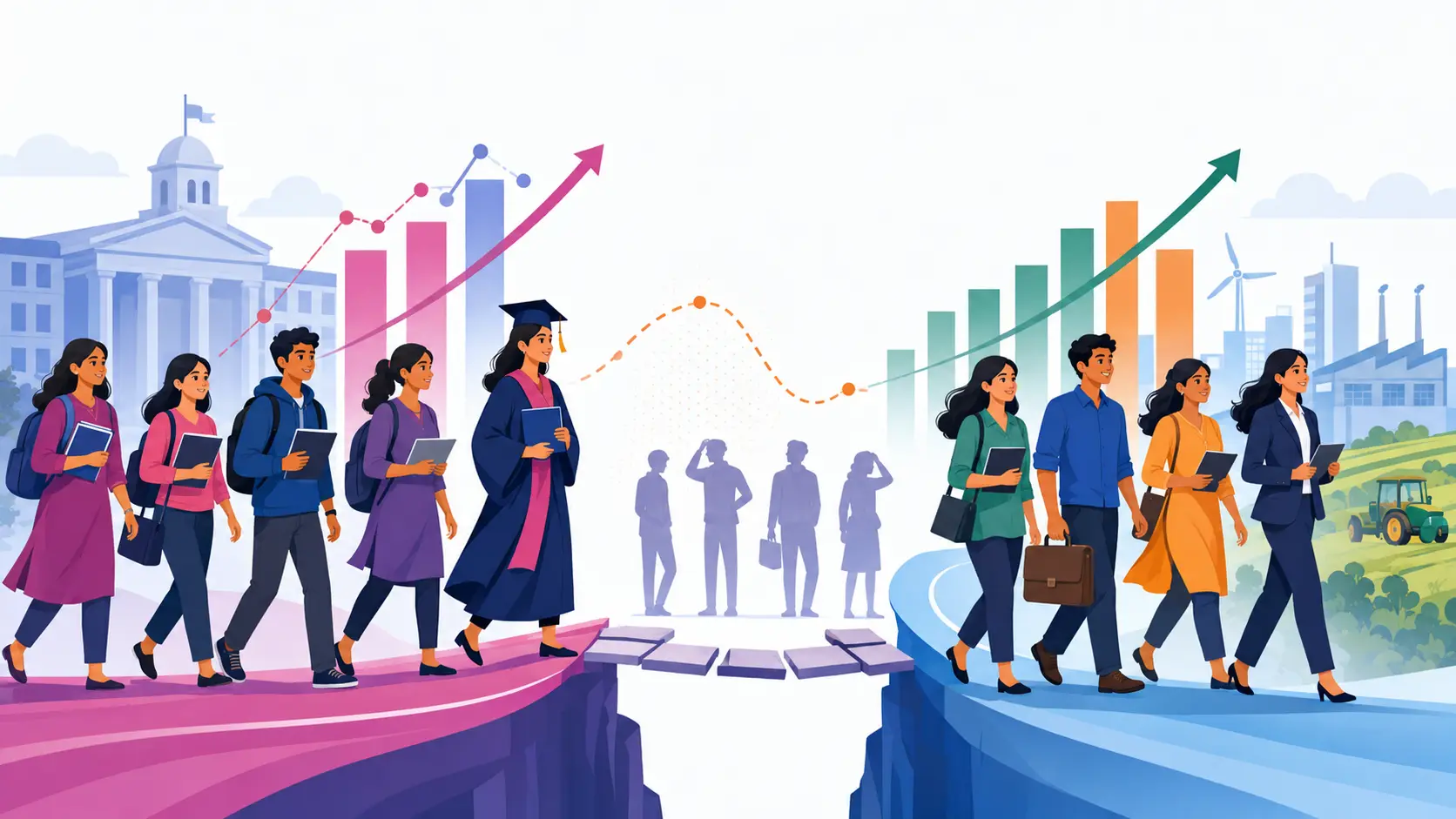
Taken together, the reports highlight both a major national achievement and an urgent structural challenge. India has expanded access to higher education, but it has not yet built a coherent system that consistently translates degree attainment into real capabilities, productive employment and upward economic mobility.
Increasing enrolment is a critical first step. The central issue now is whether higher education leads to meaningful learning, useful skills and secure livelihoods.
What Is Changing?
According to AISHE 2023–24, almost 4.5 crore students are enrolled in higher education, an increase of 31.5% since 2014–15. The system now comprises 1,289 universities and university-level institutions, 48,246 colleges and 15,221 standalone institutions.
Women account for approximately 2.24 crore students. Their Gross Enrolment Ratio, at 31.2, was higher than the male GER of 28.9 for the seventh consecutive year.

Enrolment among Scheduled Castes, Scheduled Tribes and Other Backward Classes has also increased substantially over the past decade. Since 2014–15, SC enrolment has risen by 51.4%, ST enrolment by 75.7% and OBC enrolment by 60.2%.
For a young woman in a small town, access to higher education can significantly alter her family’s trajectory. It may represent her first opportunity to study beyond school, live independently, enter a professional field and imagine a future not constrained by geography, income or prevailing social norms.
But this expansion remains uneven. AISHE’s national averages conceal large differences in college availability across states. State of Working India 2026, or SWI, adds that household income and social background continue to affect not only whether students enter higher education, but also which courses remain within their reach.
Expensive professional degrees such as engineering and medicine remain disproportionately accessed by students from richer households. The cost of pursuing these programmes can exceed the annual per-capita expenditure of poorer households, limiting their access to qualifications associated with some of the highest-paid occupations.”
The higher-education system has also become increasingly dependent on private institutions. AISHE reports that, among responding colleges, 70% are private unaided and another 12.9% are private aided.
Private colleges have been central to expanding capacity in a system where public provision has not grown at a comparable scale. But their dominance makes reliable public information on fees, faculty, teaching quality and graduate outcomes more—not less—important. Students and families should be able to assess institutions on evidence rather than marketing or perceived reputation.
Why Does It Matter?
India’s aspirations for 2047 depend not simply on increasing the number of graduates, but on developing people capable of establishing enterprises, building technologies and strengthening public systems and institutions.
A degree certifies that a student has completed an academic programme. Capability means being able to apply knowledge, solve unfamiliar problems, communicate effectively, collaborate and adapt to changing technologies and occupational demands.
When qualifications are disconnected from these competencies, they may retain social value, but their economic value becomes uncertain.
SWI demonstrates the scale of India’s difficult education-to-employment transition. In 2023, 11 million of the country’s 63 million graduates aged 20–29 were unemployed. Graduates accounted for 67%—roughly two-thirds—of all unemployed people in this age group.”
This finding does not establish that poor employability is the sole cause of graduate unemployment. Inadequate job creation, weak labour-market matching, limited professional networks and graduates waiting for suitable or aspirational employment may all contribute.
The problem is therefore broader than a simple mismatch between what colleges teach and what employers require. It reflects a gap between the rapid expansion of graduate education and the availability of stable, suitable work.
In a separate panel analysis of young men leaving education, SWI finds that roughly half of the graduate respondents entered some form of employment within a year. Yet only 6.7% entered permanent salaried employment. Finding any work is therefore very different from securing a stable graduate job.
This does not mean higher education no longer provides economic benefits. SWI finds that graduates generally continue to earn more than non-graduates at the time of entering the labour market and over their working lives.
But the transition from college to secure employment remains difficult and uncertain. Between 2004–05 and 2023, India added approximately five million graduates annually, while the number of employed graduates increased by only around 2.8 million each year. Graduate employment has not kept pace with the growing number of degree-holders.
AISHE documents the widening doorway into higher education. SWI examines the increasingly difficult passage from education into stable work.
The Missing Bridge Between College And Work
The challenge begins within institutions themselves.
AISHE records more than 17 lakh teachers across higher education. But aggregate faculty numbers do not show how teachers are distributed across institutions, how long they remain in their positions, the teaching loads they carry or the quality of student engagement.
Using institution-level data from earlier AISHE rounds, SWI finds that teacher recruitment has not kept pace with the growth of students and colleges, with public colleges particularly strained. The report estimates that public colleges had approximately 47 students per teacher in 2022, compared with about 28 in private colleges.”
More fundamentally, the system remains weak at linking classroom learning with actual workplaces.
AISHE’s first National Education Policy implementation module reports considerable adoption of structural reforms among responding universities. Of the 1,278 universities that responded, 69% reported registration with the Academic Bank of Credits, 56% had introduced four-year undergraduate programmes and 65% had established a research and development cell.
Yet only 41% reported having an internship cell and just 7% an apprenticeship cell.
These figures apply to responding universities, not to all colleges or higher-education institutions. Nevertheless, they suggest that changes to the formal architecture of degrees may be progressing faster than the creation of pathways for students to apply their learning in practical settings.
Internships and apprenticeships expose students to actual production systems, professional standards and organisational constraints. They also provide employers with a structured mechanism for training and evaluating prospective employees.
But workplace learning should not become another source of inequality. Students from poorer households may be unable to accept unpaid or poorly compensated placements because their families need them to begin earning.
SWI’s specific recommendation concerns vocational and skill-training programmes. It suggests integrating apprenticeship experience into the training itself, rather than requiring trainees to spend additional time outside the formal course and bear the cost of foregone earnings.
The wider principle is equally relevant to higher education: workplace exposure should be built into the learning pathway and supported adequately, rather than treated as an optional extra available mainly to students with financial resources or professional connections.
The Dual Challenge: Skills And Jobs
It would be a mistake to attribute graduate unemployment solely to employability deficits. Better teaching, practical learning and relevant curricula are necessary, but even a highly capable graduate cannot secure suitable employment if such positions are not being created.
SWI frames the challenge as both a skills problem and a jobs problem. Improving education and training is important, but supply-side skilling alone cannot compensate for weak creation of productive employment.

Workplaces are themselves important sites of skill formation. Firms expose young employees to tools, processes, teamwork and professional judgement. When productive firms are too few and smaller companies lack the resources or incentives to train workers, capability gaps continue even after graduation.
This challenge may intensify as artificial intelligence transforms entry-level cognitive work. SWI is cautious about forecasting AI’s full impact on employment in India. But an important policy question is already emerging: will firms continue to create the beginner roles through which graduates have traditionally acquired experience, judgement and domain expertise?
Universities alone cannot resolve this issue. India must simultaneously improve educational quality, expand productive enterprises, support micro, small and medium enterprises and generate more entry-level opportunities in manufacturing and modern services.
What Should India Do?
The next phase of reform should connect three outcomes that are currently measured separately: access to education, acquisition of capability and entry into productive employment.
First, AISHE should establish a stronger outcomes framework. In addition to enrolment, institutions and faculty should monitor course completion, internships, apprenticeships, initial employment, starting salaries, fields of work, entrepreneurship and longer-term career progression.
These outcomes should be disaggregated by gender, social group and geography. A degree should not be evaluated solely by the first salary it produces, but students, families and policymakers need credible evidence about what different institutions and programmes actually deliver.
Second, workplace learning should become an integral component of undergraduate education. Colleges should establish long-term partnerships with firms, public agencies, laboratories, hospitals and civil society organisations.
Employers should contribute to applied curriculum design and offer supervised learning opportunities. Public support and stipends should ensure that students from poorer households are not excluded from internships and apprenticeships because they cannot afford to work without adequate compensation.”
Third, faculty capacity must expand alongside enrolment. Increasing student intake without recruiting and retaining qualified teachers risks reducing access to participation of limited quality.
Funding and accreditation systems should assess actual teaching loads, faculty continuity, mentoring, laboratory access and learning outcomes—not merely sanctioned positions or reported infrastructure.
Fourth, planning should become more regional. National averages obscure substantial disparities in institutional density, faculty availability and employment opportunities.
District-level higher-education strategies should be aligned with local economic strengths and future requirements, whether in manufacturing, agricultural value chains, healthcare, tourism, logistics, renewable energy or digital services.
Finally, education reform must be complemented by a broader employment strategy. India needs more productive enterprises capable of hiring graduates and non-graduates, investing in workforce training and creating pathways towards higher earnings.
Higher education can prepare young people for opportunity. It cannot substitute for the creation of opportunity.
AISHE 2023–24 documents a significant national achievement: India’s higher-education system is larger, more inclusive and more gender-balanced than it was a decade ago. SWI 2026 shows that this achievement is only the beginning.
By 2047, India’s success will not be measured merely by college-enrolment figures or the number of degrees awarded. The more meaningful test will be whether those degrees have enabled young people to build productive lives and strengthened the country’s economic, scientific and institutional capabilities.
India has expanded access to higher education. The harder task now is to build systems that enable progression from enrolment to meaningful learning, from learning to productive work and from work to upward mobility.
Achieving this will require sustained collaboration among educational institutions, policymakers and employers. Only then will the expansion of higher education translate into genuine social and economic transformation.
***
Source Note:
This article draws primarily on the Government of India’s All India Survey on Higher Education 2023–24, released by the Ministry of Education on July 8, 2026 and State of Working India 2026: Youth in the Labour Market—Pathways from Learning to Earning, released by the Centre for Sustainable Employment at Azim Premji University on March 17, 2026.
Editorial Disclosure:
AI-assisted tools were used to help summarise and organise information from the source reports and to support language and copy-editing.