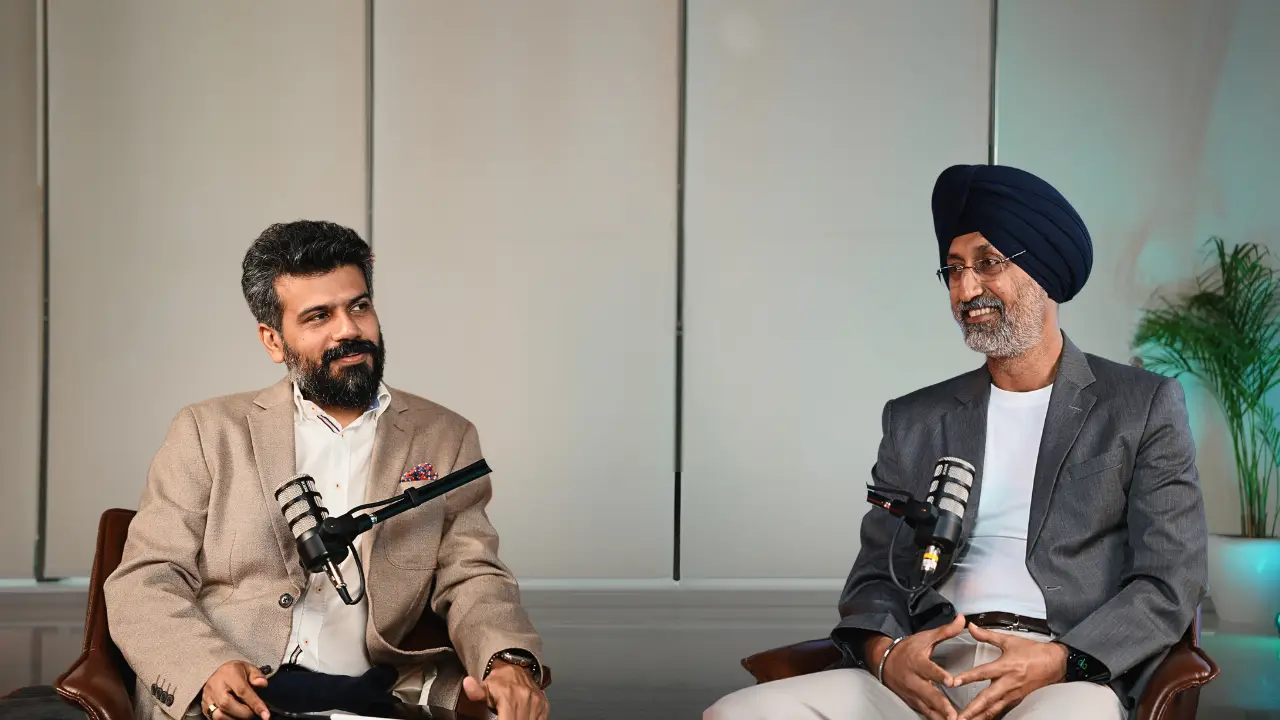

BMW Group India President and CEO Hardeep Singh Brar discusses how India is becoming increasingly important to the auto major’s global strategy as a market, manufacturing base and talent hub in a conversation with Nikhil Chawla. India has entered BMW’s top 20 global markets, with an ambition to reach the top 15 by the end of the decade. The conversation explores rising localisation, India’s potential to evolve from a software hub into a broader engineering centre and the rapid adoption of electric vehicles, with EVs already accounting for 26% of BMW’s sales. Brar also discusses changing Indian consumer preferences, the growing influence of Gen Z, social media, MINI’s expansion and BMW’s ambition to become India’s most loved and respected premium brand.
Nikhil Chawla: Hi, hello, and welcome to the first episode of One Big Podcast. I’m Nikhil Chawla and today we are talking about cars, business and most importantly, the big India opportunity with someone who knows all three really well, Hardeep Singh Barar, President and CEO, BMW Group India. Hardeep, welcome to the One Big Podcast. Now, before we get into talking about BMW India, the manufacturing of luxury cars, I want to understand, you’re a marathoner yourself. So, do you prefer running to work or do you get a car?
Hardeep Singh Brar: Good question. I wish I could run to work.
NC: It’ll be faster in Gurgaon for sure, I believe.
HSB: Oh yes, especially on rainy days. Yes, I think so. Yes, I come by car, but I don’t mind running to work because it’s about 10 kilometres and it can actually be good fun. But I need to have a shower room in my office to really do that.
NC: That’s true. And you’ll add so many 10Ks to your list.
HSB: Fortunately, I finish it before I come. So, I don’t need to run twice.
NC: Wow. Okay. So, what do you do? What time do you start running in the morning and then you make it to work?
HSB: So 6 am to 7 am is my time when I have three days of strength training and three days of runs. So, depending upon the first day is 5 kilometres, the third day is 10 and the weekend is anywhere between 15 to 21.
NC: Wow. So, half marathon is over the weekend.
HSB: Yes, close to that.
NC: That’s crazy. On that note, let’s start with running. You’ve run marathons and running a business is like a marathon. You can’t start spending on day one. What are your takeaways as a marathoner yourself? And where does BMW India stand today? Is it still building endurance as a marathoner? Or is it entering the sprint phase now?
HSB: I think you can’t be sprinting too much when you’re running a marathon. It has to be more endurance. You have to make things which are long-lasting because you can be out of breath if you’re sprinting, even in the middle of the marathon. The only time you can sprint in a marathon, it’s towards the end of it. And business is not like this. It’s never-ending, right? It is ongoing. And hence, you have to be in the endurance phase all through. Of course, within months, you can sprint a little bit. When there’s a festival season, you need to sprint. You can’t lose that opportunity. But on the whole, you have to be in endurance mode.
NC: Absolutely. Now let’s talk about how India has changed rapidly. And what has really changed the most in BMW’s thinking, in terms of India as a market, as a manufacturing base or as a talent hub?
HSB: Yeah, I think a bit of everything. Let me first tell you, we were not in the top 20 markets till now. This year, we moved into the top 20 markets, which is a big thing. And, you know, our vision is to get into the top 15.
NC: I think I’ll give credit to you, Chadhikala.
HSB: Thanks for that. And we’re looking at getting into the top 15 markets by the end of this decade. And the moment you are in the top markets, the focus increases, right? And hence, you mentioned about being the manufacturing base. It is one of the few markets where you have a manufacturing base. Only, I think, Thailand and India and the Southeast Asian market, of course, China is big. And in terms of talent also, India is a huge talent market. And as you would be aware, we started the BMW Techworks in Pune, Bangalore and Chennai. And the reason for that is, you know, the tech talent is so huge in India that it’s phenomenal. And hence, manufacturing is a focus. And talent absolutely is a focus.
NC: Can you tell us more about the tech hub that you’ve set up? Because it really stops the talent from brain drain. You’re making everything in India. So, is it also safe to say that most of the software that we drive across the world in BMW cars is kind of somehow done by Indians?
HSB: Yeah, of course. Not by Indians. There are only six tech hubs across the globe. And India is one of the newest ones. And they can see the potential which India offers, the kind of talent we have. So, a lot of stuff that you see on the digital screens is what would be made by the Indians.
NC: That’s great. And is localisation genuinely happening in India when you talk about BMW and MINI? I know they recently announced MINI for the first time being manufactured in India. And how far have you reached in terms of localisation for BMW India Group?
HSB: So let me first tell you in terms of the numbers of the volumes that we’re producing in India. 95% of the volumes which we are producing in India are actually made through local content, only 5% are fully CPUs. And within that, the ballpark percentage is that 50% of our cars are localised. So that’s the extent. And you know, volumes are not… From an overall market perspective, from luxury, they are big. But from an overall market perspective, they are still small. And then to achieve a 50% localisation, I think it’s quite a big achievement.
NC: Yeah. And you mentioned 95%. That’s a big number. So, do you really think Indian engineers in the future can build indigenous products at scale, making India more than just a market for global companies, to be honest? I can briefly mention it. But we’re just talking about software. But overall, if you think…
HSB: I think we have to get an engineering hub for that. And we are discussing it right now. Nothing is formed. I think TechWorks is the first step in that direction. And I think we are building confidence with Munich that, yes, we can do a lot of things in India. And let’s hope that we’ll be able to build on this and get some more engineering footprints into India and start localising.
NC: When you say engineering hub, can you explain it to our audience? What do you mean by that?
HSB: So, the engineering hub has multiple things. Right now, we are more of a tech and software hub which we deploy in our cars. There could be more than that. For example, can we start looking at making engines in India or transmissions on the chassis? But I think right now, we are looking at the software part because that’s where the Indian strength lies. As I said, we can start looking at some of the other parts of the cars as well as we move further.
NC: Now, I really want to point out that since the launch of iX, I’ve seen the adoption of electric luxury EVs really catapult. And I think you’re responsible for that. How has the journey been? And what kind of numbers do we have in terms of EV luxury car adoption? And BMW is really killing it, to be honest.
HSB: Absolutely. So, this year, we are already operating at 26% of our cars are electric. Last year, we were at 21%. And 2024, we were just about 7% to 8%. So that’s a huge leap that we have taken. And if you compare these numbers with the market, market is just about 6%, 6.5%. Last year, it was 5%. Before that, it was 3% to 4%. So, while the market is inching a percentage every year, we have taken a 4x leap from where we were in 2024. So that’s a phenomenal jump. And I think we just launched the i5, as you know. I think by the end of the year, we’ll reach 30%. And then there are a couple of more BEVs coming in next year. I think we should be… 1 third of our volume should be BEVs next year.
NC: That’s great. In terms of market share, how much do you have in terms of competition in terms of luxury EVs?
HSB: I think luxury EVs, we are in excess of 60%. Wow. So practically, BMW is pulling up the overall average in the luxury market. As I mentioned, the overall market is about… now inching towards between 6% to 7%. Luxury is about 9% to 10%. And because BMW is 26%, hence, this is about 10% to 12%. Otherwise, it’ll be much lower.
NC: That’s true. On Made in India, what is that one technology or component that you think that has really surprised you in India?
HSB: I think we spoke about it just now. Electrification definitely has surprised us. We didn’t expect that we will reach 26% so soon when people were apprehensive whether it’ll reach 5% or 10%. For us to imagine 26% a couple of years back was not…
NC: Because it was still the chicken and egg story. The ecosystem is not there and we’re still not there. How much have you done for the ecosystem in terms of setting up chargers and making sure that there is no range anxiety as a company?
HSB: I think the biggest thing that OEM can do because we are not experts in charging infrastructure, there we can play a very little role. The real big role that we have played is in the range. If you have a range in excess of 500 kilometres, while today it may start looking small, but when we lost last year, there weren’t too many cars which were giving 500 kilometres. And now when the market is moving towards that, we are now moving to 600s and 800s. For example, the i5 that we lost will give a range of 669. i7 is in excess of 600. And our next launch, as you will see, will go past 800. So, we are raising the bar with every launch and that’s what really helped us because the moment we said 528 kilometres…
NC: The anxiety kind of conks off because at least you can do shorter distances or shorter trips to different cities. It’s not like long distances. That is so true.
HSB: And then I’ve driven distances of 400 kilometres myself and I think we’ve made about 6-7 trips. I don’t see that as a problem anymore. I’ve been to Punjab a number of times and every time I find a new place with a new charger, I think it is getting solved, which is why I’m not at all anxious when I’m driving my electric.
NC: Absolutely. I also have to share my personal experience. I was driving… Thanks to you guys. I was driving the iXLWB for a while for a long-termer and I could really… I mean, living on the edge, took it to zero kilometres and still driving. It was really something that I didn’t want to try because if 45 gets stranded. But I thought, let me check when the company claims that it works this much kilometres because most of the car manufacturers claim that it is 600-700 kilometres or 500 kilometres. But the actual range really depends and it really falls really short. But this car actually, whatever you’ve claimed, kind of gave me more than that. I was really happy that I never felt the range anxiety. Even with 10 kilometres left, I could reach the fast charger and leave it. So that is something I think really builds up the confidence in terms of customers. And I could tell a lot of people who are planning to buy EVs that it’s not that bad anymore. It’s not like you can trust some car companies where they say this much range you’ll get. It’s not like saying 500 and getting 250, which we saw. And with BMW, you can at least trust that.
HSB: So, you are as big a risk-taker as me because I also reached almost 10 kilometres towards the end. And my driver was getting palpitations, but that was fine.
NC: You knew it, you trust your product. Yeah, same. I trusted it. And I know that if it’s BMW, I know it’ll last what it says. That was the trust I had. So, I wanted to understand, you’re a serious car lover yourself. And has the understanding the business changed the way you look at BMW? What part of the manufacturing process really fascinates you?
HSB: What really fascinates me is there are so many thousands of components, right? And how they come together and make such a driving pleasure, as we call it. And you have fun with this car. And there are so many thousands of components moving together with such precision. And that is what BMW is all about. And that really fascinates me that at such high speeds, such high RPMs, it runs so flawlessly.
NC: This is how you used to feel when you were boarding an aeroplane, you know, how it comes along and so many parts working and taking off. Now, when you’re driving such precision machines and so much of tech inside, you really feel like, how does it all happen together? And so seamlessly. Well, very well said. Now, Indian customers want more futuristic, bigger cars and a lot of features, but they still want value. How do you decide what they’ll actually pay for? I’m sure you’re like, keeping some features, removing some features from the American standard and the European standard. So how do you decide that?
HSB: I think we keep evaluating. We keep talking to, for us, talking to customers or listening to customers is very, very crucial. We keep listening to them. We keep taking feedback from our dealers, especially the best sales guys, the people who are really interacting with the consumers. Sometimes it is talking to customers and getting the inputs, but also with the people who are selling the most number of cars, who are listening very intently to the consumers, they give you fantastic insights. So, they will tell you, okay, this is a must-needed, this you can remove. So you have to optimise because at the end of the day, you have to price your car. If you keep loading everything into the car, the prices will keep on going up.
NC: And we are a frugal market.
HSB: It’s not about frugality. It’s also about, if you’re not going to use a feature, why even give it? Sometimes it’s also very interesting, for example, sunroof. You may not need it in India, you may not use it, but if you don’t give it, you’re dead. So, you have to decide what is required, but very importantly, what the customer wants. So, if you are able to know that and evaluate that, I think your job is done.
NC: You shared that you really value the feedback of the sales guys and the dealerships. How is the turnaround time? If you get a lot of feedback about a particular model, is it really possible to change it in the next iteration or is it just like a long-term plan?
HSB: See, it depends what, right? If you say, I don’t like the look of the car, you can’t, right? If it is about features, yes, you can do it. And we have every quarterly, we have some cycles and you give input and you get, so I would say anywhere between 6 to 12 months is what it takes.
NC: That’s brilliant. Now, are young Indian customers really entering the luxury car market like earlier, like they were? And how is BMW changing the way they sell cars, especially on social media? Because I’m a creator myself. I want to understand how it’s working for you guys.
HSB: Absolutely. I think the game has changed a lot. There is a clear switch from traditional media to social media. I think social media has become very interesting. You have to make your video within 15 seconds or 30, maximum one minute. You’ve seen the launches yourself. Whereas if you read an article for five minutes, you still gather half the information. This is so effective. And I think that’s what really is changing the game overall.
NC: So that is my personal journey as a columnist to create a reason why I used to write long form articles, 15, 20,000 words. One fine day in 2010, 11, somebody said this could have been a five-minute video. A similar thing repeated in 2020. Somebody said this could have been a one-minute video. So, you have to follow what is what people want. Otherwise, you perish. And that’s what I think is the biggest learning for us. Now give us a good business war story. What one risky decision that paid off and one you thought, okay, we got that wrong.
HSB: I think, my examples are very similar. I think electrification, when you, I think when we conceptualised IX1, I think it would be about five years back, Balpak. Five years back when electrification was just 1% and people were still not able to decipher where it would go to take a plunge into electrification. And that point in time, I think, was a big risk. If somebody would have looked at it, but I think it was a good calculated risk that, and if you look back now, it doesn’t look like risk. But at that point in time, it looked like a big risk, but it paid off really well. And as they say, high risk, high return. And there we are. It was a high risk. But today it is really giving us great results. Not so risky. And on what we didn’t anticipate, I think we brought in the IX1 long wheelbase, but the petrol remained in a short wheelbase. Logically, I now feel that it should have been in long wheelbase because the demand suddenly tilted towards IX1, not because it was electric, but also because it was a long wheelbase. So, I think that is one miss probably, which we could have taken care of.
NC: And something on your personal note.
HSB: Personal side, I remember long back when I was with Maruti Suzuki, we were venturing into the smaller markets, right? And you could not enter the smaller markets with a bigger format because then it wouldn’t be profitable for the dealers. So, we made the format smaller and we were not sure whether it will really work because we were making dealers invest. But when you look at the network today, I think that contributes a huge chunk, what they call rural sales. I think that was a big hit. In terms of the miss, I would say in Kia, when we launched the Siros, I think it was an over-specced car, right? There was so much of tech in that car, which the category of the customer, which was a sub four metre SUV, that customers still looked at the value. They didn’t appreciate all the tech that got into that. So, I think the car was ahead of its time. And that was a big miss, I would say.
NC: Got it. Honest answers. The IX1 is BMW’s bestselling SUV in India. There’s no doubt about it. Now you’re making it, you’ve already made it bigger with a better power terrain. What does that tell you about the Indian luxury car buyer? Of course, the learning is long wheelbase, as you mentioned. But what does it say about the Indian luxury car buyer today? What do they actually want?
HSB: See, no, they definitely look at more tech in the car. And very importantly, they want more space. So, what is happening is most of the BMW drivers, they love to drive the car themselves. But on a weekday, when you’re in a traffic situation, for example, you come from Noida to Gurgaon, which is a one and a half to two hours’ drive. And on a rainy day, it can even stretch to three hours.
NC: On a rainy day, I could reach Dubai faster.
HSB: So, you know, you don’t want to spend the car driving because you’re practically crawling, right? That is not what you really want to enjoy in a BMW. So, you want to sit in the backseat and enjoy your ride, read something, sleep for some time. And I think that’s what it has given the customer. So now a customer not only loves driving, but also using the rear seat of the BMW. And that’s the DNA which we are trying to get into India in all our cars. And that’s the factor what people are really loving it.
NC: Talking about the rear seats, we’ve already received invites for the 7 Series coming in. Really excited about it to see the new tech because it was ahead of its time again. Look at the kind of screens you got, the kind of tech it got. Really looking forward to the refresh. See you on the launch day again.
HSB: Yes, thank you.
NC: I wanted to understand one thing. Personally, are you a petrol head or an EV person? It’s a tough one, I know.
HSB: Yeah, I’m a petrol head still because you like that sound.
NC: Especially when you have M cars in your portfolio.
HSB: Absolutely, yes. But honestly, I drive on the weekdays, I drive an EV and I love that too. So, it’s kind of I’ve started, the EV has started growing on me and now I’m a bit confused, but long distance, I still like to have the Grand Rush. Yeah, yeah. And you said it right and we’ll never let you take that petrol out of your…
NC: You’re one of the few car makers who still have the manual shift. Do you enjoy manual shift more or automatic?
HSB: See, it depends what kind of situation you are in. When you are on a long drive, I don’t mind having a manual because then you get power.
NC: Yes, that’s very important.
HSB: Whereas, when you want to go easy with your family, then I would prefer an automatic.
NC: Got it. Now, you have access to all the best cars in the world. Of course, the portfolio is crazy. When at off work, what car do you genuinely love driving and which BMW would you actually buy with your own money?
HSB: So, I have two cars. For fun, I would like to buy any of the M cars, M2 or M4. But if it is a more family-orientated car, I would go with the X5.
NC: X5? Why not the X7? It’s too big.
HSB: Yeah, I don’t need the third row. It is compact.
NC: With parking spaces in India.
HSB: That’s right. Yes, it gives you the best of everything.
NC: That is so true. Now, five years from now, what would BMW India would have achieved for you to say, we really got India right?
HSB: So, as I said, we want to be in the top 15 markets. And for me, that is very crucial that if we are able to get into the top 15 markets with all the initiatives we are taking, whether it is the brand, the product introductions, what we’re doing for the consumer, I would and being in the top 50 markets would be an outcome of doing all of this. And that’s where I would feel that what we did in India, we’ve been able to achieve what we went out for.
NC: You mentioned about the global standings. Where do we stand in India? Where does BMW stand in terms of numbers in India? What is the ranking?
HSB: We are now just number 20, just entered into the top 20.
NC: No, I’m talking about the Indian market. Where do you stand in terms of competition?
HSB: So right now, if you look at the registration numbers, we are number one, from Jan to July, including the month of August. In terms of registrations, we are number one.
NC: How much is the margin right now? Because it was very close.
HSB: Yeah, it’s about 500 units as of date.
NC: And with the newer cars coming in all the best, I think the festive season will also come in a lot of sales. That’s great. Hardeep, BMW is a group. It’s not just one car company and making cars. It’s about other things. And you’re very diversified in terms of two wheelers also, in terms of the most loved small cars in the world, the Mini Coopers. If you can talk more about, how do you really synergise between these three brands and are you making sure that these come together as a big one unit?
HSB: Very interesting question, Nikhil. So, this is something which I really enjoy doing. And we start looking at what can be done together. So, beginning of this year, I think 8th March is the Women’s Day. And that day we invited all the women, whether you were women who were riding, women who were driving Mini or women who were driving BMW. We got all of them together. I think there were close to 1,000-odd women across the country who came together and…
NC: Not many brands can pull that off. Riders, drivers and whatnot.
HSB: Exactly. And the kind of conversation that happened during those meetings were very interesting. And the Mini customer looking at BMW and the BMW customer looking at Mini and Motron. And interestingly, a lot of women, motorcyclists as well, who love the brand. So, I think that’s the beauty of having three different brands, while they’re very, very unique and very different brands. But they come together beautifully. Even on the 15th of August, 15th and 16th of August, we had something called Freedom Drive slash Freedom Ride. And again, more than 2,000 people came together in more than 20 cities. And the whole thing was free to watch all of them coming together.
NC: From where to where was it? Was it across the country?
HSB: It was across the country. Every city will decide their destination, starting point and destination. And people really, really enjoyed that.
NC: As a marathoner, we can say Lake Ostrava, but across the country, we can run anywhere, we can drive anywhere. So that’s definitely. Now, could you tell us some numbers about Mini? How is the brand driving? And how much have you seen the growth since? Because there has been launched a plethora of models, and we can see the production happening in India. How has the growth been?
HSB: So let me first tell you, we don’t know; about a couple of months back, we launched the Countryman C, which is, again, a localisation initiative being produced in India. And we launched it at a price point of 47,50,000 by which the Indian market is still a high, but from many perspectives, very, very attractive price point. And ever since we are seeing the mini sales exploding, and we are already growing at 100%. Last year, we did 730 units. So, in full year, this year, the plan is to cross the mark of 1500 units. And this is bringing in a lot of these enthusiastic young customers who love the quirkiness of mini, and they’re really, really enjoying it. And we want to make mini even bigger than where we are today. In fact, last month alone, mini became the fifth largest luxury brand in India.
NC: Wow. That is big.
HSB: Yeah. But we have to make it for a full year or six months. So, we are looking at the second half. Can mini standalone brand can become the fifth largest luxury brand?
NC: Hardeep, you mentioned about the 730. It’s been the flagship for BMW and not just BMW, but also the automotive industry on that large. You’re just about to launch the new one. And I said that I’ll meet you at the launch. But if there’s something that you want to tell us about the car and also, you know, at the X1 launch, we got a surprise of the i5. Can we expect a surprise?
HSB: But let me first tell you, I think 730 is a top of the line. For us, an amazing brand shipper. And we are really, really invested in that. And the next 7 series is going to be the next level. And in the last launch, i5 came as a surprise. But this time, we will launch both petrol and electric together. So, there is no surprise from the product viewpoint. But yes, there is a surprise. As you know, in mini we got Kareena Kapoor as our ambassador. And in BMW, we will get another ambassador for which you have to wait for the date. Or you can keep guessing till then.
NC: But if you can help with the initials?
HSB: Then it’s a straight giveaway. I will not be able to do that. I think that you’ve already got enough in your podcast that it’s a seven is coming ahead of anybody else. But for this information, you’ll have to wait for another 15 days.
NC: My last question to you is one big dream for India from BMW and for you.
HSB: I think so. Number one, I think we would like to be the most respected and most loved brand in India. For me, that is very, very important.
And rest, everything is an outcome of that. As I said, being at the pole position or being in the top 15 markets in the world, I think it is an outcome of that. So, we would like to make the brand which is iconic, even more iconic, even more loved, even more wanted. And very importantly, for me, the Gen Z who are loving it. And in fact, that was one of your questions. Gen Z is loving it. A lot of Gen Z customers coming in. A lot of entrepreneurs, young entrepreneurs and a lot of startup founders are coming into the BMW family. And they are really, really loving the brand.
NC: And one big dream for yourself?
HSB: For myself? That’s a tough one. I think I’m happy the way things are. So, I can’t expect more than that. And the important thing is to enjoy the journey.
NC: Thank you so much.
HSB: Thank you, Nikhil for being here and it was lovely catching up with you.
NC: Absolutely. Thank you so much.
Watch the full podcast here