
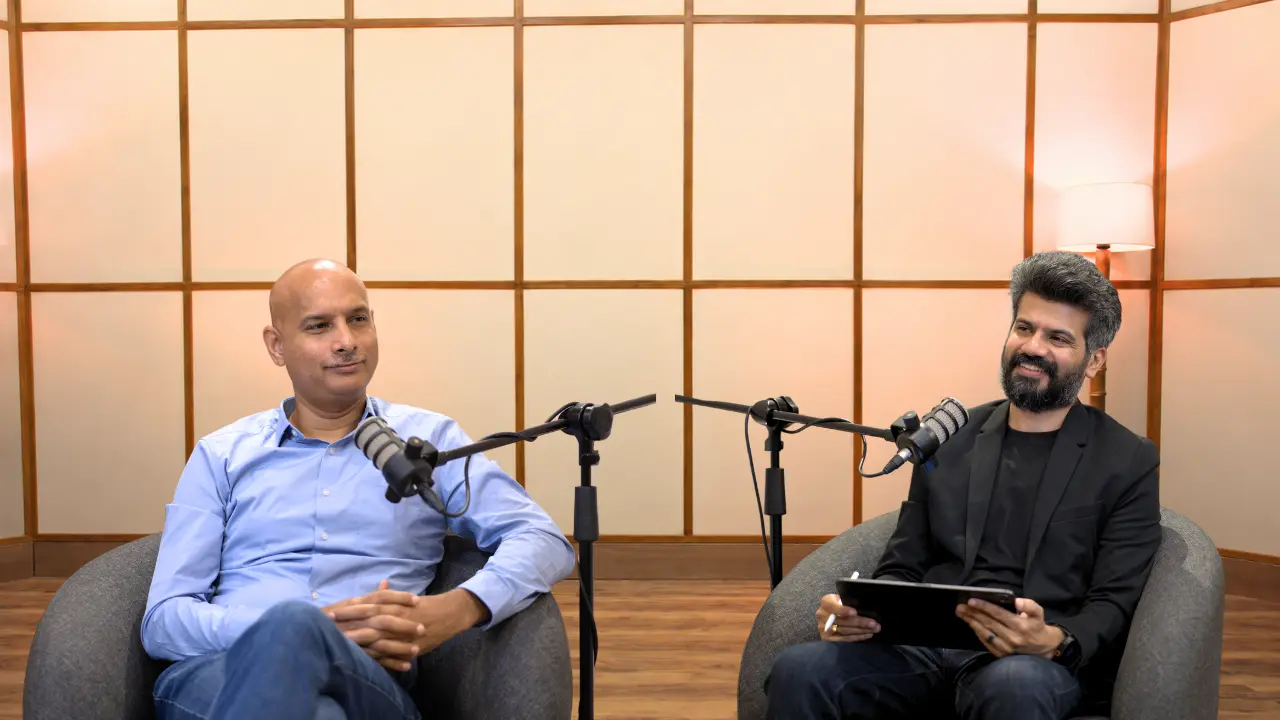

Sasidhar Thumuluri, a financial inclusion professional and former CEO of Sub-K, discusses how India can build on its progress in financial inclusion to help households move from access to credit towards long-term financial security. He explains how AI can improve borrower assessments and lending decisions, while arguing that technology alone cannot replace human judgement and trust in serving underserved communities. The conversation with Nikhil Chawla examines the limitations of credit-led microfinance, the role of savings and insurance in protecting families against financial shocks, and how digital infrastructure could help create a wider financial services ecosystem. Thumuluri also makes the case for measuring inclusion through wealth creation, rather than access to credit or consumption alone.
Nikhil Chawla: Welcome to another episode of One Big Podcast. I am Nikhil Chawla, and today we are diving into some of the conversations shaping our future.
Does a street vendor, a small shopkeeper or a woman running a business from home truly feel financially secure? And what about the people the financial system simply cannot see?
Today’s guest has spent over two decades working on these questions. Sasidhar, welcome to One Big Podcast.
Sasidhar Thumuluri: Thank you.
NC: Before we get into finance, when did you last pay in cash yourself? And when was the first time you saw somebody make a payment with their phone? How was that experience?
ST: Interestingly, the first time I saw somebody using a mobile phone to transfer value was in the Philippines, not India. It was at least 18 years ago, I think, in 2008. I used to visit many countries during those days, and people used to pay each other in talktime. That was the transfer of value. Some random person walked up to me and said, ‘Can you transfer ten pesos’ worth of talktime to me?’ He gave me ten pesos, and I transferred the talktime. That was how people used to carry out mobile money transactions in those days. Then, of course, things changed. India has moved on, and we have UPI and everything. But my first experience was outside India.
NC: Interesting. Today, a street vendor accepts UPI payments on a phone. Twenty-five years ago, a large part of India ran entirely on cash, and many families had no bank account or were dependent on moneylenders. How did India get from there to where we are today?
ST: I started at that level, going into villages and trying to source loans in rural areas. In Jharkhand, we experienced a literal exchange of goods, and we created loan products in kind, rather than cash. I am talking about the early days, when this whole business started. We used to give people seeds as a loan and collect the produce as repayment. Then we would sell the produce in the market, as traditional traders do in villages.
NC: Correct. The barter system.
ST: Those were the days when we started lending. Of course, that was not the case everywhere. In the southern states, it was still cash; in some of the eastern states, it was like that.
Even disbursements used to happen in cash, and collections, of course, used to happen in cash. It was a logistical nightmare. We were not only trying to address credit and payments; we also had to manage the movement of cash and deal with it. Banks used to close by two o’clock in the afternoon, so we used to keep a lot of cash in our offices. We found it difficult to manage the physical side of it. Today, 70–80% of the money gets buried in the village economy. We do not deal with too much cash, and the whole idea of money has changed. We are living in a very different world.
NC: That is true. UPI has changed how we pay, but that is not the same as saving or borrowing. What is the next big change you think India needs?
ST: UPI has definitely changed the way we think about money and transactions. The good thing about UPI is that it is starting to create evidence of transactions that were not there before. There is a trail. Every individual, whether they like it or not, is entering the digital payments ecosystem in some way.
The next big thing, in my opinion, is how we use this data. How do you convert it into something valuable for the same consumer?
You can see whether people can pay a small insurance premium, for example. You know their payment patterns now. Can you run a prediction model to see whether a person can pay a premium of ₹100 per month for an insurance product, or save ₹1,000 per month in a savings product?
There is much more innovation we can pursue now that the data is becoming visible. In my opinion, the next big thing is more comprehensive financial inclusion, beyond just payments or credit.
NC: I agree. During your Sub-K days, you observed that a trusted person from the village often mattered more than technology. First, you need to explain to people what Sub-K is. And do you think that human link still matters today?
ST: To give you some context about what Sub-K does, when we were running a non-banking financial company for microcredit, we faced many roadblocks that prevented us from doing anything other than providing loans. NBFCs in India are allowed only to provide loans. They cannot collect deposits. They can sell insurance, but they have to go through a different regulatory channel. There are a lot of complications. We asked, ‘How can we build a comprehensive financial services platform?’ Credit is a necessary but insufficient condition for livelihoods. Sometimes, too much credit is not good either.
Sub-K was born out of this thinking: could we plug into the banking ecosystem and create an assisted model on the ground to do what bank branches could not? Bank branches are not available everywhere, particularly in rural areas. If a bank branch cannot deliver, can we deliver microtransactions or microfinancial products to rural areas through an extended channel?
That came to be called the BC channel. Business correspondents are the agents on the ground. This was conceived well before the RBI released its first business correspondent guidelines. The thinking started much earlier, but there was no vehicle for it. As soon as the business correspondent regulations were released in 2006, we started experimenting with the idea of a comprehensive financial inclusion model through agent networks. That became Sub-K in 2010.
Sub-K establishes a fleet of feet on the street, either as fixed-point agents or mobile agents. They become the face of the bank for people who want a service. It could be a cash-in or cash-out service, or they might want to apply for a loan. This enables those services at, or near, a customer’s doorstep through an extended human chain that reaches the last mile. That is what we used to do. To your question about whether the human connection is still relevant: I would say it is relevant, but we are in a different environment today.
NC: Yes, it is digital.
ST: Yes. When we started, everything was done on paper, and everything was cash. Most of it is now digitised. Earlier, we did a lot of physical verification; now there is digital verification. But there are two reasons why we still need a human touch. Many people in rural areas are not necessarily equipped with digital devices, and digital literacy is quite limited. To make sure people are informed about the financial decisions they are taking before applying for a loan or buying an insurance policy, you still need somebody to help them.
Of course, you can have an AI avatar talking to a person on the ground, but we are some way from that today. We still feel that human contact and trust are critical to enabling fair inclusion. Otherwise, people can be misled.
NC: Talking about inclusion, having a bank account is one thing, but feeling financially safe is another. What does it truly take for an ordinary family to feel included today?
ST: Inclusion starts with access. That is something we have largely solved, and it is a huge achievement for India. Today, almost 90% of adults have a bank account, and about 70% of them use those accounts. Of course, there is still some dormancy. So access is a part of inclusion, and that is something we have been able to address. But if you borrow beyond your means and do not pay it back, you are excluded because you will not get another loan.
NC: Why is the old microfinance model struggling nowadays?
ST: This is a good question in terms of how narrowly we see inclusion. Microfinance, even before what you see today, started with the intention of having people, mostly in rural and low-income communities, start helping each other save some money and then lend to each other. So self-help groups were formed a long time ago in India, in the 1990s, and even before that many NGOs tried this, and then the government took it on and rolled out a large self-help group programme across the country. That was the origin of the early days of microfinance, when we did not even know the term.
It moved to the self-help group model, which is a more formalised way of saving and lending within communities, and then to a credit-centric model. The shift from a savings-led model to a credit-centric one happened partly out of compulsion and partly because of commercial needs. In the original self-help group model, a lender had to wait for a year and see how well people saved. The idea was to understand their savings habits before lending to them, so that we could assess whether they would continue to pay. That was the premise. But as a lender, if I had to wait for a full year, my commercial model would take a hit. I might even have to charge more to cover the cost of that year’s wait.
So the microfinance world then moved to a model where it said, ‘Let us use the community as social collateral, but we do not need to wait that long. We can use the mutual trust that is being created or that already exists within communities, and start giving small loans to see how people behave. When they start paying back, we can slowly increase the loan size.’
Today, microfinance is a much bigger version of that small, group-based lending model, which borrowed the idea of group-based savings. But over the past 25 years or so, the model has only multiplied credit. Savings have taken a back seat.
The challenge we face today, and the reason there is so much news about microfinance, is that people are being encouraged to borrow. Money is available, and there is access, but there has not been an effort to help these communities become more resilient with their money.
If I have four MFIs coming to lend to me, I know I can borrow easily. We have created a very easy channel. That is a huge contribution by the sector. Today, if a rural woman wants a loan, she really does not have to do a lot of hard work. She can make a phone call, and somebody will appear in front of her house. That is the contribution, and it is amazing.
NC: Absolutely. You talked in depth about self-help groups and communities. Can AI and data today help a lender trust someone who has no payslip, no property papers and no credit history? Do you think that works?
ST: It should, to a large extent, but not 100%. We still need the communities we work with to provide more data, because we are only beginning to see some of it. Your question is whether, if the human layer is replaced with AI, it can act like a human in terms of trust. To some extent, and for some customers, it can.
Microfinance as a model has always treated all customers as one block and has painted them all with the same brush. Everybody gets the same kind of loan and the same kind of treatment. Everything is more or less similar. There is no real distinction between one customer and another because it is a simplified lending model.
Today, with AI and data, you can do that segmentation. You can take some customers out of that standardised treatment and use the data they provide. Some are very digitally included; others are not. For those who are more digitally included, you can apply AI tools and data analytics to understand the customer better than a human would. I would say it can even do a better job than a human.
We have tried some interesting models. If you send a person, they bring not only their abilities but also their biases, and there is friction. It is hard work. People have to travel a long way and do a lot of work on the ground. Sometimes it is tiring. By the time I have seen four customers, I may be too tired to do a thorough job with the fifth. At the end of the day, we are relying on that person’s judgement. So it is not humanly possible to do all the work with the same consistency and to the same standard. People bring their emotions, gut feelings and biases. If you rely on that a lot, trust can sometimes be broken because the person is unable to do all the work they are supposed to do very well.
AI, on the other hand, can do a much better job than a human if we train the models very effectively. A thousand people do not work in the same way, but AI can perform the same task consistently across a thousand people. In my opinion, you have to curate the technology available today and apply it to the right customers. It can do wonders and enhance human capability. I would not say it will replace a human, but it will certainly help that tired person do a better job because AI is now doing 50% of their work.
I still believe AI has a lot of potential. It is at a very early stage, and we should explore where it can add value and bring costs down. Microfinance is very expensive. The loans are very, very expensive for people who really cannot afford them. How can you reduce those costs? In microfinance, or financial inclusion more broadly, human resources are the biggest cost.
NC: Yes.
ST: If you can rationalise that, perhaps you can pass on those benefits as well.
NC: You mentioned that an AI system can do a better job than humans in most cases. If a machine decides who gets a loan, what could actually go wrong?
ST: We have to be careful about making something fully digitally driven. For example, I apply for a loan at a bank and get a reply saying that I am not eligible. Interestingly, one bank told me that my company’s name did not appear on its approved list, so the system did not let me proceed. I said, ‘That is not evaluating me.’
NC: I was once rejected because I did not have a landline number. They said, ‘We need one.’ I said, ‘That is very archaic because we are in 2024.’
ST: Correct. Some fields have to be filled in. That is the risk of running fully end-to-end digital decision-making tools.
What is important is that AI or data does not necessarily make the decision, but it gives you enough information to decide.
There may be many ‘green-channel’ cases: the customer is great, all the data is good, and your engine tells you that the customer is more or less risk-free. For those customers, I think the machine can make the decision.
But if the machine says, ‘This is not a great customer for me,’ you should not blindly reject that customer. Take that case and manage the exception. A human should come into the picture and see why that particular customer was rejected.
NC: Human intervention.
ST: Unless there are clear reasons for rejection. There are always KYC rejections, for example. If someone does not pass those checks, a human cannot approve them because it is not allowed. There are some non-negotiables and basic requirements that a machine can assess. There are some easy cases where the machine can decide. But there is always a middle ground where it cannot necessarily decide very well. If you bring in a human there and allow them to make the decision, you get the best of both.
NC: That makes a lot of sense.
ST: Talking about applications of AI in financial inclusion, one area where it is already being used is collections. In any lending business, collections are the most expensive part. Either you lose money because people do not pay in full, which is a risk and a cost, or you have to employ people to collect the money.
One interesting use case already being applied extensively is creating calling agents. When a customer’s payment is due, they receive a reminder call. If they miss the payment, they immediately receive a missed-payment call. It is not just a call. The AI agent also negotiates with you. It sets a new date or sets up a payment channel for you. You can still figure out whether it is an AI agent or a human if you know what to look for, but for the general public it can be an effective tool to remind people and work with them to streamline payments.
Lending organisations have many call centres set up solely to follow up with customers. Even in microfinance, people use call centres, and that is a huge cost.
Now, if a thousand customers miss a payment today, my AI agent is triggered, the conversations start, and everything is recorded. I know exactly what happened and when the money is going to come, because a promise to pay has been set up. This is a practical use of AI that is already happening, and I think it helps a lot with collections.
Another area where AI helps is underwriting: bringing together data from multiple channels, not only past payment history and credit bureau records, but also transactions on UPI, for example. There is an account aggregator framework in India today through which you can access data from all the banks you work with. You can create a financial profile of the customer. AI and machine learning have a big role to play in determining that profile, as long as there is data. Even if the data available isn’t much, you can create personas through AI models. Lenders can therefore rely more on data than they used to.
Another opportunity is that you already have customers in your database. You may have been lending to them for a long time without creating new products for them. Now product development has become easier with AI. AI can tell you how many customers in your database have children going to college, which may indicate an opportunity for an education loan. That was very difficult to work out manually. Of course, you could do a lot of data analytics, but it was an expensive exercise. With AI, analytics has become much more democratised.
It is easier to identify households where a daughter may be getting married, or children are going to school or college. There can also be proxies. If a marriage has recently taken place in a family, a new room might be built in the same house, or they might get a new car or another vehicle. So you know an asset may be created in some way. Can I create a financial product that enables that to happen? Is there an opportunity to lend more or create a new product? There are many opportunities for product development and improving efficiency.
One interesting experiment we conducted is no longer an experiment; it has now been run at sufficient scale. As we were discussing, somebody has to visit the house and carry out an assessment on the ground. Typically, in unsecured lending or informal-sector lending, you send somebody out to check everything: whether the customer is fine, their house, their living conditions and their business conditions. You have to see these things. Then you create a credit memo on which decisions are based. Credit memos are converted into objective scores. At present, this is all done by humans. As I said earlier, human biases sometimes play a role, and you do not know whether you are doing a good job.
We trained an AI platform with about half a million video recordings of these appraisals on the ground. We asked our field staff to record what they were doing, both audio and video, and then applied AI to it. We trained the tool to tell us what was happening in the conversation and what it could see. We use various parameters to underwrite a loan: the living conditions, whether there are assets in the house, the condition of the house, the business, whether there is stock, and whether customers are coming and going. Many things matter when you make that decision. Even the tone and sentiment of the conversation matter. How is the customer responding to you? That also matters in terms of how they will respond after taking the loan. We trained the AI platform to understand both the audio and the video. Of course, all this is done with consent.
NC: Half a million? How much time did that take?
ST: In microfinance, we do give out a lot of loans.
NC: I understand.
ST: We did this for about three to four years. When we started recording, we did not have AI in mind. We wanted to do it for audit and training purposes. We wanted to make sure our people on the ground were not taking shortcuts. As I said, a tired loan officer can take a shortcut. It is not intentional; I do not doubt their intention. But not everybody has the same energy.
NC: How were these recordings made? Were they wearing something on their heads, or were they just using phones?
ST: They were using phones. We also conducted remote interviews with some customers. We did not do everything on the ground because some customers were repeat customers, so we could talk to them on the phone. We created those interaction channels. Customers would join something like a Zoom call through an internal platform we had created. We would ask, ‘Can you show me your business?’ She would show us her sewing machine or the buffaloes in her backyard, as well as her house. We would ask, ‘We would like to see your house. Would you mind showing us?’
You could see whether there was a television, a refrigerator or a fully stocked kitchen. All these things matter in understanding someone’s capability or ability to pay. For the business, is the buffalo in her own backyard, or is she showing somebody else’s buffalo?
All these things matter in microfinance and informal lending. Sometimes, you do not know whether a sewing machine is even working. There is a sewing machine in everybody’s house, by the way. Everybody says, ‘I want a loan for tailoring,’ but that does not mean there is a working sewing machine.
A video recording can show you that she can use the machine and that it works. So much evidence is created. What do you do with it? That was why we started recording.
Later, when generative AI and LLMs came along, we started feeding these videos into LLMs and asking, ‘What can you see?’ They gave us all the information. But we could not just do something generic, so we started training the AI. We told it what to look for and how to create a complete credit memo without anybody having to type or write anything.
Now, the loan officer’s job is to go, observe and talk. No decisions are made there, and they are not required to make judgements. They are only supposed to have a conversation, which is the social part that humans are generally good at. We said, ‘Go and talk to the customer, take their permission and see whether you can record the conversation. As soon as you finish, stop the recording.’ Within a minute, you get a complete credit memo.
A human cannot necessarily match that ability because they will miss something. When you are watching something, you can be distracted. You have two eyes; AI has a thousand. You can train it to have a thousand eyes.
We used data from a thousand loan officers conducting different appraisals to create a standard model. That means you are bringing a thousand people’s experiences into one model, which is impossible for a single human to do. In that sense, it completely changes how you underwrite informal credit.
AI enables you to capture data that was never there before. You did not have verified data about whether a person had three consumer durables in their house. That makes a big difference in determining whether the customer is stable or potentially a migrant. I would never have been able to verify that data. My field officer might write something on an application, but how do you know whether what they have filled in is correct? Now, I do not need them to fill it in, nor do I need to verify it, because it is already evidenced.
NC: True.
ST: That becomes a permanent data point in the customer’s profile. You can use it for more than a microfinance loan. Now I know the customer’s profile. This customer may not need a microfinance loan; they need a new kitchen. Can we provide a small home-improvement loan? It informs you about so many things. That is the power we are bringing to the table today. These are still early days, as I said. There may be mistakes, hallucinations and so on. You have to train the tool carefully to avoid those.
NC: Some amount of human intervention.
ST: Of course. As I said, there is the green channel and a red channel. The grey or amber channel is where a decision obviously needs to be made.
NC: A balanced approach.
ST: There has to be a balance. I am giving you a few use cases we can think of today. Tomorrow may look very different.
NC: Every day is a new day. If we want secure households and stronger small businesses by 2047, what should we build now?
ST: This is important because, at present, when people say ‘financial inclusion’, they talk about two things: payments and credit. But we have missed a big opportunity in the process.
As I said, we started the inclusion exercise by giving people access to banking and loans. We overdid that. Many people started defaulting, and then we started excluding them.
I am talking about microfinance because that is what I am more familiar with, although it is not the only form of financial inclusion. We have excluded at least five million borrowers in the past year.
NC: Five million?
ST: Five million. We have pushed them out of the system because they did not repay last year. They will not get a loan for the next seven years because of the credit bureaus.
NC: They are blacklisted.
ST: Yes, in a way. What happened in this process? Why did the customer not pay? One reason is that they may have borrowed beyond their means. But what does ‘beyond their means’ mean? It means they do not have savings set aside as a backstop. They do not have insurance. If there is a health emergency in the household, all the money is diverted there, and the first thing they do is default on the loan.
They have no protection against natural calamities or anything else outside their control. Everything is managed with the same income from the enterprise they run. It may be a business, or it may be work they do somewhere. When a sudden shock happens, there is nothing to fall back on. You reduce your obligations and divert that money, and that is when loans are defaulted on.
Going forward, this is a lesson that all lenders in the unsecured space, where everybody is suffering, should learn. How do you create resilience for these customers so that you do not get into trouble yourself and, at the same time, the customer becomes more included?
These customers have proved beyond doubt that they can pay a certain amount every week, month or fortnight. They have built that ability and discipline. How can you channel it into small savings programmes, small SIPs or small insurance premiums to protect themselves?
We created microcredit, which is a small loan, and micropayments, such as weekly payments. That is how the business became successful: people did not have to bring a lot of money each week. It started with ₹100 a week, and then the amounts increased. People could pay because it was broken down into small payments.
Can you use that philosophy or model to encourage people to set money aside? If someone is making a loan repayment of ₹1,000, can you encourage them to put ₹100 into a savings account? Can you ask them to buy a small insurance plan for ₹200?
At present, insurance is bought for the loan. The loan is always given with insurance so that, if something happens in the family, the loan is covered. Nothing else. The family gets nothing. The only benefit is that they do not die with the obligation. Can you add a little to it? Can you provide something in addition to credit insurance? If you are using technology and reducing costs, can you provide another product from those cost savings so that the customer does not have to pay extra? You would charge the same price for the product but give them additional cover. If something happens tomorrow, the first thing protected will be your loan anyway.
Today, unless a death occurs, the loan is not covered, because it is insured against a death in the family. With cover for health or climate shocks, you create an opportunity for the family to avoid going backwards in income or wealth. At the same time, as a lender, you protect your own financial flows.
In the next 15–20 years, it is very important that we create these models and move from income generation to wealth creation.
NC: Yes.
ST: That is the journey for all of us. With data and technology, it is much more achievable now than before. All the neobank models we hear about can be applied to these communities. There may be initial costs to cover, such as technology costs. From a policy perspective, how can we create shared platforms? India Stack has allowed payments to become more accessible. Now there is work on the Unified Lending Interface, or ULI, which is described as something similar to UPI for credit.
Can we start creating digital public infrastructure that enables products beyond credit? Credit is very important, and much still needs to be done there. But if you add savings, insurance and perhaps pensions, there can be long-term wealth creation. People would not have to sell their land if somebody fell ill. They could draw on their investments or savings to cover the loss, or claim on their insurance. Their income would remain stable, and growth would be visible. We need to build that whole ecosystem by 2047.
If I were to talk about one metric, today the bottom 50% of India’s population owns 6–7% of the wealth, while the top 1% owns 40%. That is the real inequality we are talking about. It has worsened over the past 40 years. While inclusion has happened, data from the 1960s to the 1980s shows that the bottom 50% owned about 11–12% of the wealth. Over the past 40 years, that has come down to 6–7%. This is consistent. The top is growing. The top 1% have tripled their wealth over the past 40 years. When I say the bottom 50%, I am talking about 700–800 million people in this country. That is not a small number; it is the size of a continent. Their share of wealth is only 6–7%.
NC: The disparity is huge.
ST: Yes. That is because they have nothing to cover them against shocks. Most of these expenses come in large amounts. It could be a health problem, a flood or another natural calamity. It takes them back by a few years.
If, by 2047, we can at least return to the 1960s level and restore that community’s share to 12%, I think we will have achieved a lot. It is about reversing the trend. I am not asking for a new metric; at least let us return to the old one. That is achievable today by creating the right products and channels, given how much digital capability and AI are now available.
NC: I agree. That brings me to the last question I ask every guest: what is your one big dream for India?
ST: It is the big dream I mentioned: for the bottom 50% to regain their wealth, or at least their share of it. We are not talking about revolutions. We are talking about creating the right opportunities and thinking beyond the one product that is always enticing: credit. There is much more that can be done.
To sum up what we have discussed, it is about creating a financial opportunity marketplace for these communities and putting AI on top of it. When somebody logs into my app, my app can educate them and direct them to the right place. It could say, ‘You are applying for a loan, but it looks as though you actually need insurance.’ AI can identify this and say, ‘A loan is expensive for you. Insurance is cheaper. You pay ₹500 and are covered for ₹5 lakh, rather than borrowing ₹5 lakh and paying 24% interest.’ If AI can do that on the customer’s phone, I think the dream will be fulfilled. The customer would say, ‘Yes, why should I pay 24% interest on a ₹5 lakh loan? Why can I not pay a ₹500 premium and cover what I am trying to cover?’ These are the things we should start building. In my opinion, the distribution of wealth is more important than the distribution of income.
Today, we have a problem with how we measure inequality. It is usually measured using the Gini coefficient. In India, we measure it through the share of consumption, rather than the share of income or wealth. The consumption gap is usually lower because rich people do not consume as much in proportion to what they have. It may look as though they consume a lot, but they save much more and create wealth. They create physical or financial assets. People in the lower bracket of the population have financial assets. They have land and properties that are not necessarily very valuable. Financial assets are only 2% for that community. In the higher-income bracket, financial assets are much greater, and people can liquidate them when needed. My point is that we need to help policymakers and practitioners understand the income gap and, more importantly, the wealth gap. That is the gap we should narrow, rather than the consumption gap.
The consumption gap is narrowing. People are consuming because they have access to credit, so they are buying things. The question is whether they are buying for the right need. Are we creating assets, whether financial or physical?
My big dream is that everybody should create wealth. There is one model I keep talking about, which I call EPIC.
E is for earn. You help people earn money through small loans or, if they are very poor, subsidies and similar support.
P is for protect. Have the right insurance schemes. The government has done great work with public insurance programmes, particularly Jeevan Jyoti and Jeevan Suraksha. These are very good programmes, but they are at a very early stage.
I is for invest. People should invest in the right products, either saving money or making small investments.
C is for compound. Those investments should compound to create long-term wealth.
We have to create an epic story by 2047. This EPIC model, in my opinion, is something we should really think about from policy to practice.
NC: Very well said. Thank you so much for your time today. It was a pleasure talking to you.
ST: Thank you. I am really honoured to be here.
NC: Likewise. Thank you.
ST: Thank you.