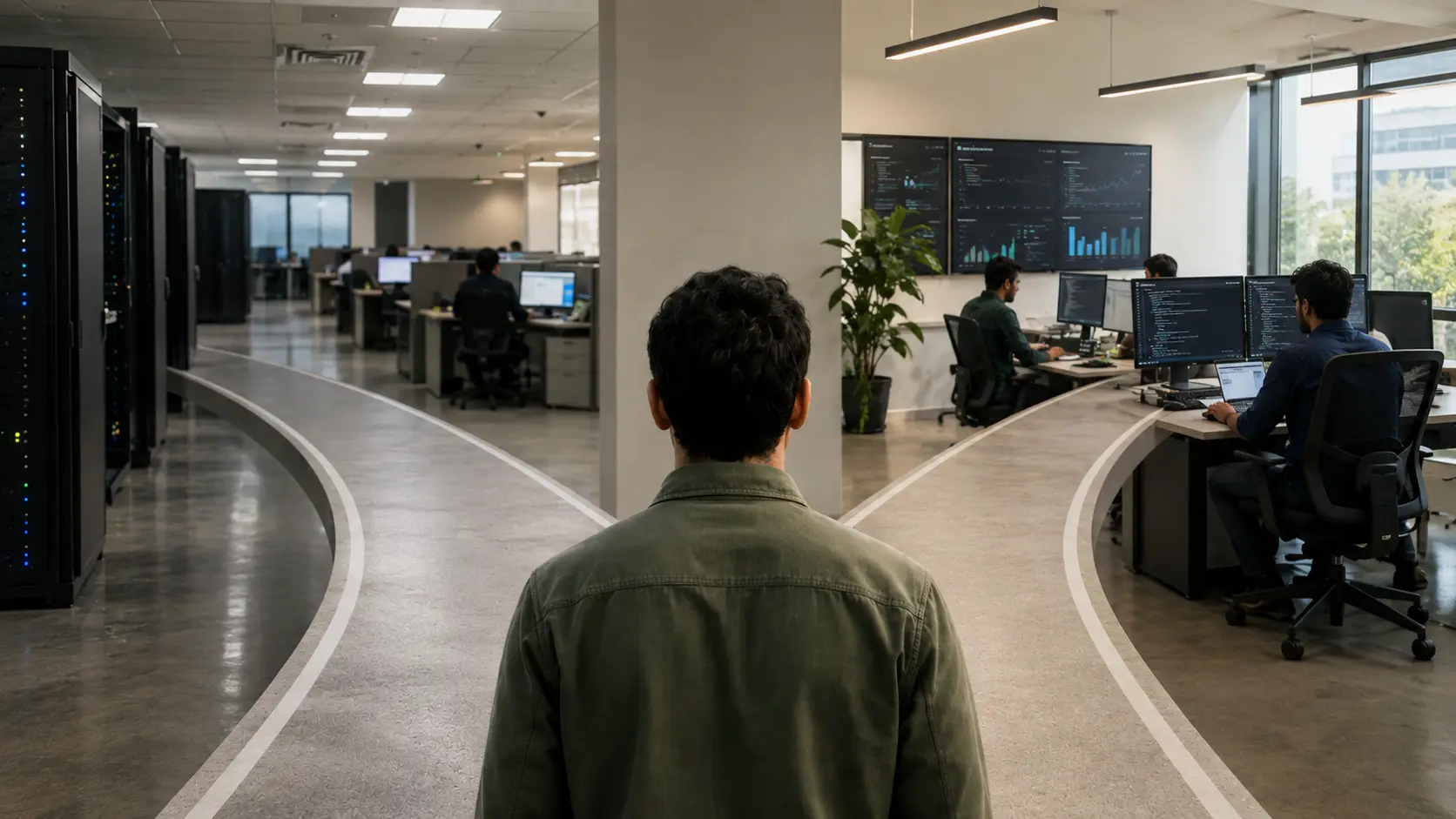

As AI adoption moves from experimentation to deployment across global businesses, India’s technology employment market is beginning to split into two tracks. AI-related hiring increased 16% year-on-year in June 2026, even as overall IT recruitment declined 3%, as employers became more selective about the skills they were hiring for. The divergence suggests that demand is not disappearing from the sector but shifting towards AI, cloud, cybersecurity, data, and transformation capabilities. The real test now is whether India’s workforce can adapt as quickly as hiring demand is changing.
What Is Changing?
As reported by Reuters, AI-related hiring in India’s IT sector increased 16% year-on-year in June 2026, while overall IT hiring fell 3%, according to Naukri’s JobSpeak data. The figures offer one of the clearest signs yet that technology hiring is no longer moving as a single market.
A similar pattern is emerging across India’s global capability centres, or GCCs, which have become a major source of high-value technology employment in India. Because GCCs often reflect where multinational companies are directing technology investment, their hiring patterns can provide an early indication of changing skill demand. Reuters reported in May 2026 that these centres were continuing to hire, but becoming more selective, with demand increasingly concentrated in AI, cybersecurity and other specialised technical capabilities.
Why Does It Matter?
In June, Tata Sons Chairman N. Chandrasekaran observed that “some of the work being done will go to AI agents”, describing it as the nature of the transition taking place “as a company, as an industry, and as a country”. As AI takes over parts of routine workflows, companies increasingly need people who can deploy and integrate these systems into business operations.
PwC’s 2026 AI Jobs Barometer analysed nearly a billion job advertisements across six continents and found that skills requirements are changing 66% faster in occupations most exposed to AI than they were just a year ago. The report also found that workers in AI-exposed occupations are seeing stronger wage growth than those in less-exposed roles, even as employers increasingly prioritise AI-related capabilities across sectors.
The trend is no longer confined to technology. PwC found accelerating change in industries ranging from financial services and professional services to manufacturing, healthcare, and education. AI is not creating a separate labour market for specialists alone. It is changing the skills employers value within existing occupations.
What Happens Next?
Puneet Chandok, President of Microsoft India and South Asia, told Reuters that “the colour for every job and role will change”, arguing that finding talent with the right AI skills is becoming a growing challenge.
Companies are looking for workers who can combine technical expertise with domain knowledge, business understanding, and the ability to work alongside AI systems. As firms continue investing in AI adoption, demand may increasingly favour workers involved in deployment, transformation, data infrastructure, cybersecurity, and AI-enabled operations. More jobs may come to involve AI, but fewer may resemble the conventional delivery, maintenance, support and implementation roles that powered earlier phases of India’s IT growth.
What Should India Do?
Deena Dayalan, Global Head of Digital Operations and Cloud Transformation at Kimberly-Clark, told Reuters that “the zero-to-two-years experience… will go away is my assumption in the next few years.”
India’s IT sector has historically developed talent through large cohorts of junior workers who gained experience through coding, testing, support, maintenance, and process-oriented work before moving into more specialised positions. If some of those tasks become increasingly automated, companies, universities, and training institutions may need to rethink how workers acquire practical experience and progress into higher-value roles.
The challenge is not simply preparing people for new roles. It is ensuring that workers can still build careers in an industry whose entry points are beginning to change.