
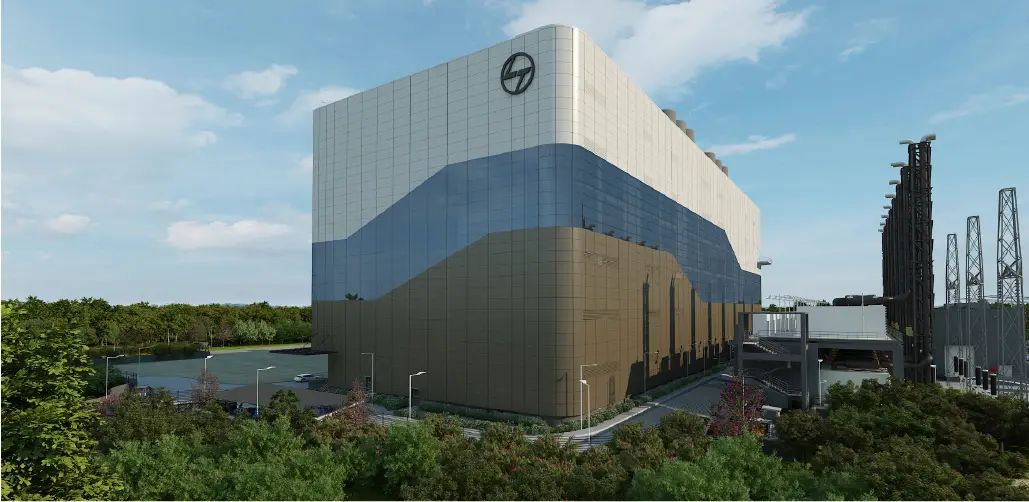

Larsen & Toubro (L&T) has secured a contract from US-based AI company Together AI, to build a computing facility in Chennai equipped with 10,000 NVIDIA B300 GPUs which are specialised processors used to train and run advanced AI systems. The facility will be built at L&T’s Vyoma.AI data centre campus, with the first phase designed for 250 MW capacity.
The scale of the project points to a broader shift in how AI is built and deployed. As AI systems become more computationally intensive, companies will need greater capacity to house, power and operate the hardware behind them. L&T’s move shows how AI is creating a new infrastructure requirement alongside the software and models that have traditionally defined the technology.
What Is Changing?
According to the L&T report, its AI infrastructure subsidiary LTN Compute has secured an order to deploy a 10,000-GPU NVIDIA B300 AI infrastructure for Together AI at the Vyoma.AI data-centre campus in Chennai. The facility will provide the computing power needed to train and run AI systems, while L&T plans to expand its AI infrastructure business across India.
The Chennai campus is designed for a far greater scale than the initial GPU deployment. Phase I is designed for 250 MW, with the broader campus eventually intended to support significantly greater capacity. The project involves building the power, cooling, networking and data-centre infrastructure needed to run thousands of GPUs at scale, rather than simply installing more computing hardware.
Why Does It Matter?
As AI models become more capable, the computing infrastructure required to train and run them is becoming increasingly important. That computing capacity has to be housed, powered, cooled and connected, making the infrastructure behind AI a strategic capability in its own right.
The Ken’s reporting on E2E also highlights that the infrastructure opportunity extends beyond the physical hardware itself. The value of a GPU cloud depends on the software and orchestration layer that sits above the chips, alongside capabilities such as security, networking and reliable access to computing capacity.
L&T’s entry is significant because it brings an engineering and infrastructure conglomerate into a market that has traditionally been associated with technology companies, cloud providers and specialised data-centre operators and AI companies through sovereign cloud and GPU-as-a-Service.
For India, this broadens the AI opportunity beyond developing applications and models. The country could also build capabilities in the physical infrastructure that allows those technologies to operate at scale.
What Happens Next?
L&T’s Chennai deployment could mark the beginning of a larger domestic AI infrastructure market. LTN Compute plans to develop AI-ready data centres across India and provide large-scale computing capacity to organisations that may not have the resources to build their own GPU infrastructure.
The indicators to watch will therefore extend beyond the number of GPUs installed. As reported by The Ken, the economics of GPU infrastructure will also depend on utilisation. E2E Networks, for instance, has been operating its GPU fleet at around 35–40% capacity, below its 80% target, while newer GPUs continue to require fresh investment. This highlights a central challenge for AI infrastructure operators: expensive computing capacity must be kept sufficiently utilised even as rapid advances in hardware shorten the economic life of existing chips.
As AI adoption grows, demand for reliable power, high-density data centres, cooling systems, networking and specialised engineering will also increase. The ability of Indian companies to build and operate this infrastructure repeatedly and economically will determine whether AI factories develop into a durable industrial segment rather than remaining a small number of large technology projects.
What Should India Do?
India should treat AI infrastructure as part of its broader industrial and technological capability. Building an AI economy will require more than access to models and skilled workers; it will also require reliable computing, power, data-centre capacity and the engineering capabilities needed to operate them.
The opportunity is to connect India’s existing strengths in engineering and infrastructure with the emerging requirements of the AI economy. This means developing the domestic ecosystem around compute, energy, data centres, networking and specialised technical talent rather than treating each as a separate investment. If AI increasingly resembles an infrastructure industry, India’s ability to build that infrastructure at scale could become an important determinant of its long-term competitiveness in AI.
***
Source note:
This article is based on L&T’s 13 August 2026 announcement on its partnership with Together AI to build a 10,000-GPU NVIDIA B300 AI computing facility at the Vyoma.AI data-centre campus in Chennai. Additional context on the economics and operational challenges of large-scale GPU infrastructure was drawn from The Ken’s reporting on L&T and E2E Networks.
Editorial Disclosure:
AI-assisted tools were used to help summarise and organise information from the source reports and to support language and copy-editing.