


India’s defence story is entering a new phase. The latest signal is the Defence Acquisition Council’s approval on 7 September 2026 of in-principle capital acquisition proposals worth about ₹1.10 lakh crore, with approximately 98% of procurement planned from Indian industry. The package covers CBRN reconnaissance vehicles, high-mobility vehicles, helicopters, mine-laying systems, bridging equipment, and other requirements across the armed forces.
The significance is not just the order’s size. It is the emergence of defence procurement as a mechanism for creating industrial capability. When the largest and most sophisticated customer in the country, the Indian armed forces, deliberately creates demand for domestic products, it influences where companies invest, which technologies develop, which suppliers emerge, and where skilled talent is built.
That makes the defence sector increasingly relevant not only to national security, but to India’s Future Factory, deep-tech and manufacturing strategy.
What Is Changing?
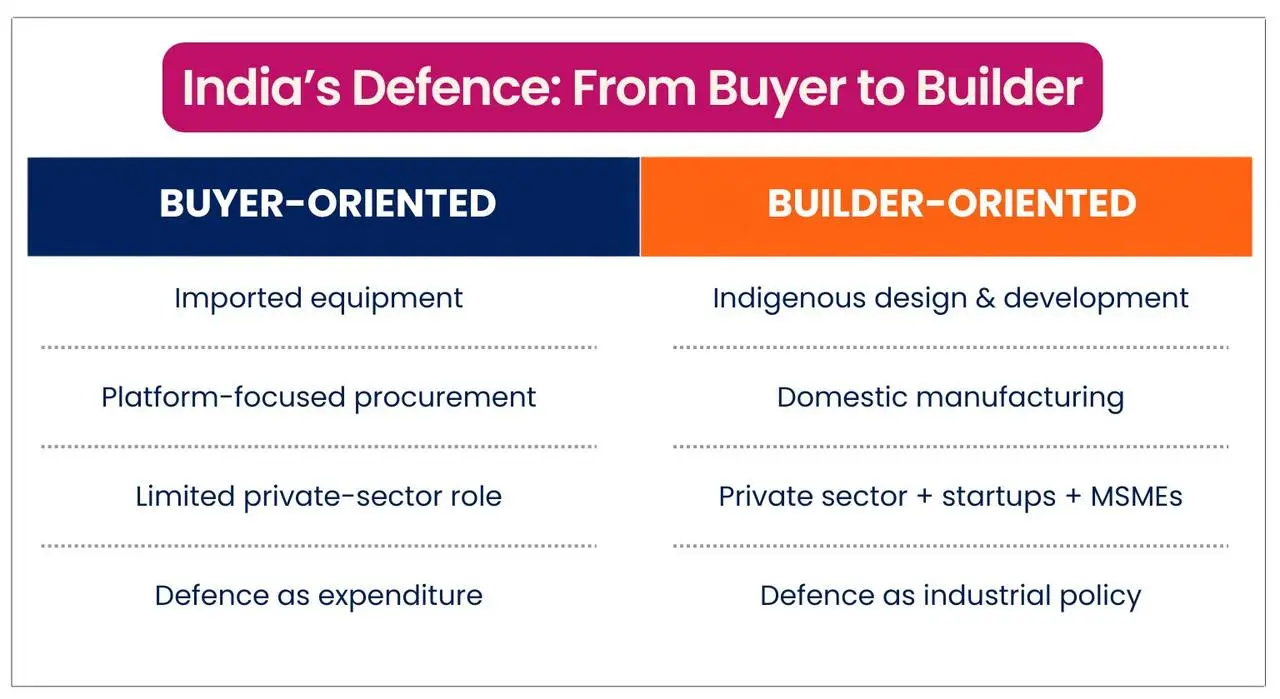
India is moving from a predominantly buyer-oriented defence model towards a builder-oriented model.
The evidence is substantial. India’s defence production reached a record ₹1.78 lakh crore in FY2025–26, up 15.6% from ₹1.54 lakh crore the previous year and more than double the FY2020–21 level. Defence exports reached ₹38,424 crore compared with ₹686 crore in FY2013–14. Indian defence products are now exported to more than 80 countries.
The private sector is also becoming more significant. It accounted for approximately 24% of defence production in FY2025–26, or around ₹42,000 crore, its highest share so far. In exports, private companies contributed 45.16% of the FY2025–26 total.
The procurement architecture is changing alongside production. The draft Defence Acquisition Procedure 2026 proposes stronger support for indigenous design and development and raises the indigenous-content requirement to 60% in the Buy (Indian-IDDM) category, up from 50% under the earlier framework.
This is important because the policy objective is gradually shifting from:
“Buy Indian equipment”
to:
“Design, develop and manufacture more of the underlying technology in India.”
The innovation ecosystem is expanding. By March 2026, iDEX had engaged 676 startups, MSMEs, and innovators and generated 551 design-and-development contracts.
The implication is that the defence ecosystem is becoming broader:
Armed Forces → DPSUs → private primes → MSMEs → startups → universities → R&D institutions.
This is a fundamentally different industrial architecture.
Why Does It Matter?
Defence is one of the few sectors where government demand can create an industrial market for technologies that may initially be too risky or immature for the civilian market.
Consider the technologies increasingly relevant to modern warfare:
AI, drones, robotics, electronic warfare, sensors, secure communications, semiconductors, advanced materials, autonomous systems, cyber technologies and space systems.
Many of these technologies have dual-use potential.
A defence requirement can create the first market for an Indian company. Once the technology is proven, the company can move into civilian applications and international markets.
This creates an industrial multiplier:
Defence requirement → R&D → prototype → procurement → manufacturing → supply chain → exports → civilian applications
That is why defence procurement can become much more than a budgetary expenditure.
It can become demand-side industrial policy.
The scale of India’s current procurement pipeline makes this significant. Government data shows defence contracts worth around ₹1.82 lakh crore were concluded in FY2025–26, while the broader production ecosystem targets ₹3 lakh crore of annual defence production and ₹50,000 crore of exports by 2029.
But there is a deeper issue.
India must distinguish between localisation and capability.
If India manufactures the final platform but imports its engine, sensor, semiconductor, communication system, or critical material, it has localised production without fully localising technology.
The real industrial prize is therefore not:
Made in India.
It is:
Designed in India → Engineered in India → Manufactured in India → Improved in India → Exported from India.
That is the difference between assembly capability and industrial power.
Who Will Be Affected?
Large defence companies
Large public and private companies will remain the prime integrators but will increasingly need deeper domestic supply chains. Their competitive advantage will depend not only on platforms but also on their ability to manage thousands of technology and manufacturing partners.
MSMEs
This could be a major opportunity for Indian MSMEs.
The Ministry of Defence says the Srijan/DEEP ecosystem has over 41,000 vendors and 2.7 lakh products listed, while technology-transfer mechanisms are opening DRDO technologies and intellectual property to industry.
The opportunity is particularly strong in:
precision engineering + electronics + sensors + components + machining + composites + software + testing + maintenance.
Startups
Startups are entering areas traditionally dominated by large defence firms.
The government reports iDEX participation across drones, AI, quantum technology, cybersecurity, robotics and advanced technologies, with 58 prototypes already receiving procurement clearance worth approximately ₹3,853 crore as of early 2026.
The challenge for startups, however, is moving from:
challenge → prototype
to:
prototype → production → repeat order → export.
That conversion will determine if India’s defence-startup ecosystem becomes economically significant.
Universities and research institutions
Opening defence R&D funding to industry, startups, and academia creates a larger market for applied research.
Government data says 25% of the defence R&D budget has been opened to industry, startups and academia since 2022–23.
This could change the traditional relationship between Indian research and industry from:
research → publication
towards:
research → prototype → military application → commercialisation.
States
Defence industrial corridors in Uttar Pradesh and Tamil Nadu are important experiments in regional industrial clustering.
The government says about ₹70,000 crore of investment has been proposed across the two corridors, with around ₹10,000 crore already invested as of July 2026.
Their success will depend on actual factories, suppliers, technology, and exports, not just investment commitments next.
The next phase will focus on conversion.
India has created a substantial policy pipeline:
indigenisation lists → domestic procurement preference → iDEX → DAP reforms → defence corridors → R&D funding → technology transfer.
The question now is whether these mechanisms can produce globally competitive companies.
Three developments will be particularly important.
First: procurement must become faster.
A startup cannot survive a decade-long procurement cycle. If technology changes faster than procurement, the armed forces may receive outdated innovation. The procurement system must buy capability, not just predefined equipment.
Second: component-level localisation will become critical.
India cannot achieve strategic autonomy by assembling imported subsystems battlefield is likely to be:
chips + sensors + engines + propulsion + communications + electronic warfare + batteries + advanced materials.
Third: exports will become the real test.
Domestic procurement can create an initial market. International customers test whether Indian products are competitive. India’s defence exports growing to ₹38,424 crore is encouraging, but the next goal should be to move from exporting individual systems and components to building globally recognised defence technology companies and platforms.
What Should India Do?
India should move from an indigenisation mindset to a capability-building mindset.
First, measure value addition, not just procurement value.
Every major defence programme should be assessed for:
domestic content + domestic IP + domestic suppliers + technology creation + export potential.
Second, make the armed forces an innovation customer.
The military should be an active partner in developing prototypes, testing technologies, and providing rapid feedback. This is especially important for AI, drones, robotics, and electronic warfare, where technology cycles are very short.
Third, build component ecosystems.
India should develop domestic capabilities in bottlenecks that can undermine an otherwise indigenous platform:
semiconductors, sensors, propulsion, power electronics, advanced materials, optics and precision machinery.
Fourth, connect defence corridors to broader industrial clusters.
A defence corridor should not be just a collection of defence factories.
It should connect to:
universities + engineering companies + MSMEs + testing facilities + logistics + finance + civilian industries.
Fifth, create an export-first mindset. Question should increasingly be:
Can the product meet an Indian military requirement and simultaneously become competitive in another market?
That would force Indian defence companies to improve cost, quality, reliability, and technology.
What Are the Possible Futures?
Future 1: India becomes a global defence-manufacturing hub
Domestic demand creates scale. Startups provide technology. Large companies integrate systems. MSMEs build components. R&D produces indigenous IP. Exports provide global scale. In this scenario, defence becomes one of India’s major engines of advanced manufacturing.
Future 2: India becomes a large defence assembler
India achieves high domestic procurement and impressive production numbers but continues to import critical technologies such as engines, semiconductors, sensors, and specialised materials.
Production grows, but technological dependence remains.
This would represent localisation without full industrial sovereignty.
Future 3: India builds a dual-use technology ecosystem
This is potentially the most valuable outcome.
Defence becomes the first customer for technologies that subsequently enter:
automotive + aerospace + robotics + telecom + electronics + space + industrial automation + civilian AI.
The defence sector becomes a platform for broader technological industrialisation.
The OBF Perspective
India’s defence transformation should not be judged simply by how much it spends or how many platforms it produces. The real measure is whether procurement creates capability that compounds.
A successful system should work like this:
Government demand
↓
Indian R&D
↓
Startup/MSME innovation
↓
Prototype & testing
↓
Domestic procurement
↓
Scale manufacturing
↓
Supplier ecosystem
↓
Global exports
↓
Civilian technology spillovers
That would transform defence from a consumer of national resources into a creator of national industrial capability.