
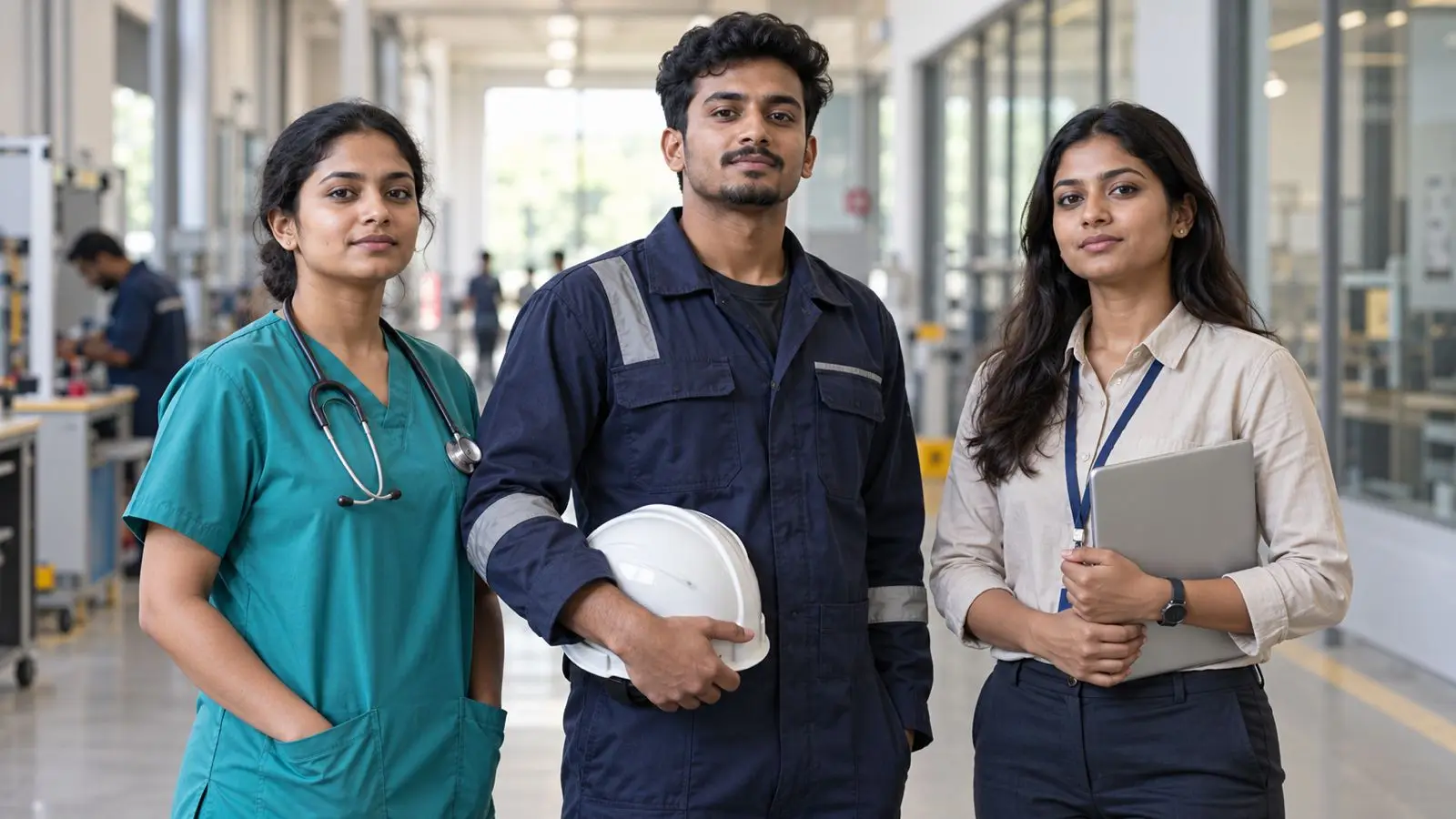

India has long seen its large young population as a demographic asset. The greater opportunity nowadays is to convert that population into something of which the world is increasingly in short supply: a steady supply of skilled workers.
Getting the timing right is essential. The NITI Aayog’s 2026 framework on international mobility states that India has an overseas migrant population of 18.5 million, the largest such population in the world. The same framework also notes a global shortage of 11.1 million health workers by 2030, with high- and upper-middle-income countries alone needing an extra 8.4 million. More generally, the World Economic Forum believes that nearly 40% of workers’ core skills could change by 2030. Demand is rising in healthcare, construction, logistics, ICT, transport and green industries.
This creates an unusual opportunity for India: instead of treating migration primarily as people leaving India, it can be treated as a form of skills export.
India already has a solid base. The NSDC’s work on the global skills gap shows demand for Indian workers in the Gulf region, Europe, Japan, Australia, Canada, and other areas. Its analysis suggests a potential demand of about 2.63 million Indian workers in the UAE, Saudi Arabia and Qatar, some 300,000 in Germany, the Netherlands, the UK, Sweden and Switzerland, and approximately 950,000 in Singapore, Australia, New Zealand, Canada, the United States, Japan and Malaysia over the periods under study.
The major development is that India is now establishing the institutional facilities needed to take advantage of this opportunity. According to NITI Aayog’s framework on international mobility, it has selected 25 priority countries and the occupations that are in short supply in them, and the Ministry of Skill Development and Entrepreneurship has entered into agreements for skill development and technical training with countries such as Australia, Denmark, France, Germany, Japan, Qatar, Singapore and the UAE.
The most recent BRICS declaration goes a step further, calling for mutual recognition of qualifications, greater professional mobility, stronger links between TVET and industry, and training that matches market demand. Moreover, BRICS has supported cooperation in new skills, employability and technologies.
This is potentially transformative.
India should not regard its workforce as part of a domestic reservoir that periodically migrates overseas; instead, it could set up a global system for supplying workers by identifying international demand, training people according to specific occupational standards, certifying them, assisting with their migration, and then continuously improving their skills after they have been deployed.
The model would be:
Global labour demand → occupational mapping → India-based training → international certification → mobility → employment → continuous upskilling.
However, a significant limitation remains: India cannot become the world’s skills bank simply by issuing certificates; it must produce workers who can meet international standards.
The World Bank has identified the ongoing mismatch between skills and requirements in India as a limitation on productivity, firm growth and earnings; the programme it has set out for 2026 is specifically intended to improve the alignment between India’s training system and labour market needs.
The deeper opportunity
The real reward is not just remittances.
A well-functioning global skills ecosystem could generate foreign exchange, create employment opportunities, build international networks, facilitate technology transfer, and drive higher domestic productivity. It would also enable India to convert its demographic scale into an exportable economic capability.
India’s demographic dividend will eventually be judged not by the number of young people the country has, but by the number of people worldwide India can make employable.
The strategic question is therefore bigger than skilling:
Can India create the world’s most sophisticated system for matching global labour shortages with Indian talent?
If it can, India would also be exporting workers.
That is equivalent to exporting capability.