
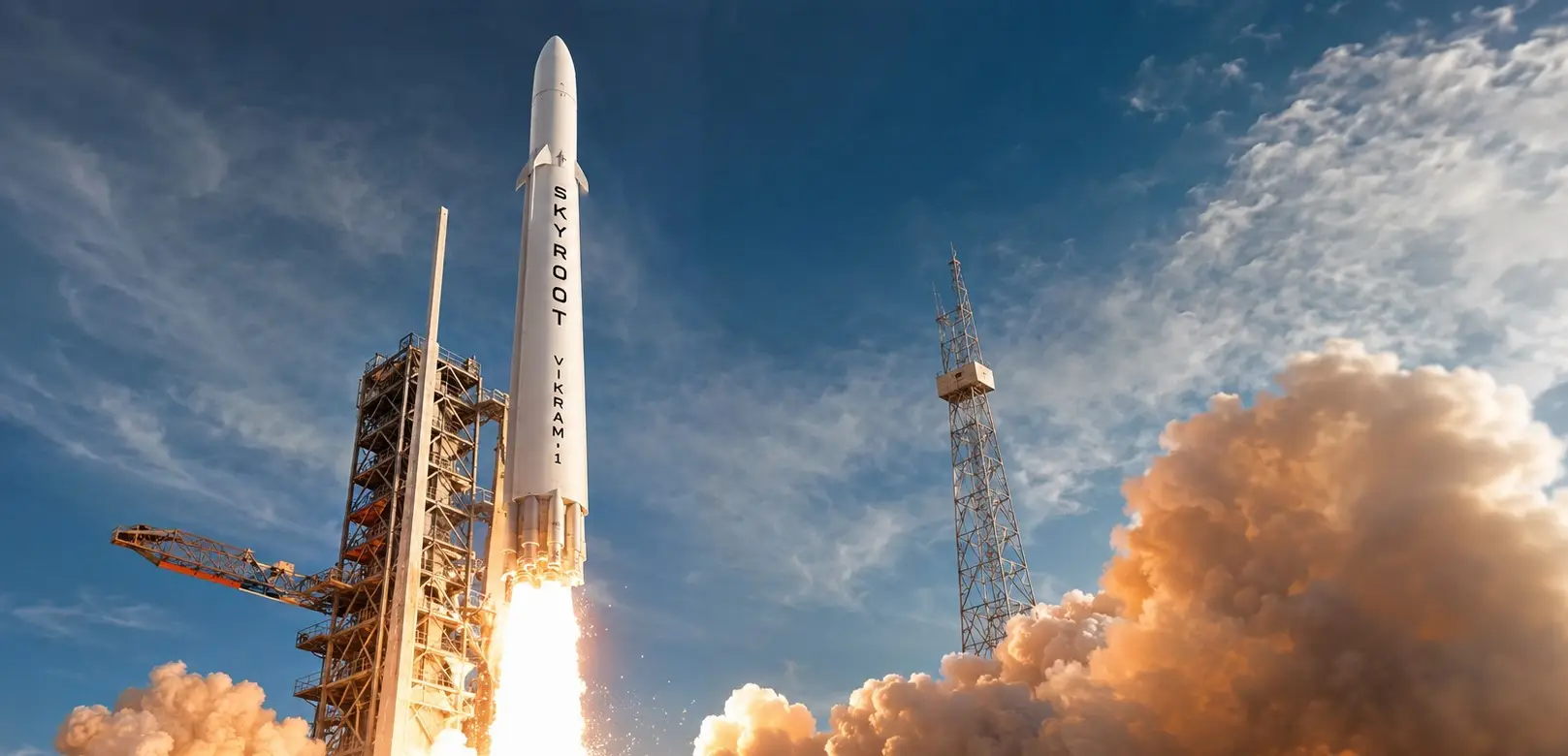

Skyroot Aerospace’s Vikram-1 has become the first privately built Indian rocket to reach orbit, making India only the third country after the United States and China to develop private orbital launch capability. The achievement marks a new phase for India’s space sector. It shows that a private Indian company can design, manufacture and integrate a highly complex launch vehicle at home. It also creates the basis for commercial orbital launches, expands India’s domestic launch capacity and could strengthen advanced manufacturing across sectors such as aviation, defence and precision engineering. The larger test will be whether this first success can be repeated reliably and converted into a viable launch business.
What Is Changing?
Skyroot’s Vikram-S became India’s first privately built rocket to reach space in November 2022, completing a short suborbital flight. On 18 July 2026, as part of a project called Aagman, Vikram-1 went significantly further, deploying its payloads into an orbit nearly 450 kilometres above Earth. The 24-metre, four-stage rocket completed every planned phase of the mission, including stage separation, its final burn and payload injection.
Placing a payload in orbit requires a rocket to achieve a precise speed, altitude and trajectory. Vikram-1’s propulsion, navigation systems, software, advanced materials and thousands of components therefore had to work together with almost no margin for error.
Skyroot designed and built the rocket at its new Infinity Campus in Hyderabad, backed by approximately ₹1,000 crore in planned investment and expected to create more than 1,000 high-tech jobs. ISRO supported the project with testing facilities and launch infrastructure at the Satish Dhawan Space Centre. Vikram-1’s Orbital Adjustment Module uses a fully 3D-printed liquid engine, marking an advance in production methods as well as rocket design.
Why Does It Matter?
The mission reflects the impact of India’s 2020 space reforms, which allowed private firms to develop launch vehicles, satellites and space services of their own. India now has more than 400 space start-ups, including Agnikul, Pixxel and Bellatrix Aerospace, which are building rockets, satellites and propulsion systems.
Vikram-1 also adds domestic launch capacity at a time when ISRO’s Polar Satellite Launch Vehicle, the workhorse rocket used to place many Indian and commercial satellites into orbit, has faced setbacks in two consecutive missions. It gives satellite operators another Indian route to orbit.
The capabilities involved—precision manufacturing, propulsion, navigation and advanced materials—also have applications across aviation, defence and other strategic industries. ISRO Chairman V. Narayanan has welcomed private companies entering areas such as spacecraft and defence navigation systems, stating that their participation can reduce import dependence and support India’s long-term development goals.
What Happens Next?
Skyroot plans another Vikram-1 test flight later in 2026 before beginning commercial launches in 2027. It is also developing Vikram-2, a larger rocket designed to carry up to 900 kilograms into low-Earth orbit, with its first launch targeted for 2027.
The next challenge is not simply to reach orbit again, but to do so reliably and frequently enough to win paying customers. Commercial viability will depend on repeated launches, predictable schedules, competitive costs and the ability to manufacture rockets consistently.
The opportunity is substantial. IN-SPACe (India National Space Promotion and Authorisation Centre) wants India’s space economy to grow from $8.4 billion to $44 billion by 2033, while the global space economy is projected to reach $1.8 trillion by 2035. How much of that market Indian companies capture will depend on whether Vikram-1 becomes a repeatable industrial product rather than a one-off engineering success.
What Should India Do?
Skyroot must now prove that Vikram-1 can be manufactured and launched repeatedly. Government agencies, investors and industry must help create the conditions for that scale by strengthening component supply chains, precision-engineering capacity, testing infrastructure and long-term funding for high-risk hardware development.
The broader objective should be to turn one successful private launch into a durable industrial capability. That means enabling more Indian firms to design critical systems, qualify components and integrate complex technologies at home. Vikram-1 will matter most if it helps build an advanced-manufacturing ecosystem that extends well beyond the space sector.