

India’s space sector is no longer limited to government missions. Private companies are entering launch services, satellite manufacturing, Earth observation and space-data applications following reforms introduced since 2020. But opening the sector is only the beginning. The larger test is whether India can turn its technological strengths into viable businesses with regular customers in India and overseas.
What Is Changing?
India’s space economy is currently valued at about $9 billion. A Government release says it could reach $40–45 billion over the next decade as private participation expands alongside the scientific and strategic capabilities built by the Indian Space Research Organisation (ISRO).
Private interest is growing. The number of registered space start-ups rose from one in 2014 to around 440 by August 2026. Government data also shows that IN-SPACe — the single-window agency that authorises and supervises private space activity — had issued 113 authorisations to 52 non-government entities by August 2026; 18 of those entities were start-ups.
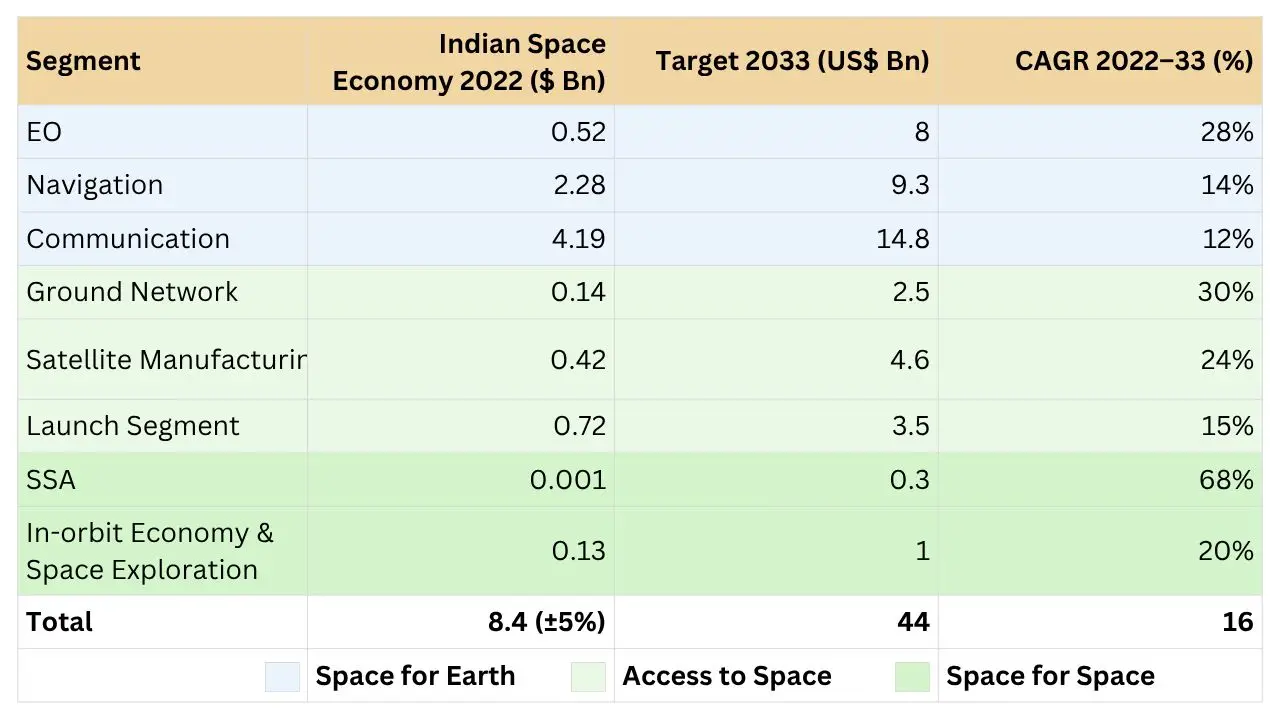
The government’s longer-term ambition is larger still. IN-SPACe’s decadal strategy projects India’s space economy reaching about $44 billion by 2033, including $11 billion in exports. Its baseline was $8.4 billion in 2022, or roughly 2% of the global space economy. Reaching the ambition would require annual growth of about 16% and an increase in India’s global share to 8%.
Why Does It Matter?
Launch services are only one part of the opportunity. IN-SPACe’s 2033 vision assigns about $3.5 billion of the potential $44 billion market to launches, while roughly $32 billion is expected from satellite-enabled services and applications, including communication, navigation and Earth observation.
That changes the commercial question. Earth-observation data can support agriculture, infrastructure planning, disaster management and logistics. Communication satellites can expand connectivity, while space data can feed analytics and decision-support products.
The reforms therefore do not turn India’s space programme from a scientific and strategic capability into a commercial enterprise. They add a larger commercial layer around those capabilities, allowing space infrastructure to support businesses across multiple sectors.
What Happens Next?
The government is building some of the infrastructure and financing private companies need. A ₹1,000-crore venture capital fund is planned for deployment over up to five years from the start of fund operations. The government estimates average deployment of ₹150–250 crore a year, depending on investment opportunities and funding requirements.
A separate ₹500-crore Technology Adoption Fund is intended to help companies commercialise indigenous technologies. Private entities have also gained greater access to ISRO infrastructure and technical expertise.
The change is beginning to appear in specific programmes. IN-SPACe has developed a public-private partnership framework under which private entities can design, build, own and operate Earth-observation satellite constellations, including satellites, launches, ground infrastructure and downstream analytics.
The transition, however, is not complete. Funding and commercial execution remain uneven, and opening the sector does not by itself create sustained demand or globally competitive businesses.
What Should India Do?
The next challenge is converting a growing start-up ecosystem into companies with dependable revenues. Government procurement, access to infrastructure and early-stage financing can create an initial market, but long-term growth will depend on paying customers at home and abroad.
India will need to use public procurement more deliberately as an anchor customer for domestic space products and services, while helping companies prove reliability, scale delivery and compete for export contracts. Success should therefore be measured less by start-up or authorisation counts and more by repeat customers, revenue, deployment and exports.
That is especially important because IN-SPACe’s $11 billion export figure is a market-potential ambition, not a forecast. Meeting it would require Indian companies to win a much larger share of the global market.
Scientific and strategic missions will remain at the heart of India’s space programme. For its commercial reforms to succeed, India will need steady revenue, dependable private companies, strong local demand and exports that can compete globally.
India has already proved that it can develop space technology. The next test is whether it can create lasting markets around it.
***
Source Note:
This article is based primarily on the PIB Backgrounder Strengthening India’s Space Sovereignty, which outlines the expansion of India’s space economy and the growing role of private participation across launches, satellite manufacturing, Earth observation and downstream space services. Data on the number of space start-ups, private investment and IN-SPACe authorisations is drawn from government releases and IN-SPACe’s decadal strategy. Additional context on the space start-up venture capital fund, Technology Adoption Fund and public-private partnership framework for Earth-observation constellations is drawn from PIB and IN-SPACe documents.
Editorial Disclosure:
AI-assisted tools were used to help summarise and organise information from the source reports and to support language and copy-editing.