
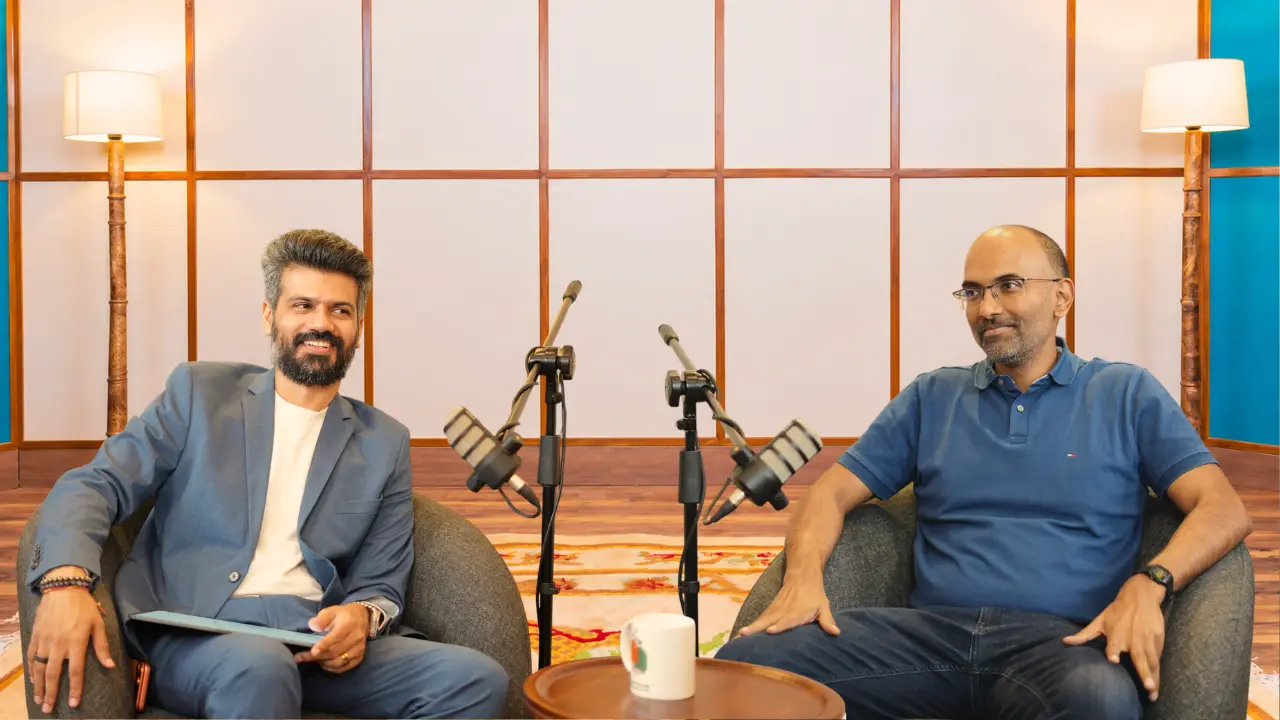

Raghu Reddy, CEO of Lumio, discusses what it takes to build a homegrown consumer electronics brand in a conversation with Nikhil Chawla. He reflects on lessons from his time as Senior Director at Snapdeal and Chief Business Officer at Xiaomi India, and how they shaped his approach to Lumio. He explains why the company saw room for product innovation in televisions and projectors, how hardware, software and AI can improve the experience of finding and watching content, and why after-sales service is central to building trust. The conversation also explores the progress of Make in India and the local component supply chains and design capabilities needed to move beyond assembly. Reddy shares his ambition to see more Indian entrepreneurs build consumer electronics brands.
Nikhil Chawla: Thank you so much for joining us, Raghu. I mean, we’ve known each other for almost a decade now. And, you know, seeing on stage for Xiaomi was always like a great time listening to you and understanding what made you like to move on from a brand like Xiaomi to make something of your own, like Lumio.
Raghu Reddy: I guess, uh, it was a bit of a journey. I’ve been in consumer electronics now for more than fourteen years? You know, I spent close to seven years at Xiaomi. But even before that, I was on the e-commerce side of things with Snapdeal, you know, working on a bunch of consumer electronics categories.
NC: I want you to be absolutely brutally honest. Are you assembling in India or are you making in India?
RR: Obviously, everything is now getting assembled in India. But making in India is also a journey. Yeah. I think, you know, all brands are going through that journey, including us. To be again, completely honest, we’re probably the first brand that’s actually making the projectors here in India even today. I think, you know, while TVs, most of it is now being made in India, but in projectors, most of it is still getting imported. We’re probably amongst the one or two brands that are actually making it here in India.
NC: But where are you manufacturing in India? Where is this factory being set up?
RR: We are manufacturing projectors in Daman.
NC: Okay.
RR: I mean, it took us a lot of time to get it right because again, I think there wasn’t any factory that was doing projectors in India.
NC: And why, just the entire interesting choice. Daman is it?
RR: There was an existing capacity that was there. They were manufacturing products for export from that facility. So we felt that’s good enough for us actually.
NC: You already have that supply chain and supply chain processes in place.
RR: But yeah, it took a little bit of time to get it ready. I think it pushed out our timelines by about four or five months. because just getting the line ready to meet the Indian conditions to ensure that the quality is there. But all in all, I think it now helps us move much faster. Respond to demand a lot faster having this facility over here.
NC: So what do you think will take for us as a country to stop just assembling, to start making things for the world, for the global audience? Like, do you see that happening soon?
RR: See, it is going to be a, you know, journey. I think, you know, wherever this has happened, uh, it’s again taken a few decades. Overall, I think the good part is that.
NC: But are we on the right path for the supply chain?
RR: We are on the right path. For example, I think the government has pushed for the Make in India programme since twenty fourteen. Yeah, it’s been more than a decade now, which meant that at first assembly started over here in India. Now you see that there’s a whole bunch of PLI schemes for component manufacturing. What it means is that the ecosystem is building right now. And as the ecosystem builds, you will have a lot more value added work also happening in the country. So it’s a combination, right? I mean you have design capabilities getting built up. You have manufacturing capabilities being built up. You also have local brands coming up. All of this put together will drive. You know, innovation in a manner where you could potentially look at building out products for the global markets.
NC: Do you think like global brands like Apple, when they start making an Indian supply to the world, it makes a difference. Does it help?
RR: It helps. I mean just that ecosystem coming up here in India, I think it has a ripple effect on a lot of others and on the overall industry as well.
NC: It also builds trust that Apple is making in India. So, from your experience, what is holding back Indian startups? Like, is it the capital? Is it the talent or is it the components?
RR: I would frame it that way. I think there is a time and a place for everything. And I think what you see right now is that here’s actually a whole bunch of hardware startups that are coming up. So there is initiative amongst people who’ve got the right experience to come in and try to attempt this. But of course, the overall ecosystem will also have to evolve both in terms of capital allocation as well as components. But like I said everything is a journey. I think we’re on the right path. You’ll see a lot more companies coming up in the future.
NC: Can you also please tell Gen-Z about what Snapdeal is?
RR: Oh, yeah. Snapdeal. That’s a good one. I think you could say Snapdeal was the second biggest e-commerce platform back in the day when e-commerce had just started off in India. Right after Flipkart, it grew very rapidly between twenty twelve to twenty sixteen. I was there for three years between twenty twelve to twenty fifteen. Heading a bunch of consumer electronics categories over there. Got a good ringside view of how e-commerce works? How does it work for the brands? How do brands sort of approach e-commerce? And then of course, I went on to the other side on the brand side, got a really good sense of how global brands think about products. And from there, how does the whole business come into play, GTM come into play, etc. So with all of that experience, I felt that maybe there’s an opportunity for a good homegrown consumer electronics brand to come up with the experience that me and some of the other friends and colleagues who come and join me overall.
NC: Lovely. But why start with TVs? Like, why are the AV categories? What were the established players missing that you thought it’s needed and we should do it.
RR: I think that’s been the one constant question that we’ve got for a really long time by a bunch of people. Okay. Why TVs… I think for everyone, TVs just seem like a really mature category with a lot of competitors being there. But when we spent time evaluating all the consumer electronics categories, we felt that while you could say, it’s a mature category and it’s already hit a certain number and it continues to operate at that number. But when we spoke to a lot of customers, when we analyzed a lot of customer reviews, we realized that there is something fundamental about the user experience that is broken and that seemingly had not been addressed by anybody in the industry. I mean…
NC: You’re challenging Google right now because most of the TVs are Google Android based.
RR: Oh yes and no. I mean, obviously Google OS runs on a lot of the TVs in the country, maybe fifty percent, sixty percent. And there are, of course, a lot of other guys. But more importantly, whether it’s a Google TV OS or it’s a web OS or a Tizen OS, you go through all the reviews. At least that’s what we did. We went through about fifty thousand plus reviews back in twenty twenty three and twenty twenty four. We realized one thing. There are a lot of people who were just not happy with how long the TVs took to boot up, or how long it took to play content. And when compared to the experience that customers or users would have on a smartphone or a laptop, the experience of watching content seemed dated.
NC: So, I mean, you kind of identified the interface being sluggish or not very user friendly or not what consumers were looking for otherwise to find something. It was very tough. And it’s not like the DVD days where you just pick up a DVD and start playing it. So you waste a lot of time just to find and discover things. But what did that fixing actually involve in the software side of the story?
RR: So two parts to this, right? I think on the whole sluggish interface bit, we spent a lot of time trying to figure out how to get it going. I mean, we identified the problem that sluggish interfaces are they’re
NC: identifying is easy, but fixing it is the…
RR: Funnily, I would disagree there. I think identifying the problem is usually the hardest thing in terms of what you want to focus on. But I think once we identified, we went around speaking to everybody in the ecosystem, trying to see how you could get this fixed. But I think the first reaction that we got from a lot of players in the ecosystem is that this is how it is. This is what is available. This is what you can do. You can’t change anything. Is the first refrain that we got. So it took us a lot of time getting around. We went off to meet the Google TV Mountain View team. And then we presented a view that, okay, you know, this is a problem that we want to solve. And they were also taken aback. They said, hey, you know what? You’re like the first Indian company that’s actually come and asked for improvement in experience because most of the conversations that we have with most Indian companies is how can you get the price down? And you’re coming here and you’re saying how can we get the experience improved? But thanks to them, they got us introduced to some of the more important players in the ecosystem on the chipset side of things. They also helped us figure out a way to optimize the OS for our devices, which helped us actually solve the problem of sluggish interfaces. Ultimately, what we managed to achieve was that across all the user interactions that they have with the TV, we were about roughly two X faster in terms of how quickly things can be done overall. So that took a little bit of time.
NC: So, I mean as I can understand you working on the software first, you took it by the horns. Did you have the hardware ready to test it or were you testing it on other hardwares before you even launched?
RR: Oh, no. I think we first got the hardware or the sluggish nature of stuff fixed, working on the hardware side along with integration on the software side. Along the way, we started setting up our team to build out TLDR, which is our own discovery layer which was frankly a journey in progress. I mean, we started off with the team. figured out what it is? That’s because again, what to watch can also be a fairly large problem to solve. So we zeroed in on sports because sports is something that is hard to find on OTT. You probably know there’s a match happening, I mean, IPL, etc. is happening on Hotstar. But if you take that out of the purview…
NC: Most of the series and all, you don’t know..
RR: You don’t know where it is. So we first started solving sports on TLDR, which is our discovery…
NC: Can you tell us, boomers, what TLDR is?
RR: TLDR is an internet slang “too long didn’t read”, of course. More importantly you use it in a way when you want something to be communicated in a jiffy. And how do you get that kind of experience going on a TV is what we are aiming to achieve.
NC: Love the wordplay there. So, I mean, what surprised you the most about building your first product? Was it like the supply chain? Was it like procuring sourcing things or just putting it all together.
RR: To be honest, I think the biggest challenge is actually figuring out what you want to do. Like I mentioned, I think you know there’s obviously a lot of sayings out there which says that ideas are a dime a dozen, but execution is the real deal. But I think, even getting the right idea in terms of using, figuring out what is actually bothering customers and then figuring out what you want to focus on and getting that right, I think takes a lot of time. Yeah. I think we were lucky that we landed on the right insight immediately. But now that we’ve gone through our journey across like not just one category, but multiple categories, I still think that getting that right is the hardest thing.
NC: Okay. The most important question, which was like, every brand has AI in it integrated in their devices. What about you guys? I got a demo of something that you’re building, and the AI integration was crazy because you could do things, send WhatsApp and whatnot, and communicate with the TV and send it to friends, whatever you’re watching and all. Do you think it’s just a word or is it actually happening? The AI revolution.
RR: Oh, I think it’s funny because if you look at a lot of brands, since I think twenty twenty four, you see product pages it’s peppered with AI.
NC: But even the demos, when you see Google and all the demos, some people chop, I think words or some company just chopped everything else and kept the word AI and it was like repeated a hundred times. AI, AI, AI, AI, All those keynotes.
RR: Forget Google, right? But I mean, if you look at consumer products, consumer durables. AI is peppered everywhere. But what you realize is that most customers couldn’t figure out, you know, what AI was doing for a…
NC: I saw a power bank that says with AI. Okay, then we’re getting there.
RR: We’ve seen, I think we’ve seen a lot of products with which are ACs and washing machines and refrigerators calling out AI in bold. I’m like, okay.
NC: And charging extra for that. To be honest, I don’t want to name the company, but they sent me an AC to review, which said that it’s AI and it was twenty five thousand rupees extra and the AC was not cooling, but the AI robot or the AI app took a complete test of it and said, AC is working fine. I called an engineer. He said the gas is not there. That is what I did for me.
RR: Anyways, I think when we looked at it, we realized that there is a genuine opportunity for us to put AI to work in a manner that customers can feel the difference and which is what we set out to build with TLDR neo, which is our, you could say an agent. So that sort of working behind the scenes to help you find what you want to watch, right? So, what we’ve done is we’ve realized that customers finding something to watch on the TV means that you use the TV remote to give a voice command, which necessarily does not work all the time. So what we’ve done is we’ve actually allowed you to pair your phone through WhatsApp to the TV, and then you can give your commands on WhatsApp either by typing, which you’re used to and it’s very convenient, or you can actually give a voice command on WhatsApp. It’s using the phone’s microphones, which means that it’s actually able to hear it clearly and transmit it clearly. And then the agent gets to work and makes sure that it goes through our entire database of the links and figures out where a particular movie is. Or I mean if you were to give it a descriptive view of what you’re feeling like watching, it’ll still figure out movies that fit the bill and then showcase that on your TV. So we’re doing two things. We’re making the journey of searching for something on a TV very easy. and we’re making sure that it’s all available on the TV with links to where it’s actually streaming as well.
NC: It was a very interesting feature. I think I was talking to Sudeep and we did like a quick demo of that couple’s thing. Can you talk about that?
RR: Okay. Yeah. I think that’s a very interesting use case. We’ve still not rolled it out, but we’ve done a POC. I think one of the things is that finding content is difficult. Finding good content is difficult. But at the same time, if the couple is sitting there trying to watch it, you never really agree on things. So what we built out is you ask neo, what are you in a mood for? And then it will ship out ten options to both you and your better half. Uh, and then you swipe left or right, and then whatever matches at least gets you to a consensus choice overall.
NC: I want you to understand, like building projectors, a lot of companies have been doing it. There’s global competition. You made it in India, you kept the pricing low. There’s so much happening globally. The semiconductor shortage. The policies are changing every day. How did you manage to keep the pricing intact and also the quality so good?
RR: Right. There are two parts to the question that you just asked. Obviously what did we do on the projector side? That’s the first one. The second one is how do we keep the prices under control given what’s happening with the memory side? So getting back to the first one, which is what we did with the projectors? I think when we started researching this category in twenty twenty four, we realized that there are two parts to the market. There’s one which are global brands that have been around for a long time. They continue to build projectors, but tend to be very expensive, starting upwards of seventy or eighty thousand and going all the way up. And then there was one more class of projectors, which was the really cheap ones that sell for less than five or six thousand bucks.
NC: But can you really call them projectors?
RR: Yeah. So the problem is that we realized that a lot of customers are actually picking those cheaper projectors, but then they get very disillusioned very quickly because these projectors claim a lot of things, but they don’t really meet what they claim. For example, they say that Netflix will work and a bunch of other OTT apps will work, but they don’t really work. Maybe you’ll be lucky if one or two apps work. Otherwise, most customers are used to, again, hooking up a laptop to the projector or something, something like that. So what we did was we again worked with Google. I think we are probably the first Indian brand to get a certified Google license to integrate into the projector, which means that everything becomes simple. All you need is a wall and Wi-Fi. And literally, I mean, you just start projecting and you can start jumping into any of the apps…
NC: and there’s no learning curve involved…
RR: There’s no learning curve, right. The second big aspect for projectors was that a lot of these brands were, frankly, they were selling, but they didn’t really have any customer service or a service network to speak of. Even if something were to go wrong, there was something that the customers could get back to. And then once we started selling projectors, we realized that we actually tapped into a completely new segment altogether. We realized that a lot of our customers were actually college students who were ordering it for their hostel rooms, for their dorms, etc., because we realized that a projector is a communal living experience and nothing better than having something like that in your college when you want to watch a lot of things together overall. So that’s something that came out much later after we sort of jumped into the market. And we’re happy that it’s actually appealing to a lot of the eighteen to twenty five year olds overall.
NC: We’ll get on to the category question later because I want to learn there is something that I’ve heard. Maybe it’s right, maybe it’s wrong that you’re entering a new category. We get to that, but how long were you working with Xiaomi and how was your experience there? What were the things that you could carry forward in this, and what did you have to unlearn before forming your own company?
RR: I think across Xiaomi and Snapdeal experience. I think the biggest learnings were in terms of how do you plan a product roadmap and how do you plan a lifecycle for a product? So that’s something that I think helped us immensely. I mean, touchwood. I mean, how do you sort of plan out your supply chain? How do you ensure that you get a certain quantity? At what point in time? All of that, I think, helped us smoothen out our journey. Touchwood there have been no hiccups in terms of how we’ve gone about planning our business and hit the numbers that we’ve had to hit. Uh, but I think the biggest thing that we’d have to probably unlearn is with Xiaomi. We were always trying to get the product that could appeal to, say eighty, ninety percent of the audiences. Which means that you get everything right. But most importantly, the right cost. And that’s how you sort of get there.
NC: Correct.
RR: But I think as a startup, you don’t have the resources of a large organization, which means that you are actually trying to find niches where you would want to operate in and where you want to make a name, build credibility for yourself, which meant that our approach was the exact opposite of what we were doing back then, which is finding a niche which has a problem. And how do you solve that problem and how do you reach out to that audience overall?
NC: Absolutely. But why the name Lumio like that? You mentioned that build you up the name, be a household name or be a niche player. Why the name Lumio?
RR: Oh, I think, long story short, I think loom. I mean, Lumen’s is obviously a measure of the display. We’re obviously jumping into display categories. We were fairly clear about that. So LUM came from there. And then ultimately, we want our devices to be different not just purely from a hardware standpoint, but even from a software standpoint, that’s been a big area of focus. Yeah, we got IO together from that angle. And then I mean, Lumio came about.
NC: Lovely. So you reported around one hundred crores in GMV in the last thirteen months of your launch. How did you really pursue it? Get People to trust in the brand. And I also, if I’m not wrong, you could order a Lumio product on Blinkit or other places and get it in ten fifteen minutes if I’m not wrong. Right?
RR: No actually not. Uh, we’ve got Lumio projectors on Instamart, which allows for…
NC: I remember seeing somewhere because my friend wanted to do a math screening, like where can I get a projector? I said, just check these hypermarkets. And he said, I found it. Yeah, lovely.
RR: But TVs are not yet there in Quick Commerce.
NC: But you have your projectors there?
RR: Projectors are there. TVs have been selling on Amazon and then on Flipkart. So those are the platforms that we are available on. But yeah, coming back to your question, how do you convince customers? I think that’s again, like one of the bigger challenges. Because I think most people assume that TVs are a touch and feel experience kind of a product. We took the other, we went against the grain over there and we said we’ll go online. But I think the insight that we had landed on that TVs are sluggish was like a really powerful insight because I think the moment we were able to showcase that to a lot of reviewers, a lot of our community folks across the country, people were really able to appreciate that. Okay, hey, these TVs are, you know, two X faster. So I think the first set of articles that came out, I think I convinced a bunch of early adopters to come and buy. But when those customers actually came back onto Amazon, they wrote their reviews about us living up to what you are claiming. I think that set in motion a virtuous cycle, right? And of course, you know, we reached out to a lot of these kinds of audiences digitally who were in the market through Instagram, through YouTube, etc.
NC: I’m one of them. I trusted it and I loved it, and I shared my opinion, my reviews about it in the magazines, and wrote on my social media. And of course it feels nice to see that an Indian brand coming up and putting in so much effort for the experience, for the discovery and keeping the cost that sensitive, that because we’re a frugal market, we can’t forget that. So everybody wants more of everything in less. So what you have been able to achieve is really, really crazy. And of course, as you said that the reviews really help because it’s easy to sell something easily. How about service repair all of that network? Have you set it up? If and when something breaks down, we’re there for you.
RR: Yeah. I think this is a very important part of building the business, especially if you aspire to be a well-known, trusted brand. I think how you approach service is probably the most important thing. So we started work on service literally at the same time when we started defining the product. Yeah. You know, we got on board somebody with twenty five years of experience across a lot of consumer electronics and durables companies. He came in at least nine months before we went to launch and then started setting up the network. So when we actually launched the product we had about close to three hundred service centers in our network. And now over the last one year or so since we’ve launched, we’ve actually scaled that up to about four hundred service centers overall. And we’ve also been working diligently to put out processes that can help us service customers, of course as a new brand can everything be pitch perfect? Obviously not. We’ve had our share of learnings on where we can improve, etc. But that’s a journey. But for us, I think that’s the most important aspect of running the business. I mean, one is how do you give a product that actually meets customers expectations? But most importantly, when things go wrong, how quickly can you turn around and, you know, get things fixed overall?
NC: So all your products are being sold online. What is the demographics like? Because obviously people, I would say who are fifty, sixty plus would definitely want to go to a store, check the TV before buying a TV. And buying a TV is not like a personal decision in Indian homes. It’s like a family decision. Till today. It’s not like going out and buying a phone. So your family goes and sees you check the sound. Somebody wants something or the other, some certain features. What is the demographics like and what is the market that you’re tapping right now?
RR: Right. No, no, I think this question is very pertinent. And I think when we started asking ourselves this question since we started selling, I think it was very revealing in terms of what came out right. You’re bang on. Most of the customers who are like forty and forty five plus they are not our customers at all. What we see is the majority of our customers, at least for TVs, are between the age groups of twenty five to forty, twenty five to forty five and most of these guys tend to come from some of the metro centres like Delhi NCR. Mumbai and the southern metros, which are Hyderabad, Bangalore and Chennai. What we’ve seen is a lot of these customers are white collar employees. And I think for them, the decision making is driven a lot more by online media as opposed to going into stores and checking out the product. So a lot of these customers figured out online that our products meet a certain requirement. There are a lot of people who reviewed it and have good things to say. And they decided that, no, they don’t need to go to a store to check it out and then actually buy the product.
NC: So what’s been the hardest part of scaling this mix of software and hardware? Because you’re doing it both on your own. It’s like an ecosystem. Like what Apple would do, give you the hardware, give you the software and keep working on it, keep, keep improving it with each iteration, with each update. What’s the hardest part of scaling both hardware and software, and especially because you’re expanding your portfolio now.
RR: Like I mentioned, I think the hardest part, frankly, is figuring out what to build. Even on the hardware side, uh, we spent a lot of time obsessing over because, you know, for example, in TVs, everyone tries to build a product on the axis of display and sound, but we took a contrary view of that and we said, no, we could build on this aspect because there is a pain point. Now addressing that pain point helped us get to one hundred crores very quickly which is why I think figuring out what is important to customers is the hardest part. And the same is the case with even software. You know, we’ve run a bunch of experiments on what we want to integrate into TLDR. But it’s a consistent trial and error kind of a thing. You go back and speak to customers, figure out what it is that they like or don’t like. So figuring what to do is frankly the hardest part. But of course once you get it going. That is replaced by how do you get your planning, right? How do you get your repair and service network? Right? And so on and so forth.
NC: So, I mean, five years from now, what do you think Lumio would be known for? Because right now we have TV and projectors. And if I believe the grapevine, maybe there’s another category that you’re entering into soon, maybe. Where do you see Lumio in five years?
RR: We aim to build Lumio into a very credible, very trusted brand in the home entertainment space, that’s actually striving to improve the experience either by optimizing on the hardware or changing what we could do over there or using software to help improve your overall experience. So that’s something that we’ll continue to strive for and build and hopefully that helps us build a credible and a trusted brand moniker. Overall.
NC: I mean, it’s on the lighter side. I want to understand obviously you love your own TLDR platform and ecosystem and the kind of interface you built. But other than that, before the TLDR existed, was it the Apple TV, OS interface, the Amazon Fire TV interface, or the stock Android? Or maybe if you wanted to try something else like a webOS or a Tizen.
RR: I think I’ve been largely using the Google OS across my entire career, but obviously we’ve dabbled, played around with Apple TV, OS as well as fire. and we try to always see what is it that, we can get inspired on that we could possibly integrate into TLDR and what is it that even they don’t do that. Maybe there’s an opportunity for us to do so. So you could say our experiences are built across these three platforms, but, no real how do I put it, something that we love, etc.. Yeah. I mean, the idea is to see how we improve the TLDR of the customers.
NC: I wanted to understand when Xiaomi started, they kept saying that we’ll never have a brand ambassador. But then we saw a lot of actors and cricketers coming along. Is it going to be the same story for you guys? You, I’m sure you don’t have a brand ambassador right now. You’re not even putting any ads.
RR: We’re too small to afford a brand ambassador right now. So my colleagues, you know, Sudip and KD, you would see them across a lot of our videos.
NC: Lovely seeing you. Yes. Of course. I think you’re lucky to have him as a brand ambassador because I’m a big fan of his. And the things he does on and playing around and tearing apart gadgets, gadgets sometimes hurtful. But he’s got to do what he’s got to do. So yeah. Absolutely lovely. My one last question to you is, what is your one big dream for India? Your personal and for Lumio.
RR: I think getting a lot more product companies out. I think if you look at consumer electronics as a space, you don’t see too many homegrown brands or hopefully there are many entrepreneurs who come up, step forward and try to build out, you know, brands.
NC: Lovely. That’s great. And for Lumio?
RR: Like I said, building out a name for us as a trusted and a credible brand, that’s something that’s very, very important because revenue numbers, etc. those are all by products. I think you have to get your product and your service, right? And if you get that right, then I think all the other things will follow.
NC: Well, thank you so much for your time, Raghu. It was lovely talking to you. And I’m looking forward to testing your new category of products.
RR: Oh, thank you so much, Nikhil. Thanks for your thanks for having me over.
NC: Pleasure. Thank you.