
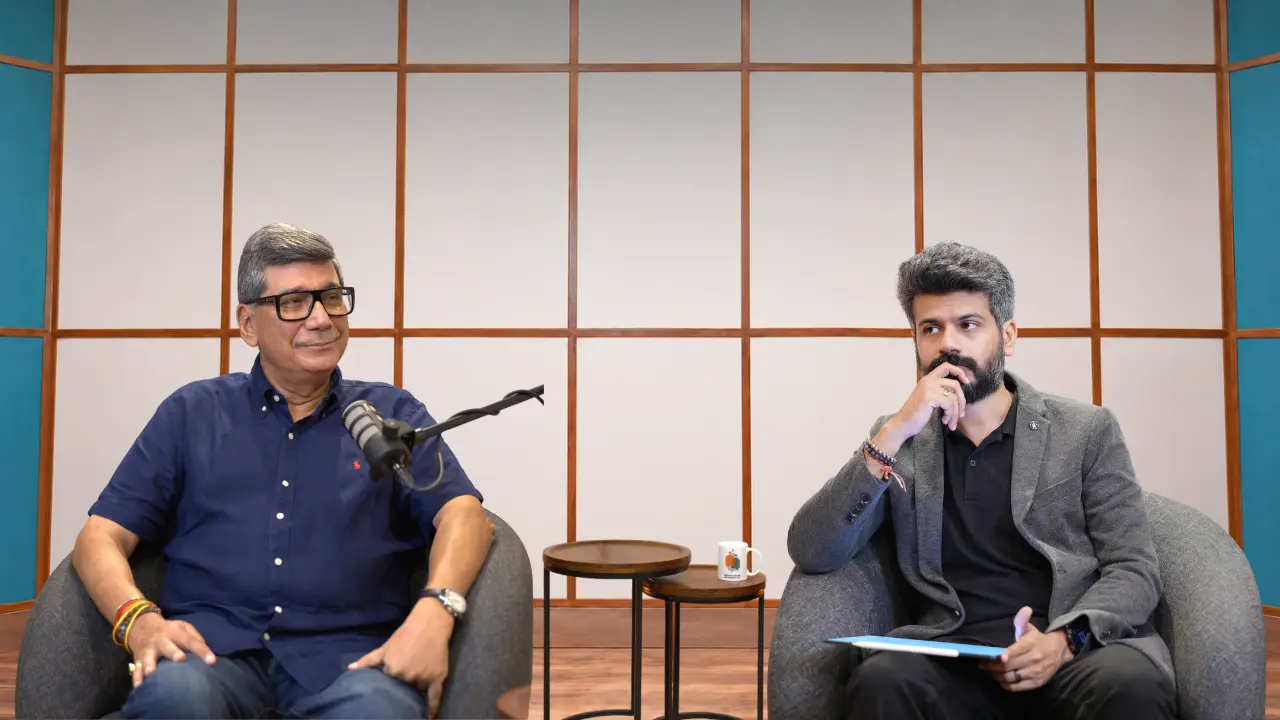

Ravinder Zutshi, former Deputy Managing Director of Samsung India, has watched India’s consumer electronics industry change from a market dominated by domestic brands and imports to one increasingly focused on local manufacturing and deeper supply chains. In conversation with Nikhil Chawla, he reflects on helping build Samsung in India from near-zero brand awareness, the role of product, service and distribution in its growth, and the company’s early investments in manufacturing and R&D. The conversation explores India’s progress under Make in India, the continuing gaps in component manufacturing, rising memory costs and what it will take for the country to move further beyond assembly and build globally competitive electronics businesses.
Nikhil Chawla: Hello and welcome to the One Big Podcast. I’m Nikhil Chawla, and today I’m sitting with Mr Ravinder Zutshi, who helped build technology brands in India when they barely existed here. Welcome to the podcast, sir.
Ravinder Zutshi: Hello, Nikhil.
NC: Welcome to the One Big Podcast.
RZ: Thank you, Nikhil.
NC: I want to ask you something. After a career spanning decades selling technology to India, what is that one gadget or technology that you could never convince yourself to buy?
RZ: Never convinced myself to buy? I think the pager.
NC: Pager? You never had one?
RZ: No, no.
NC: Wow. Interesting.
RZ: We had pagers in 1995. You recall, before mobile phones came to India, pagers were launched around June or July 1995. I was not convinced as far as the pager was concerned. But the gap between the pager launch and the mobile phone launch was only about three or four months, which had never happened anywhere else in the world. India was the only country where there was just a three- or four-month gap between the launch of pagers and mobile phones.
NC: But what an interesting technology that was. You had to call somebody, tell them what you wanted to text, and then they would type it and send it.
RZ: Yes. It was good for service teams. I recall we used them for some time.
NC: I’m not sure, but I remember Aamir Khan once saying, after using pagers for a long time, that he would stick to pager technology because, “I don’t want to be bothered, and I decide when I reply.” I’m not sure if it was exactly
RZ: in that context…
NC Yes, of course. It was one-sided.
RZ: Yes. You’re not forced to respond. It’s a one-sided call.
NC: Absolutely.
RZ: But for people like us, maybe it was not so effective to operate with a pager. A mobile phone was a much better gadget.
NC: Now we’ve gone back in time, so let’s go back to 1994, when Videocon had asked you to evaluate whether Samsung should be in India and whether you should tie up with Samsung to bring it here. The brand was barely known. Of course, the Koreans hadn’t really entered the country. There was no obvious reason for an Indian consumer not to buy an Indian brand like Videocon and instead buy Samsung. What did the market look like back then, and what convinced you that there was a real opportunity for a company like Samsung?
RZ: When Videocon started consultations with Samsung Electronics, the brand was definitely not known in India. I still recall going home one evening after our first discussions with the visiting team from Korea. My wife asked me, “Which company are you talking to?” I said, “Samsung.” She said, “What do they make? Are they in apparel, or do they make something else?” I said, “No, no. It’s an electronics company.” What I’m saying is that top-of-mind awareness was absolutely zero in terms of electronics. It was a very unknown brand in India. But if you go back a little further, to the 1980s, when the Asian Games came to India in 1982, colour television broadcasting was launched. India was not prepared for colour TV at that time, frankly. A lot of Indian importers imported colour TVs under licences from a few countries. There were products from Panasonic, Philips and Korea as well. Unfortunately, some of the products that came from Korea were not of very high quality. So people did remember LG and Samsung for quite some time, but they were not very convinced about the quality during that period.
NC: Compared with the Japanese brands back in the day?
RZ: Yes, because the Japanese were ruling the world at that time. You had Matsushita, Sony, JVC and Toshiba. There were also companies from Germany and elsewhere. Thomson was there, among others. The government had allowed some companies to import televisions during the Asian Games period. So that perception about quality was still in people’s minds when we started discussions with Samsung. But then we thought about it and realised that, over the years, Samsung had become quite a significant brand domestically in Korea. If you go back to those years, Samsung was also one of the largest and most successful OEMs for major brands in America. They were manufacturing for GE and doing a lot of work for other American brands. Samsung was also one of the largest manufacturers of CRTs. CRT is the picture tube.
NC: Cathode-rat tube?
RZ: Cathode-ray tube. Absolutely. So there was a history behind it. The brand was doing well, but its footprint in India was zero. There were also a lot of licensing issues around collaboration because the government was not allowing a 100 per cent subsidiary of an electronics company in India. That’s where the challenge started, and we began working on it. The Videocon team and I went around the market and took feedback. It took some time, obviously, but ultimately we thought it was worth entering into a joint venture with Samsung to bring the brand into India.
NC: In terms of that joint venture, what was Videocon’s share, and what exactly were you bringing into India?
RZ: Let’s first talk about the equity part. As you know, the government was not very comfortable with 100 per cent foreign equity. Samsung Electronics Korea had 51 per cent equity, and 49 per cent from the Videocon International Group. They participated in this equity joint-venture. Finally, we signed the MOU with them, I think, in March 1995. To operate the business, we essentially had to launch a new company with an Indian name. Eventually, the name became Samsung Electronics India Private Limited. Initially, the company had a different name because there were certain rules that had to be followed.
NC: Like National Panasonic and similar examples, where you had to have an Indian name?
RZ: Yes. There were a lot of such arrangements. Panasonic initially had a trading company here, and it also had a number of joint ventures in India. If you go back to around 1993 or 1994, they had a joint venture with Dhooth for manufacturing washing machines in Pune. They had a joint venture with Dhooth for manufacturing air conditioners in Madras, now Chennai. They also had a joint venture with a group in Madras for rice cookers. And the batteries, the Novino and the Nippo batteries. Novino’s was with Lakhanpal’s in Gujarat and Nippo was in Madras. So, there were many joint ventures around that time because, again, the government was not allowing 100 per cent subsidiaries for these companies.
NC: You took Samsung from almost zero awareness to around 95 per cent within a few years. Looking back, was that a marketing win, a distribution win, a service win, or was it a cohesive effort involving all three?
RZ: I think it started with the product. The product we brought in was something different from what we had seen in the Indian market from domestic manufacturers. Of course, we started very small, with only colour televisions. Colour TV was the main foray and the backbone of the business when we started in India. Samsung was very clear that we should begin with TVs because we realised it was a category we could enter relatively easily. The most important thing we realised at the time was that customer service was in a very poor state across brands. Most of the market was still Indian brands. Panasonic had just started business in India, while Sony was still importing through Dubai and had a trading company here. We realised service could be a game changer for us. I think we were the first company in India, in 1995, to start a “Service on Wheels” kind of operation. It was very simple. We bought a few Maruti vans, painted them with Samsung logos and put “Service on Wheels” on them. We would take service directly to the customer’s doorstep. So I would attribute the initial success to the product, followed by a strong service approach. That really helped build confidence in the brand and loyalty towards it. At that time, there was no modern retail and very little organised regional retail. In the South there were a few chains, but otherwise there were standalone stores across India along with distributors. We worked in parallel with distribution as well as direct stores. We were also among the first to start opening franchise brand stores. We introduced that concept in India in 1996, when we opened our first brand store in Delhi. That took the brand to a different level in terms of credibility and exposure. Stores in those days were not very large.
NC: It was more experiential selling.
RZ: Exactly. Experiential selling. A customer could come in, sit down, walk around and check the products. It became a much better selling environment. I think that was one big win. It took us into a very different mindset among consumers.
NC: You said that, personally, you knew around 75 per cent of Samsung’s 2,500-plus dealers, and almost 100 per cent in Punjab and Haryana.
RZ I would say the North was almost completely covered, absolutely.
NC: Those are bonkers figures. Nowadays, with quick commerce, D2C apps and everything else, we seem to have moved away from the relationship-driven distribution system we once had. Do you think that model is dead, or is it somehow still relevant?
RZ: No, I don’t think it’s dead. Many of those stores you’re talking about have simply become multiple-store businesses. In those days, they might have had one or two stores. Today, they may have 100 or 200. I can recall at least 20 or 30 partners who were one-store operations at one point and are much larger businesses today. Take Vijay Sales. When I started in 1995, they had only one store in Bombay. Today, they have close to 200 or more stores. Everybody has expanded significantly. That also helped shape the mindset behind businesses such as Reliance and Croma—that you could have stores across the country.
NC: You flew around 120 dealers and their spouses to Agra for Samsung’s 1995 launch, if I’m not wrong.
RZ: Yes, absolutely. In December.
NC: That’s a very different era of brand building. What’s the modern equivalent of a move like that, or has nothing really replaced it?
RZ: No, it has gone far beyond that now. But I’ll give you a couple of examples. In 1995, we tried this concept of taking dealers with their families—husband and wife—to Agra as a destination launch for Samsung’s business in India. I think it was one of the largest gatherings organised by any brand at the time. We had the whole Bollywood down there. We brought Bally Sagoo from London. Shekhar Suman was the MC. We chartered a Jet Airways flight from Delhi to Agra and took the families with us. Everybody was very happy because they had never seen anything like that happen in the trade. They were genuinely moved by the experience. It was probably the first time families were involved in that way. Dealers had travelled abroad before. I remember another company taking about 650 dealers to Japan on two jumbo jets—one from Bombay and one from Delhi. So dealers had travelled, but involving families in the launch was very different. We had a great show in Mughal, Agra, and everybody was very happy. In fact, Kapil Dev was our first brand ambassador in India. In 1997, we signed Kapil and his wife, Romi, as a couple for our business in India. The first time a couple ever signed somebody that freely, you know he was a very restricted person. He would never approach anyone nor would he let anyone approach him. So, we were the first company who took Kapil Dev on board.
NC: And you’re still playing golf with him?
RZ: Yes, we’re still very close friends. That friendship still exists. In India, there were two routes that we always discussed internally: Bollywood and cricket. We felt those two things could take a brand to another level. That thought was always there. We started with cricket, moved to Bollywood and then went back to cricket again. At one point, we became the first company to take 11 Indian cricket players together to endorse our brand.
NC: The whole team?
RZ: Yes. We created a concept called “Team Samsung”. That was around 2002, before the 2003 World Cup. There was always a drive to work with Bollywood as well. Then IIFA happened, with Amitabh Bachchan as its leading face along with Wizcraft. We always thought these associations could take the brand to a different level in the consumer’s mind. So we moved between cricket and Bollywood, and I think that interplay delivered very good results for Samsung’s business in India.
NC: If you had to pick one actor today for a contemporary Samsung launch, who would you choose?
RZ: Public choice has changed. We had Amitabh Bachchan with us for a long time because of the IIFA collaboration. We also worked with younger actors. Going back to around 2000, we had Tabu and Bipasha Basu. We launched several TVs with them. We even worked with Deepika Padukone. One of her early assignments was with us in Bangalore for the launch of our notebooks. So we’ve worked with many of them. In today’s context, though, the choice could probably be someone like Ranveer Singh or Ranbir Kapoor because they’re very popular with audiences.
NC: Coming back to building trust and service, Samsung’s early edge, as you mentioned, was after-sales service—the service vans and engineers—when the company was still very small and nascent. Do Indian customers today still make brand decisions based on service, or has that shifted almost entirely to online reviews, star ratings and, of course, people like me reviewing products?
RZ: Ratings are fine. Anybody buying today has access to e-commerce. That’s the first thing. Fundamentally, a consumer will always go online and check what is available. Of course, they probably check the price more than the rating when it’s already a known brand. But even today, when you talk to people, they still ask which brand provides better service. Whether it’s an air conditioner or a refrigerator, consumers feel that if they need service, it should be provided within a reasonable amount of time. They can’t wait for two or three days. So I think that concept still works. People still see service as a major factor when buying a product.
NC: That’s true. By the time you left, I think you were the last Indian senior executive from Samsung’s original 1995 team.
RZ: Yes, maybe I was the last one to leave. I retired after a very long stint with them.
NC: There hasn’t really been an Indian MD after that. What’s your secret?
RZ: There’s no secret. I think it has more to do with my long association with them. Since I was the first employee, I helped take the company to a different level. At that time, my approach was to get partners on board. It wasn’t easy. We can’t forget that brands such as Onida, BPL and Videocon were among the fastest-selling brands in India. It was very difficult to break the loyalty those brands had built with dealers and partners.
NC: But you also had to build the trust of a Korean company for them to eventually put you in that senior position.
RZ: That came much later. Obviously, I wasn’t MD from day one.
NC: But yes, you had to build trust on both sides.
RZ: My trust with Samsung was built through integrity, my approach to the job, and the way I quietly and systematically built the business across India. We started in North India, then moved West and then South. My ability to connect with partners, bring good partners on board and deliver business probably made them realise that I had genuinely supported the brand. There’s also a loyalty factor. These days, people don’t work for so long in one organisation. If you ask me, my entire career involved only three brands. I started with Philips, went to Videocon, came to Samsung and then retired. Only three brands. That takes your credibility with promoters to a different level. In the later part of my career with Samsung, I also became the face of the organisation. You have to understand that they never really had an Indian face. Even now, they don’t really have one. I was their face, whether it was with the government, the public or business partners. A lot of good work happened during my tenure. For example, there’s the incident we were talking about involving TVs being imported into India. Gradually, I did a lot of work for them, and that probably made them feel that I should be given a strong position. And, of course, delivery was always there. We became the top electronics brand over the years.
NC: And they continue to be.
RZ: They continue to be there.
NC: Could you describe how Samsung’s manufacturing operations expanded across India over the decades? What were the big milestones? What made the company choose to increase manufacturing in India over the years—from air conditioners in Noida in the early 2000s to where it is today? India also became an export hub, if I’m not wrong.
RZ: I’ll tell you how they worked. The first thing I learnt about them was that their investments were focused heavily on manufacturing. When they came to India, the first thought was: let’s find a place to manufacture products. Noida was our first plant, where we manufactured TVs. Gradually, in the same plant, we started manufacturing refrigerators and washing machines. Manufacturing was the key focus. They always believed that if you wanted to be in India for the long term, you needed a manufacturing base. I give them full credit for that. They also focused on setting up an R&D base because they believed India should keep doing engineering and innovating products specifically for Indian consumers. Whatever we produced here was directed towards Indian tastes. Take microwaves. We had models where you could select dozens of Indian dishes directly from the control panel. The same applied to refrigerators. In India, we don’t have the same culture of storing large amounts of meat as in some other markets. If you go abroad, freezer sizes are often much larger. In India, we had to decide what the right freezer-to-refrigerator ratio should be. Here, the focus is more on refrigeration than freezing. The freezer is often for ice cubes and ice cream. So the ratio of refrigerator space to freezer space was designed specifically for Indian market conditions. They had a lot of focus on products like that and kept innovating. They also believed the life cycle of a product shouldn’t be too long. A customer should see something new when they walk into a showroom after a year or two.
NC: Like cricket mode on TVs and things like that?
RZ: Exactly. Whether it was a television or washing machine, we needed to give the customer something different after some time. Regular model changes were an important focus. Customers should find something new when they return to a store. The second part was expanding manufacturing. They realised India is a huge country, so North India could not necessarily supply the South efficiently. That’s how the Chennai factory came into the picture. I personally went there and met the Tamil Nadu team. The choice at one stage was between Tamil Nadu and Andhra Pradesh.
NC: How easy or difficult was it to set these things up back in the day, given red tape and everything else?
RZ: By then, we were beyond 2005, and things had started changing.
NC: Got it. The government was pushing for it?
RZ: Yes. Every chief minister was very keen to bring manufacturing into their state. I remember Y. S. Rajasekhara Reddy in Andhra Pradesh, and Stalin, who was at that time not the chief minister, he was, I think, he was municipal commissioner and his father was the chief minister in Tamil Nadu. You had a government that was also very keen to attract investment. The focus everywhere was to get large multinationals to manufacture in the state. There were a lot of incentives. Land was available at cheaper prices, for example. Hyundai had already established a strong manufacturing presence in Chennai for automobiles. In electronics, there weren’t many companies initially. Flextronics was there. Dell was there. Nokia had bought land in Chennai for manufacturing, and that site later became associated with Foxconn. We also acquired land there and started manufacturing in Chennai around 2008. The focus was always to produce in India rather than import. In earlier years, Indian businesses often had more of a trading mindset. Samsung’s approach was local manufacturing: make in India and sell in India. Then exports started as well. Chennai became a production hub partly because Samsung wanted the port to be close to the factory. That’s one reason Chennai was a better option than somewhere inland such as Hyderabad. The factory was established there, and exports started from Chennai.
NC: Which countries were you exporting to back in the day?
RZ: Mostly to West Asia. Some consignments also went to Africa because Samsung didn’t have a factory in Africa at that time. They would use factories in places such as Thailand and India to serve those markets.
NC: As an industry association president, this is where the story gets interesting. You pushed back against issues such as imports and refurbished devices, and you lobbied for local manufacturing incentives well before Make in India existed as a campaign. Looking at where Indian manufacturing stands today, did the industry get there, or are we still fighting some of the same battles we were fighting back then?
RZ: I think the industry has evolved a lot over the years. My time was a very difficult period in terms of convincing the government to support manufacturing. Eventually, incentive structures started coming in, which have evolved into what we see today with schemes such as PLI. When we started manufacturing mobile phones in India, for example, the duty structure didn’t favour us. It actually favoured imports. Surprisingly, people who were importing weren’t paying certain levies that manufacturers in India had to pay. I had to meet the finance minister and say, “Sir, we don’t understand how this can operate like this.” It was a big fight. But the government was listening, I’ll be honest. The rules changed, and we received support. Import duties went up while some relief was provided for local manufacturing. That is how it started gradually. The government’s focus began shifting towards local manufacturing rather than imports. Then came manufacturing support.
NC: You mentioned a very interesting anecdote about how you had to literally tell the government that people shouldn’t simply be allowed to bring televisions back with them after a foreign trip.
RZ: Yes. We realised that whenever we went to the airport, you’d see so many TVs piled up around the baggage belts.
NC: I remember it very clearly.
RZ: People would fly to Dubai or Thailand, buy a TV and bring it back to India because the baggage allowance allowed a television to be imported without duty.
NC: Any size?
RZ: There were practical limitations because of the value cap. You couldn’t necessarily bring the biggest television because of the permitted baggage value. But a lot of 32-inch and 43-inch TVs were coming in from these countries. We commissioned surveys through an agency and checked four or five major airports in India—Bangalore, Delhi, Mumbai, Calcutta and others—to see how many TVs were arriving every day. We realised that more than a million TVs—around 1.5 million annually—were coming from places such as Thailand and Dubai. So, on behalf of the industry and manufacturers, we approached the government and said, “This isn’t fair. There should be some restrictions.” Eventually, the government agreed that televisions would no longer qualify as a free import under the baggage allowance. If you brought a TV into India as baggage, you had to pay duty. That was a big win for us.
NC: Not a big win for consumers who were trying to save money, I’m sure.
RZ: But there were warranty and service issues as well. We had problems in a lot of cases.
NC: How long did it take to convince the government? Was it months or years?
RZ: Not years. I think around eight to ten months.
NC: That’s good. From Samsung to Optimus manufacturing tie up with the Winstone to LG enterprise business, you’ve watched India go from being largely an assembly market to something more substantial. What is the one part of the electronics supply chain that India still hasn’t cracked?
RZ: I wouldn’t say India hasn’t cracked it. I would say India has started cracking it. Components were the big issue. The supply chain simply wasn’t there. Today, that’s why PLI and similar schemes have come into action, including for air conditioners. The incentives aren’t necessarily for the finished AC itself. They’re aimed at components such as compressors and copper tubing. The government’s idea was that component manufacturing also had to be supported. I remember talking a lot with Amitabh Kant about this. Mr Piyush Goyal was also very clear that India wanted companies to manufacture components here and that those companies should receive support. Mobile phones were a major import category, so they received strong manufacturing support as well. Once these policies were put into action, a lot of companies came in. There were many joint ventures. Companies such as Dixon and other large OEMs entered joint ventures with Chinese and Korean firms to manufacture products and components in India. That has now started. It may take more time, but if you look at Tata Electronics and some other companies, they’re moving deeper into semiconductor manufacturing. India is entering parts of the manufacturing supply chain that were simply not present earlier. Previously, it was often about finished products or assembly. Now, with government support and the focus on Make in India, people have realised that components should also be manufactured here. I see a great future for India becoming a strong component-manufacturing base for mobile phones, televisions, appliances and other products. Take compressors. Earlier, we would never have thought of making compressors in India. Now there are good ventures coming up that will manufacture AC compressors and refrigerator compressors in India. So the broader component-manufacturing and supply-chain ecosystem is slowly being built in India.
NC: Now that you’ve mentioned it, I’ve asked a few other guests on the podcast about Make in India. What exactly is “made in India”? Are we really making in India, or are we still assembling in India? There are still many things that we’re simply putting together, while other things are genuinely being manufactured here. How do you explain that?
RZ: I’ll be honest. It is still not completely made in India. Let’s be very clear about that. But what we were ten years ago and what we are today has completely changed. The thought process has changed first. The focus has changed. The idea is no longer simply to import and sell. The idea is to make it in India. Obviously, it takes time. China started this process roughly 30 years ago. We started seriously around ten years ago. So we need to give it more time before we can say that an entire mobile phone is completely made in India. But even today, a lot of housings, PCBs and other components are being made in India.
NC: Do you think a company like Apple manufacturing in India is a big feat? Does it also inspire other players to manufacture here?
RZ: Yes, Samsung started first. I’m sure Apple must have seen Samsung building such large manufacturing capacity in India. After Vietnam, India became one of Samsung’s largest manufacturing bases for mobile phones. Apple must also have seen that it has a great market in India. Thanks to its collaborations with Foxconn and Tata, Apple is now setting up more of what we call vertical integration.Gradually, they’re moving beyond just assembly. Some components are also being made in India. It will take more time, but, as I said, the path is right and the focus is correct. Over the years, I think we’ll reach a point where we can say with pride that a complete phone is made in India.
NC: If you were still the MD of Samsung today, how would you manage the memory crisis we’re going through globally? I’ve been asking this question to a lot of people who are still involved in manufacturing and technology businesses that depend on memory. How would you manage this situation? These are tough times. Someone told me that mobile-phone prices may never go back to what they were two years ago. Yesterday, I also heard that people have started buying 4G phones again to keep costs low, because they are comfortable with that trade-off. It’s becoming difficult to sell a 5G phone below ₹10,000 because of memory costs. How would you manage this situation?
RZ: It’s a Catch-22 situation because memory prices will keep rising as demand becomes so huge. There aren’t that many large manufacturers of memory. That’s something we have to understand. Samsung has been one of the large companies in this business for many years. Today, with enormous consumption and memory becoming a critical component in almost every technology product, I think it’s going to be very tough to manage prices. Unless something changes drastically—manufacturing capacity increases by leaps and bounds, or more facilities are created to produce memory—I don’t think prices can really be controlled over the next two or three years. Demand is going up. Requirements are increasing across every category of business. Coming to your point about mobile phones, that’s also one reason the refurbished-phone business has taken a big leap.
NC: India is a frugal market.
RZ: Absolutely. You have to keep that in mind. The Indian market used to be dominated by the ₹10,000 to ₹20,000 segment. Now, suddenly, prices are moving towards ₹25,000 or ₹30,000. Consumers become wary and wonder what they should do, so they start looking at older phones or refurbished phones. Coming back to your point, it’s going to be very tough to manage this whole demand-versus-supply situation for memory.
NC: Lovely. Before we get to the last question, I wanted to ask you something personal. When we met the other day, you mentioned being a BMW lover. Our first guest on the podcast was the head of BMW India, and we spoke a lot about the brand and its position in the Indian market. Why your love for BMW?
RZ: I don’t know why. I can only say that I’ve tried both major German brands. In Korea, of course, there is a lot of brand loyalty. People feel they should use their own brands. So the Hyundai Sonata was the first car they offered me. I used a Sonata for some time, but I told them it didn’t really fit me.
NC: Did you ask for a Genesis back then?
RZ: Genesis was used only by the top senior executives in Korea. Even today, barring the chairman, most senior executives in Korea use Hyundai Genesis. The car never really came to India at that time. In my case, I started with a Mercedes C200 Kompressor. But once I moved to a BMW 5 Series, there was no going back. This was around 20 years ago. That car had a different pep and a different kick that I felt wasn’t there elsewhere. So I stayed with the 5 Series for a long time—525, 530 and so on. Eventually, I moved into the X5 SUV. I still drive an X5, and I find it a very comfortable car to own.
NC: What do you think of the new-age BMW? There’s so much technology now, the design language has completely changed, and then there are those big grilles.
RZ: I get confused, I’ll be honest. My son tells me, “You’re not fit to drive such cars because you don’t understand so much of the tech. You’re from old age.” But he’s right in one sense. It’s difficult to understand every feature of a car today. Cars have become extremely high-tech.
NC: There are some cars where even the AC vents have to be controlled through a touchscreen. You can’t physically toggle them. And I think, come on, you could save a lot of semiconductors and chips by not doing that. Bring some of those features—and the cost—down. My last question to you is: what is your one big dream for India on a personal level?
RZ: My dream has always been that there should be one Indian brand that competes globally. That’s my dream. I thought we would have achieved it by now, but somehow we’ve lost pace somewhere. I don’t know which company will eventually do it.
NC: I asked another guest the other day: when will we see an Indian brand that is available and loved globally? I’m not even necessarily talking about the US market because they have their own major technology players. But if you go to Eastern Europe or the UAE, for example, you’d hope to see at least one Indian consumer brand selling there and being genuinely recognised.
RZ: Nikhil, I feel sorry about that because I’ve seen multiple sides of the technology industry. I’ve seen Korea, India and Japan. Indian talent, I don’t think, is any less than talent in the US or Korea. Maybe we’re much better in some ways. We speak English which is a global language. We’re technologically oriented and hardworking. I don’t know what’s stopping us from having a brand that is genuinely present globally. We have everything. Of course, we’re seeing a lot of good things happening on the technology side. But as a consumer brand, we still lack that kind of global presence. In technology-led services, fintech and UPI, we’re doing impressive things. You have companies such as Blinkit and Zomato. My sister was visiting from Canada and said, “You are so blessed. You have Blinkit. How do you live such a comfortable life?” She said that for her, she has to drive out to a store such as Costco to buy things herself. Here, you order something and it arrives at your house in minutes.
NC: I also feel some of that is possible because of the relatively inexpensive resources available here.
RZ: Yes, inexpensive resources obviously help, but the idea behind the product is also very good. We’ve done a lot of good work there. But as a consumer brand, we still lack that kind of global brand-building.
NC: And forget physical products for a moment. Look at AI models. The world is building them, and we haven’t done enough yet.
RZ: We’re still some distance behind. We may host AI summits and do many things, but there’s still a long way to go before we put ourselves firmly on that global podium.
NC: Absolutely. Thank you so much for taking out the time, sir. Lovely speaking with you.
RZ: Thank you. I enjoyed this.
NC: Thank you.
RZ: Thanks a lot.