

On June 8, 2026, the RBI introduced a special USD-INR forex swap window that absorbed bank hedging costs to encourage 3-to-5-year FCNR(B) deposits. Commercial banks passed these cost savings to depositors as higher yields (7%–7.5%), successfully driving a massive $52.3 billion in FCNR(B) mobilisation ($56.85 billion overall scheme inflows). This dollar influx boosted India’s foreign exchange reserves beyond $707 billion, providing a vital buffer to defend the rupee against exchange-rate volatility.
Because the scheme surpassed its targets well ahead of schedule, the RBI advanced the deposit cutoff date from September 30 to August 31, 2026. This early closure prevented excess domestic liquidity and mitigated a concentrated maturity wall from 2029 to 2031. Ultimately, the tactical measure stabilised foreign exchange liquidity in the short term, though banks will need to manage and refinance these foreign liabilities when they mature.
When the Reserve Bank of India (RBI) launched its special US dollar-rupee forex swap facility for Foreign Currency Non-Resident (Bank) [FCNR(B)] deposits on June 8, 2026, external financial pressures were steadily accumulating. Facing global economic uncertainty, volatile geopolitical conditions, and persistent downward pressure on the Indian rupee, Mint Street deployed a macroeconomic tool straight out of its crisis playbook.
The primary objective was simple: mobilize long-term foreign currency directly into the banking sector, insulate local money markets from capital flight, and build a fortress-like foreign exchange reserve to stabilise the domestic currency.
The policy produced results faster and on a far greater scale than initially projected. By mid-August 2026, the central bank announced the premature closure of the fresh deposit window effective August 31, 2026 a full month ahead of its original September 30 deadline.
The Policy Architecture: How The Framework Mobilised Capital
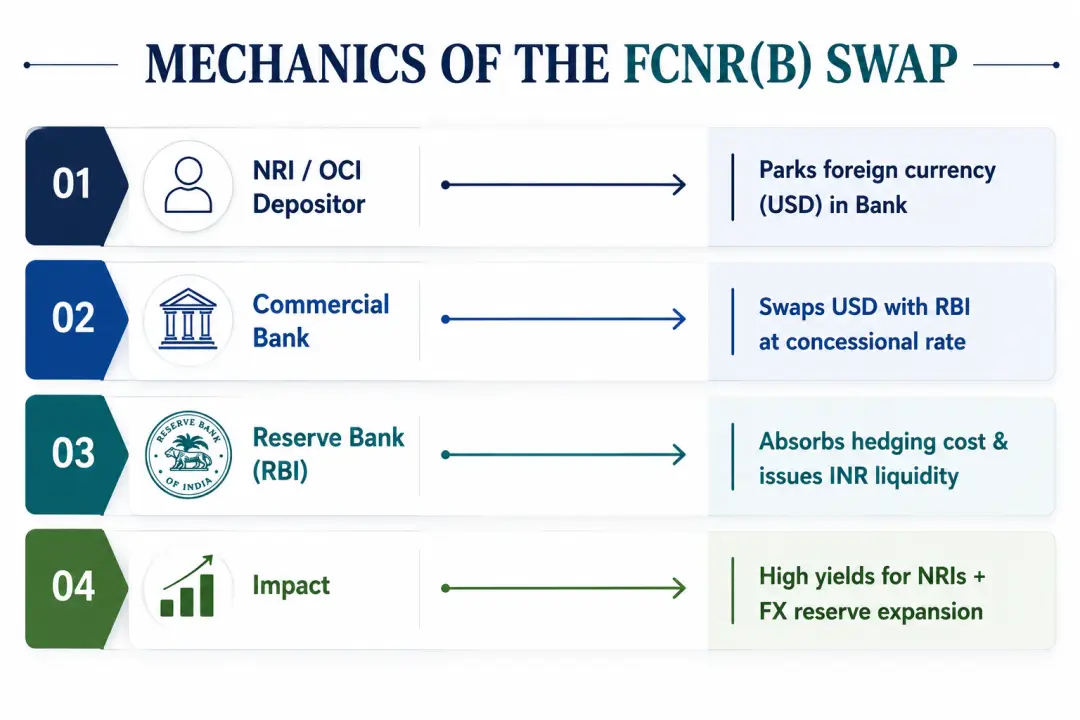
Under standard FCNR(B) operations, Non-Resident Indians (NRIs) and Overseas Citizens of India (OCIs) place foreign-currency-denominated deposits with Indian banks. While this protects depositors from exchange-rate risk, Indian banks face a fundamental obstacle: the high cost of hedging foreign exchange exposure, which drastically reduces the net yield banks can offer to depositors.
To solve this bottleneck, the RBI engineered a targeted policy incentive:
- Concessional Forex Swaps: The central bank offered banks a 3-to-5-year US dollar-rupee buy/sell swap at concessional rates, effectively absorbing the entire currency hedging cost.
- Deregulation of Interest Ceilings: The RBI temporarily lifted regulatory caps on interest rates for fresh 3-to-5-year FCNR(B) deposits.
- Enhanced Depositor Yields: Freed from currency hedging burdens, commercial lenders aggressively raised deposit rates—in some cases up to 6.25%–7.50% annually on USD-denominated accounts.
- Structural Safeguards: The framework mandated a strict 1-year lock-in period to discourage speculative short-term capital (“hot money”) and force a longer-term investment horizon.
Inflow Analytics: A Record-Breaking Liquidity Surge
The policy triggered an unprecedented inflow of hard currency into the domestic banking network. Authorised dealer bank data through August 13, 2026, reflects the scale of the mobilisation:
| Channel / Category | Inflow Volume (USD) | Share of Total |
| FCNR(B) Deposits | $52.300 Billion | 92.00% |
| Overseas Foreign Currency Borrowings (OFCB) | $2.805 Billion | 4.93% |
| External Commercial Borrowings (ECB) | $1.741 Billion | 3.07% |
| Total Scheme Capital Realized | $56.846 Billion | 100.00% |
The $52.3 billion raised purely via FCNR(B) accounts dwarf historical benchmarks, including the landmark 2013 swap window that raised $26 billion during the “Taper Tantrum”. This influx pushed India’s overall foreign exchange reserves past a record $707 billion, insulating the currency market against balance-of-payment shocks.
The Rationale Behind Early Closure
The sudden decision to move the cut-off date forward from September 30 to August 31 initially surprised market participants. However, the central bank’s premature exit was a calculated risk-management decision driven by three considerations:
- Goal Achievement Ahead of Schedule: Total special facility mobilisation surpassed internal projections, with projections indicating that keeping the window open until late September could have pushed total inflows beyond $80 billion to $100 billion.
- Managing Future Redemption Walls: Every dollar accepted under a 3-to-5-year swap represents a future contractual liability for the central bank. Allowing uninterrupted inflows would create a massive, concentrated maturity wall in 2029–2031, complicating future monetary liquidity management when the RBI must unwind these positions.
- Preventing Domestic Market Distortions: The sudden surge in banking system deposits ($115 billion over six weeks) threatened to oversaturate interbank money markets with local currency liquidity, running counter to broader inflation control targets.
Comprehensive Cost-Benefit Analysis
Evaluating the policy requires weighing its immediate macroeconomic stabilization benefits against the future liabilities created on the central bank’s balance sheet.
Cost-Benefit Balance Sheet
| PROS (Immediate FX Benefits) | CONS (Forward Liabilities) |
| • Rapid reserve expansion | • RBI bears hedging cost |
| • Rupee exchange rate stability | • Concentrated 2029-31 wall |
| • NRI capital integration | • Excess domestic liquidity |
The Benefits: Macroeconomic Stabilisation
- Central Bank Subsidy Costs: Absorbing currency hedging costs is not free. The RBI effectively subsidises the difference between market swap rates and the concessional rate offered to commercial banks.
- Reversal Volatility Risk: When these multi-billion-dollar accounts mature in 3 to 5 years, the central bank will need to manage substantial capital outflows, requiring strategic forward-market interventions to prevent sharp currency adjustments.
- Yield Distortion: Uncapped interest rates created distortions between domestic deposit pricing and NRI dollar pricing, temporarily compressing net interest margins for non-participating financial entities.
Policy Assessment
The 2026 FCNR(B) swap intervention stands as a successful example of targeted tactical central banking. The RBI leveraged non-resident capital to counter short-term external shocks without burning through spot foreign exchange reserves or sharply hiking domestic interest rates.
By pulling the deadline forward to August 31, 2026, the central bank demonstrated discipline stopping the program once its liquidity targets were achieved rather than allowing an unmanaged accumulation of future obligations. Managing the eventual maturities between 2029 and 2031 will require careful execution, but as an immediate response to external volatility, the scheme provided stability when it was needed most.
***
Disclaimer:
This article is published as a guest contribution in the interest of encouraging informed public debate. The author is responsible for the accuracy of all facts, claims, data, citations, references and representations made in the article. One Big Future does not independently verify every statement, claim or source contained in guest submissions and shall not be held liable for any errors, omissions, inaccuracies, copyright issues, defamation claims or other consequences arising from the author’s contribution.