
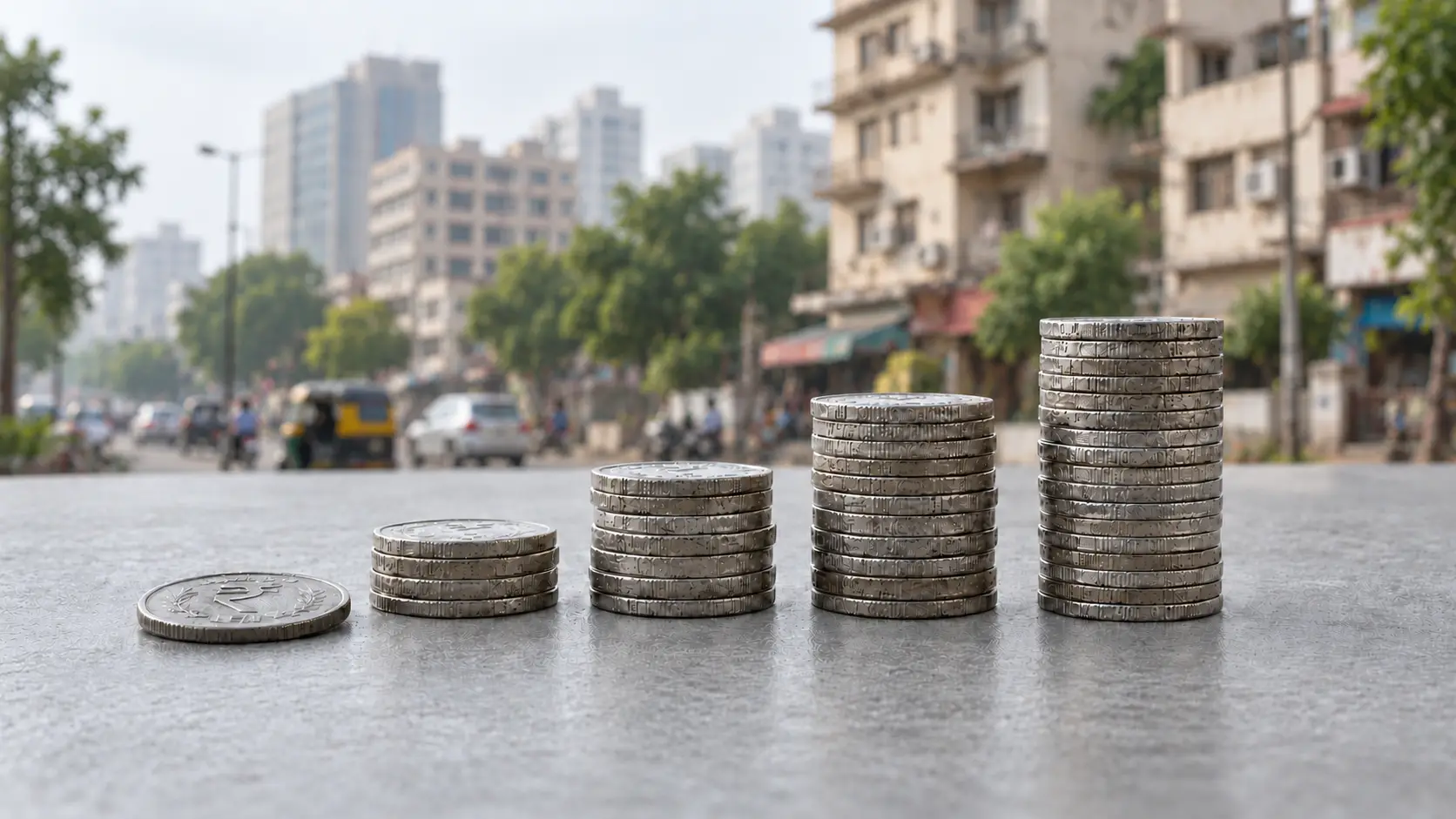

The International Monetary Fund (IMF), in its latest World Economic Outlook, raised its forecast for India’s real GDP growth to 7% for both FY2026–27 and FY2027–28, up from July forecasts of 6.4% and 6.7%, respectively. GDP, or gross domestic product, is the value of the goods and services produced in a country. Real GDP growth measures how much that output increases after adjusting for price changes. The IMF cited resilient domestic demand—spending by households, businesses and government—and strong activity in services such as finance, transport and information technology. That is a strong near-term outlook. But a two-year forecast alone cannot tell us whether India is on course to meet Viksit Bharat’s $30 trillion goal by 2047. To assess that, we need to look beyond the near term.
The same IMF report projects India’s nominal GDP at $4.52 trillion in 2027, just above the UK’s $4.49 trillion and Japan’s $4.47 trillion, according to the IMF’s October 2026 data. Nominal GDP is the value of the final goods and services produced in a country, measured using that year’s prices. The IMF converts these figures from each country’s currency into US dollars. The Japan Times reported the projections as India and the UK overtaking Japan, leaving Japan sixth in the global GDP ranking. Because the comparison uses current prices and converts GDP into dollars, the ranking can shift as prices change or currencies gain or lose value against the dollar. A larger total GDP—the size of the whole economy—does not, by itself, mean that the average person in India has a higher income or standard of living than the average person in Japan.

What The Report Says
The IMF estimates that India’s real GDP grew by 7.8% in FY2025–26, and forecasts growth of 7% in each of the next two financial years. These rates describe growth in the economy as a whole; they do not mean that each person’s income will rise by the same amount. The estimates appear in Chapter 1 of the October WEO.
The shift from July to October reflects both the IMF’s revised assessment and India’s economic performance. In July, the Fund said higher energy prices could push up fuel prices in India and lowered its near-term outlook. By October, it reported that India’s growth had remained robust despite higher oil prices, supported by domestic demand and services. It raised its forecasts, citing stronger-than-expected momentum. The IMF also revised its outlook for India over the next several years upwards compared with its January assessment. It points to population trends, a large and expanding domestic market, and continued reforms as factors supporting India’s growth potential.
For the global economy, the IMF projects growth of 3.1% in 2026 and 3.4% in 2027. It expects overall inflation—the rise in prices across the economy, including food and energy—to reach 4.7% in 2026 before easing to 4.1% in 2027. The outlook is uneven: investment in artificial intelligence (AI) and related technology is supporting some economies, while countries that import energy and have fewer links to the technology boom face higher costs. The IMF’s October WEO warns that a prolonged conflict could keep energy prices high. It also says that if expectations for AI’s profits and productivity gains are revised down, investment could weaken.

What Would It Take To Reach $30 Trillion?
In a September 2026 article for the IMF’s Finance & Development magazine, former Reserve Bank of India governor Duvvuri Subbarao argues that India’s recent growth does not guarantee it can sustain faster growth over the long term. He says private investment in factories, machinery, and business expansion is about 11% of GDP—roughly ₹11 for every ₹100 of economic output—compared with nearly 17% in 2008. He also notes that agriculture produces about 15% of GDP but employs nearly half the workforce. Subbarao argues that India needs more private investment and more productive jobs, supported by better skills, infrastructure, education and research.
A preliminary paper by economists Alok Johri and Amartya Lahiri, prepared for the India Policy Forum at the National Council of Applied Economic Research (NCAER), quantifies the longer-term challenge. Their model estimates that the economy’s total output would need to grow by an average of 9.6% a year to reach $30 trillion by 2047. It also estimates that productivity—how much the economy produces using its workers, equipment and other resources—would need to rise by about 6.1% a year for 24 years. The authors write that no country in modern economic history has come close to sustaining productivity growth at that rate.
Johri and Lahiri’s model tests what could happen if fewer barriers kept workers from moving out of agriculture and into industry and services, where output per worker is higher. In a scenario using the strongest productivity growth rates in their historical data, but leaving those barriers in place, GDP reaches $21.91 trillion in 2046–47. When the model combines that productivity scenario with removing the labour-market barriers, GDP reaches $27 trillion.

At IIT Madras’s Institute Day in April 2026, Chief Economic Adviser V. Anantha Nageswaran said reaching $30 trillion by 2047 was doable, but would require the ability to develop and use technology, along with advanced research in science and engineering. He said India would need to turn research and new technologies into productivity gains across agriculture, manufacturing, services and governance. He also said India could double GDP from $3.91 trillion to $7.8 trillion in six years, requiring about 12% annual growth in dollar terms. That means measuring GDP in US dollars, so changes in the rupee’s value affect the figure. Nageswaran’s 12% rate refers to that six-year doubling; Johri and Lahiri’s 9.6% is the average annual output growth in their model for reaching the 2047 goal. These are different calculations over different timeframes.
Together, these analyses show why the IMF’s near-term forecast cannot settle the 2047 question. The longer test is whether India can raise productivity, attract more private investment and create better jobs that lift incomes across the country.