
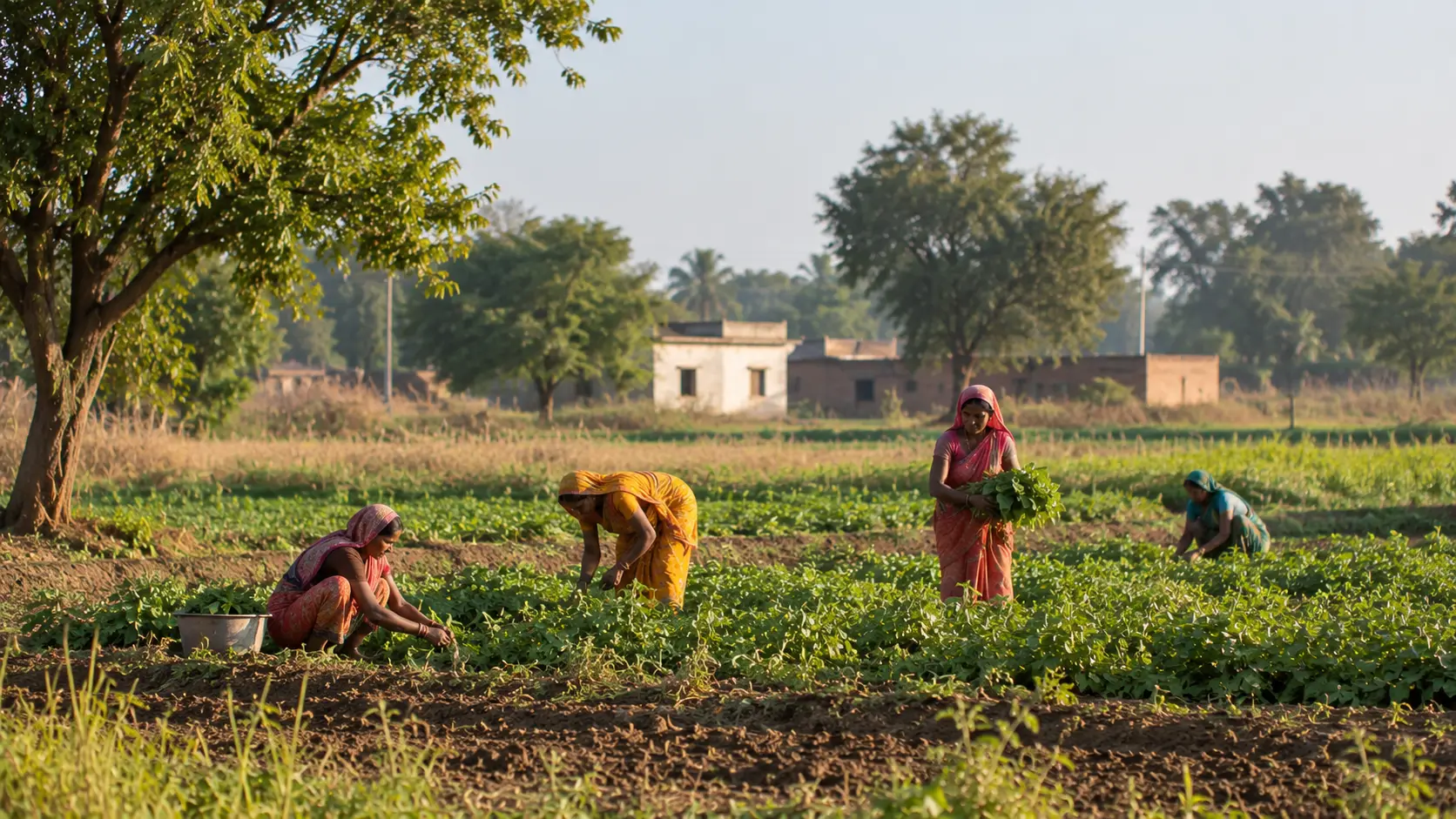

Rural Indian women’s participation in the workforce has nearly doubled in recent years. According to India’s Periodic Labour Force Survey (PLFS), the proportion of rural women aged 15 and above who were working or seeking work rose from 24.6% in 2017–18 to 47.6% in 2023–24.
But what kinds of work are behind this increase, and how much does it tell us about women’s economic progress?
A research report published by Oxfam in August 2026, titled India’s Invisible Half: Unpacking the Paradox of Indian Women’s Labour, examines this question. Written by researcher Dr Diya Dutta, the paper investigates whether rising workforce participation reflects greater access to paid, secure and productive employment. Dutta’s subsequent analysis published on Oxfam America’s platform on 8 October focuses specifically on rural women’s employment.
Drawing on official employment statistics, existing research and interviews with 21 experts, the original paper identifies three interconnected explanations for the increase: better recognition of previously undercounted work, a shortage of suitable non-agricultural jobs and economic pressures driving women into agricultural self-employment.
Together, these findings raise an important distinction between greater workforce participation and greater economic independence.
What The Employment Numbers Actually Show
The Oxfam research examines the kinds of jobs rural women perform rather than relying solely on the number participating in the labour force.
Between 2017–18 and 2023–24, the share of employed rural women classified as self-employed rose from 57% to 72.2%. In 2023–24, unpaid helpers in family enterprises accounted for 59% of these self-employed women.
In India’s employment statistics, self-employment covers different forms of economic activity, from running an independent business to contributing to a family enterprise without receiving individual wages. For example, a woman helping cultivate a family farm, tending livestock or assisting in a family shop may be performing economically productive work without receiving a separate payment. Such contributions can be counted as employment even when they do not provide her with an independent income.
What’s Behind The Increase?
Agriculture is central to understanding this trend. The report identifies women’s growing involvement in family farming as an important feature of the rural employment increase, alongside three factors that help explain the shift.
The first concerns how women’s work is measured. Much of the economic activity performed by rural women takes place alongside domestic responsibilities. Women may contribute to livestock rearing, post-harvest processing, home-based production or family businesses without identifying these activities as employment.
The report’s examination of employment measurement argues that better recognition of such activities has helped bring previously undercounted economic work into official statistics. This means part of the increase may reflect existing work becoming more visible, rather than entirely new employment.
The second factor concerns the structure of India’s economic growth. Dutta argues that India’s transition from agriculture towards services has not been accompanied by sufficient growth in labour-intensive manufacturing. This has restricted employment opportunities for women with limited formal education, particularly in rural areas.
Manufacturing and small enterprises can offer alternatives to agricultural work, providing opportunities for wages, skills development and more stable employment. The report identifies the shortage of such opportunities as one reason women remain concentrated in informal and household-based activities.
The third factor is economic pressure. According to Dutta, some rural women are taking on greater responsibilities in family farming as households seek to sustain their livelihoods. As men migrate or move towards non-agricultural jobs, women may increasingly contribute labour to farms and household enterprises.
The report interprets this reliance on agricultural self-employment, particularly unpaid family work, as a sign of limited employment opportunities and economic vulnerability.
Why This Matters For India’s Economic Future
Women working without individual wages or in poorly remunerated informal activities may have limited access to stable earnings, social security and opportunities to improve their skills.
The Oxfam report also identifies constraints affecting women’s ability to earn more from work they already perform. In agriculture, limited land ownership can restrict women’s access to affordable credit and productive resources, while difficulties reaching markets can reduce the returns from their work.
Responsibilities within the household create additional barriers. Women’s disproportionate share of unpaid domestic and care work can restrict the time available for paid employment, training and opportunities outside the home.
These challenges are closely connected to India’s broader economic transformation. Expanding women’s workforce participation is important, but the nature of the employment available determines how effectively that participation can contribute to higher incomes, greater productivity and economic independence.
Dutta’s paper recommends stronger investment in labour-intensive manufacturing and micro, small and medium enterprises (MSMEs), which can create employment opportunities beyond agriculture. It also emphasises skills development, affordable credit, better market access and stronger land rights for women engaged in farming and small businesses.
The report identifies childcare, safer transport and digital access as additional measures that could help women pursue paid employment and improve their existing livelihoods.
These priorities address two related challenges: creating more suitable jobs for women seeking paid work and improving the economic returns available to women already participating in the workforce.
Oxfam’s analysis shows why the rise in rural women’s employment must be understood through the nature of the work behind the numbers. For India’s long-term economic development, the challenge is not only to increase women’s workforce participation, but to ensure it brings greater opportunities for independent earnings, productive employment and economic security.