
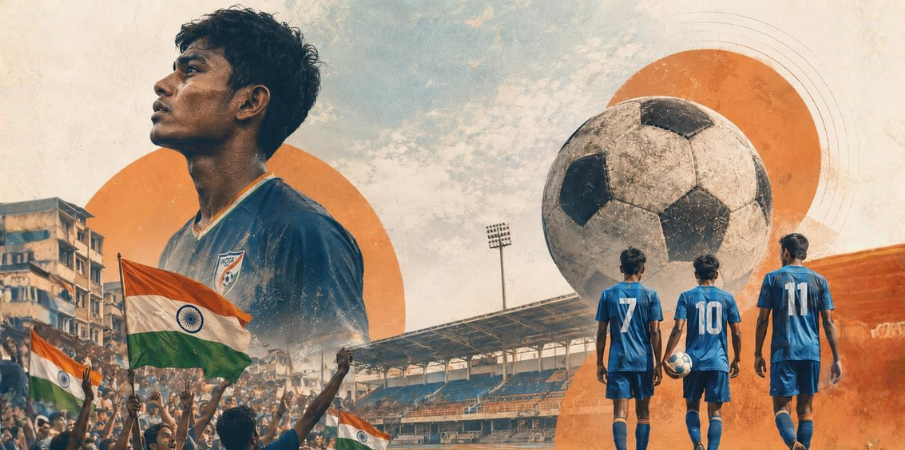

Indian football lives with a clear paradox: it has the passion of a football country, but yet lacks the outcomes of one.
Every World Cup turns neighbourhoods in Kolkata and across West Bengal into Brazil and Argentina – streets draped in yellow and sky‑blue, murals of global stars, late‑night screenings that make the tournament feel almost local.
Yet India’s men’s team has never played a World Cup match, having qualified for 1950 but withdrawn before the tournament, and is currently ranked 138th in the world in FIFA’s June 11, 2026 update.
The easy explanation is to blame talent or interest. The evidence suggests the real problem lies elsewhere.
Not About Talent, But About Structure
India has already shown in other team sports that, given a clear pathway, it can compete globally. Cricket’s domestic ladder – from district cricket through Ranji, Vijay Hazare and Syed Mushtaq Ali – gives players years of structured competition before they reach the national team, while hockey’s revival since missing the 2008 Olympics has been driven by regular age‑group nationals, zonal tournaments and promotion–relegation across divisions.
Football, by contrast, still runs on a patchwork. The Indian Super League (ISL) sits at the top, a rebranded Indian Football League (formerly I‑League) and I‑League 2 and 3 follow – below that are uneven state and city leagues whose standards and stability vary widely.
This fragmented structure means that footballers and fans are there, but they do not move through one predictable, merit‑based system together.
In successful football nations, most elite players repeatedly face one another in organised school, club and age‑group competitions, then graduate as a cohort to higher tiers. In India, many players instead bounce between school tournaments, private academies, local leagues and short club contracts, without a clearly signposted ladder from grassroots to top tier.”
The result is that players rarely spend enough years competing together inside a shared framework, which shows up later in the national team’s lack of cohesion and consistency.
ISL And Governance: Spark, Then Reset
The way India’s top division has been run encapsulates both the progress and the problems.
On the positive side, ISL has transformed the visibility of club football. Since 2014 it has delivered prime‑time television slots, more polished match presentation and a new urban audience that might never have watched I‑League or state‑league matches, and from 2019–20 it has been officially recognised as the top tier.
At the same time, the league’s early franchise model – long periods without relegation, expensive entry slots and heavy dependence on central media‑rights money – limited upward movement from the lower tiers and left clubs exposed when commercial values fell. By 2025–26, stalled rights negotiations and the end of the AIFF–FSDL deal triggered a genuine crisis: clubs warned of possible shutdowns, players were asked to accept salary cuts and questions were raised about the league’s long‑term sustainability.
That crisis has forced a reset. In July 2026, the All India Football Federation (AIFF) and all 14 ISL clubs signed a four‑year agreement that moves commercial operations to a club‑led Special Purpose Vehicle (SPV), while the AIFF retains regulatory control in line with FIFA and AFC rules. Each club will contribute ₹1.1 crore in administrative fees in the first year (rising slightly thereafter), giving the AIFF around ₹15.4 crore annually if all 14 participate, plus 10% of the SPV’s net profits to fund refereeing, legal, integrity and anti‑doping functions. The league is scheduled to return to a full home‑and‑away format from September 4, 2026, under a professional management team and a joint governing council. However, the agreement includes a two‑year review and exit option for clubs and allows the AIFF to seek renegotiation, signalling that confidence remains fragile and both sides expect to reassess whether the model is working.
Player‑eligibility rules have also been clarified. Clubs can sign up to six foreign players, with a maximum of four on the pitch, and Overseas Citizen of India (OCI) players will be treated as foreigners within that quota, not as a separate category. A mooted regulation requiring a mandatory Indian centre‑forward has been explicitly rejected; the AIFF accepts the need to develop Indian strikers but has decided that the choice of forward must remain a coaching decision, not a rule.
Together, these changes give Indian football breathing room after months of uncertainty. Whether they become a durable foundation or another temporary fix will depend on commercial stability, consistent regulation and, crucially, how well ISL is connected to the wider football pyramid.
Minerva Academy: A Useful Case Study
Within this system, Minerva Academy shows what sustained, coherent work can achieve.
In 2025, Minerva’s U‑14 team won the Gothia Cup in Sweden – often described as the World Youth Cup – beating Argentina’s Escuela de Football 18 Tucumán 4–0 in the final and becoming the first Indian club to win the tournament twice, after an earlier U‑13 title.
Over the past decade, Minerva has produced multiple youth and senior internationals, built on early talent identification, daily training, strong fitness standards and regular exposure to competitive youth football in Europe.
Minerva is best understood as a case study, not a cure‑all. It demonstrates that when one academy operates as if it belongs to a coherent global system – starting early, training scientifically, competing continuously – Indian players can match or beat age‑group peers from established football countries.
The challenge is to embed those principles across many clubs and regions, supported by a national structure that rewards long‑term development.
What Curaçao And Cape Verde Show India
Recent World Cups have offered instructive examples from countries far smaller than India.
Curaçao, with a population of just over 150,000, qualified for the 2026 World Cup by topping its CONCACAF (Confederation of North, Central America and Caribbean Association Football) group, becoming the smallest nation by area and population ever to reach the finals.
Cape Verde, a nation of around 525,000 people, has evolved from AFCON (Africa Cup of Nations) newcomer to regular contender and reached the knockout rounds of World Cup 2026 on the back of clear tactical identity, coaching stability and smart use of its diaspora talent.
These countries show that size and wealth are not decisive; structure is.”
A coherent plan, stable leadership and a unified pathway can turn limited resources into consistent international competitiveness – something India, with far greater passion and numbers, has yet to achieve.
The Way Forward: Joining The Dots
If India’s core problem is fragmentation rather than a lack of talent or interest, the answer lies in building a system that connects each stage of a player’s development.
Promotion and relegation between the ISL, the second tier and I-League 2 and 3 must become stable and predictable, with strong state leagues functioning as credible feeders into the national pyramid.”
Age-group competitions at the state and national levels also need to follow a fixed calendar, giving under-13, under-15 and under-17 players a clear understanding of which tournaments matter and how strong performances can lead to the next level.

The new ISL SPV model should therefore be judged not only by how effectively it markets and commercialises the league, but also by whether it strengthens academies, improves coaching standards and creates meaningful playing time for young Indian footballers. India already has the passion that sees Kolkata painted in the colours of Brazil and Argentina every four years. The challenge now is to build a recognisable pathway in which Indian players can develop, compete and progress together. Only then might those same streets have another flag to hang alongside the others: the Indian tricolour, flying for a team that has finally earned its place on football’s biggest stage.