
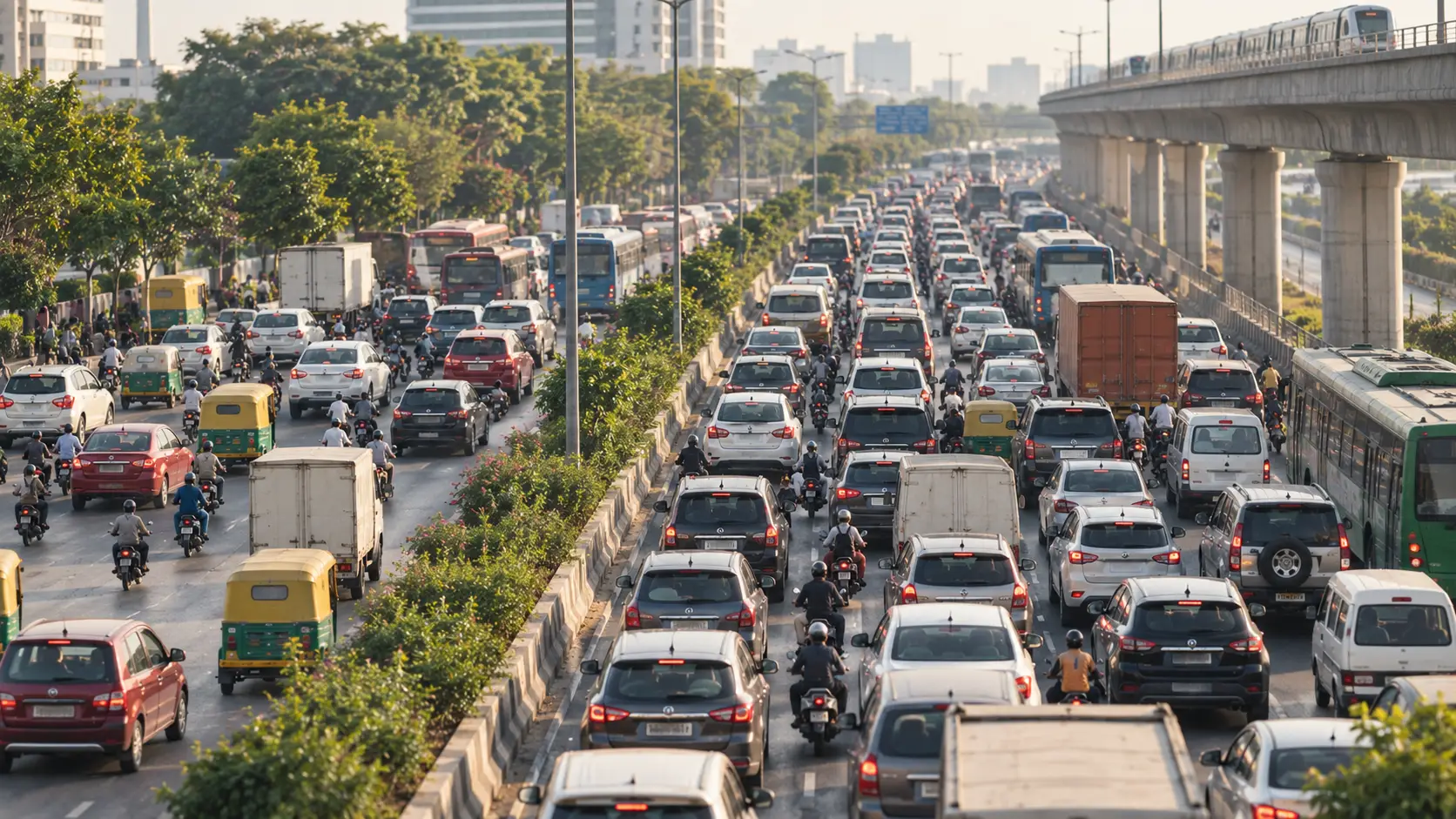

India’s automobile taxation system relies heavily on physical characteristics to determine how much consumers pay. Engine capacity, vehicle length and, for certain utility vehicles, ground clearance can determine whether a vehicle falls into a lower or substantially higher tax category, with GST rates reaching 40%.
These thresholds are straightforward to administer. But as India’s automobile market, manufacturing capabilities and policy priorities evolve, an important question is whether physical characteristics remain the right basis for deciding what the tax system should reward.
When Four Metres Changes The Tax
Under the GST reforms introduced in September 2025, petrol, LPG and CNG cars with engine capacity up to 1,200cc and length up to four metres fall into the 18% GST category. For diesel cars, the engine threshold is 1,500cc, while the four-metre length threshold remains. Cars exceeding the applicable engine-capacity or length thresholds can fall into the 40% category.
A car that crosses four metres can therefore move into a substantially higher tax category, a difference of 22 percentage points, even if its engine remains below the applicable capacity threshold.
Automobile taxation can serve objectives beyond raising revenue for the State. It can influence road safety, emissions and environmental impact, domestic manufacturing and the adoption of alternative forms of transport. The question is how closely India’s current physical thresholds correspond to those outcomes.
Do Physical Thresholds Measure Safety?
India recorded 1,83,434 road accident fatalities in 2025, translating into 502 deaths per day, the highest since the government began collecting the data. Two-wheeler riders accounted for 46.2% of those fatalities, according to the Ministry of Road Transport and Highways.
Tax policy is not responsible for these deaths. But taxation influences what consumers pay and can affect the kinds of vehicles manufacturers choose to develop. That makes it relevant to ask whether the characteristics used to determine tax treatment are useful proxies for safety outcomes.
Cars measuring above four metres can face a 40% GST rate, while evidence suggests that vehicle size can matter in some circumstances for occupant safety.
A study published in Accident Analysis & Prevention found a “car size effect” in frontal collisions and concluded that, in collisions between similarly sized cars and in single-vehicle crashes, length can influence relative injury risk. In some scenarios, greater vehicle length can increase the distance between the point of impact and the passenger cabin.
This does not mean longer cars are inherently safer. It does suggest that length alone is an imperfect basis for determining tax treatment. A more outcome-oriented framework could place greater weight on how vehicles perform in relevant safety assessments instead of relying so heavily on dimensions.
Ground Clearance And Practical Utility
Ground clearance provides another example of the same issue.
Under the current GST rules, utility vehicles such as SUVs, MUVs, MPVs and XUVs with engine capacity above 1,500cc, length above 4,000mm and ground clearance of at least 170mm attract 40% GST.
Ground clearance can have practical value for consumers using roads with potholes, uneven surfaces and other road-condition challenges. This raises a broader question about whether a characteristic with clear functional utility should play such a significant role in determining a vehicle’s tax burden.
If India wants to encourage vehicles that perform better within its transport environment, policy could place greater emphasis on pedestrian-friendly design, pedestrian protection and safety systems suited to conditions on Indian roads. India could also develop research and testing priorities around pedestrian and vulnerable-road-user safety, reducing the reliance on vehicle dimensions as a proxy for safety outcomes.
Two-Wheeler Taxation
The same issue appears in the two-wheeler market. Under the current GST structure, motorcycles up to 350cc attract 18% GST, while those above 350cc attract 40%.
Two motorcycles on opposite sides of the 350cc threshold can differ in braking systems, tyres, stability, fuel consumption, emissions and safety technology. Engine capacity is therefore an imperfect proxy for the outcomes taxation may want to influence.
In a country where two-wheelers account for the largest share of road deaths, it is reasonable to ask whether braking performance, emissions, efficiency and safety technology should have a greater role in the tax framework than engine capacity alone.
What Other Tax Systems Measure
Other emerging economies already link parts of automobile taxation more directly to policy outcomes.
Thailand is one example. Its passenger-vehicle excise system combines engine displacement with certified CO₂ emissions, with different tax rates applying across emissions bands. For passenger cars up to 3,000cc during 2026–27, published rates range from 13% for vehicles emitting up to 100g of CO₂ per kilometre to 34% for those emitting more than 200g per kilometre. Thailand’s system also incorporates emissions into taxation for other vehicle categories, including pickup passenger vehicles.
South Africa provides another example. Its environmental levy on new passenger vehicles is calculated according to CO₂ emissions above a 95g per kilometre threshold. From April 2024, the rate was raised to R146 for each additional gram of CO₂ per kilometre above that threshold.
Neither country has abandoned engine capacity or other vehicle classifications. Their tax systems, however, also measure the outcomes they are intended to influence.
What Do Tax Thresholds Encourage Manufacturers To Build?
The effect of physical thresholds extends beyond consumers. Tax policy also influences product design. When crossing four metres can trigger a major change in taxation, manufacturers have a commercial incentive to design vehicles within that boundary. That can be useful if the objective is to encourage smaller, cheaper cars.
India’s automobile industry has also changed substantially since these classifications became central to the market. India is now a major automobile manufacturing and export base. Passenger-vehicle exports reached a record 905,200 units in FY2025–26, according to the Society of Indian Automobile Manufacturers, with demand coming from markets including the Middle East, Africa and Latin America.
A manufacturer developing a vehicle for several markets can spread platform development, engineering, tooling and component costs across larger volumes. A vehicle designed primarily around India’s tax thresholds can have fewer opportunities to achieve that scale.
This creates another policy trade-off. A 3,995mm car and a 4,005mm car may have broadly comparable fuel consumption, emissions, safety technology and crash performance, yet crossing the physical threshold can have a major effect on taxation. The same applies to engine capacity. A larger-displacement engine is not automatically less efficient than a smaller one when differences in technology, vehicle weight and powertrain are taken into account.
The question is whether the tax system should create such a strong financial incentive to engineer products around particular dimensions and engine sizes. A more graduated system could reduce these tax cliffs while placing greater weight on domestic value creation, innovation, efficiency and safety.
India’s goal should be to make it easier for manufacturers to develop products that are efficient, safe, affordable and globally competitive, regardless of whether they measure 3.99 or 4.05 metres.
From Physical Thresholds To Outcomes
A more outcome-oriented automobile tax system could still retain some existing classifications, including a separate approach for genuinely high-end vehicles so that incentives intended to improve mass-market mobility do not reduce the tax burden on luxury consumption.
The larger shift would be in what the system rewards: better use of fuel or energy, lower emissions, stronger safety performance, greater domestic value creation and innovation that improves efficiency or safety.
The objective would be to encourage vehicles that deliver greater value relative to the energy they use, the road space they occupy and the risks associated with their use.
The question, then, is whether four metres is still the right number to decide what India should reward.